
 3-6
3-6R ROBBINS
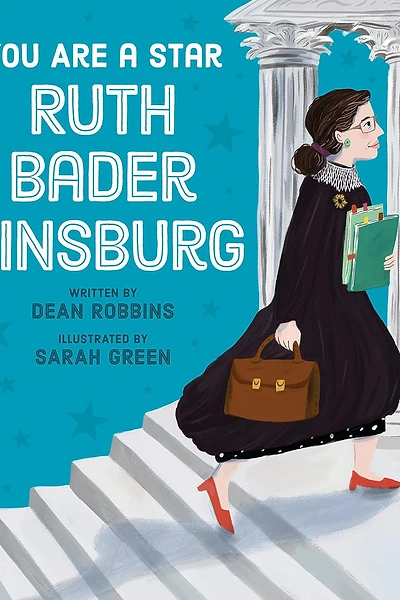
You Are a Star: Ruth Bader Ginsburg
by Dean Robbins, illustrated by Sarah Green
Pacing MaterialThe inspiring true story of Ruth Bader Ginsburg, from her fight against gender discrimination to her legendary career as a Supreme Court Justice.
Big Idea
One person's voice — even in disagreement — can shape the law and change the nation, and Ruth Bader Ginsburg proved that dissent is a form of hope.
Discussion Questions
- 1.What did Ruth Bader Ginsburg fight for?
- 2.What does it mean to 'dissent' on the Supreme Court?
- 3.Why was it important that she never gave up?
- 4.What's a rule you'd like to change, and how?
Classroom Activity
Write a Dissent
Students write a 'dissent' statement — picking a rule they disagree with and writing a respectful argument for changing it.
Lesson Plan
Learning Goals
- Describe RBG's role on the Supreme Court.
- Explain the concept of legal dissent.
- Construct a respectful argument against a rule.
- Understand how persistence creates change.
Activity Steps
- 1.Read the book, noting how RBG used dissent to create change.
- 2.Discuss what 'dissent' means and why it matters in a democracy.
- 3.Students pick a school or community rule they'd change.
- 4.Write a one-paragraph dissent with a proposed alternative.
Standards Connections
- ELA: RI.3.1 — Ask and answer questions about key details
- ELA: RI.3.2 — Identify main topic and retell key details
- ELA: RI.3.3 — Describe connection between events
- ELA: RI.6.6 — Acknowledge differences in characters' points of view
- ELA: SL.3.1 — Participate in collaborative conversations about the text
- ELA: W.3.3 — Write narratives recounting events with descriptive details
- SEL: Social Awareness
- SEL: Relationship Skills
Pace-Write-Read Study with Pace-Write It!
Focus question: How can a nonfiction biography use comics, facts, voice, and page turns to make history feel active and close? You Are a Star, Ruth Bader Ginsburg by Dean Robbins, illustrated by Sarah Green, is a 40-page Scholastic picture book biography and the first title in the You Are a Star nonfiction series. It uses a mix of first-person style narration, comic panels, and key facts to introduce young readers to Ruth Bader Ginsburg's life, law career, Supreme Court work, and public legacy.
| Element | How to notice or teach it in the novel |
|---|---|
| Pace | Read: The book moves through Ruth's life in quick, kid-friendly sections. Classroom Activity: Create a fast timeline with 5 major moments. |
| Plot | Read: The plot follows a real-life arc: childhood, learning, barriers, law, justice, legacy. Classroom Activity: Write: "She noticed… She studied… She challenged… She changed…" |
| Prosody | Read: First-person style narration can make facts sound lively and direct. Classroom Activity: Read one sentence aloud and revise it for smoother sound. |
| Word pause | Read: Comic panels and fact boxes create natural stops. Classroom Activity: Add one short pause line before an important fact. |
| Concept | Read: The central idea is that one person can use learning and law to push for fairness. Classroom Activity: Write the big idea in one sentence. |
| Voice & World View | Read: The voice is encouraging, bold, and accessible for young readers. Classroom Activity: Write with a confident "you can understand this" tone. |
| Setting & Place | Read: Places shift from Brooklyn to school, law classrooms, courtrooms, and the Supreme Court. Classroom Activity: Use setting shifts to show growth. |
| Point of View | Read: The book uses a playful biography style with first-person energy and factual support. Classroom Activity: Try one paragraph in first person as a biography voice, then label it as imagined narration. |
| Original Characters | Read: The people are real: Ruth, her family, classmates, lawyers, judges, and citizens affected by law. Classroom Activity: Make a real-person cast list. |
| Dialogue | Read: Comic panels may use speech-bubble energy to make history feel immediate. Classroom Activity: Write one short speech bubble that captures a belief, not a fake quote. |
| Details | Read: Key facts include law school, gender barriers, court cases, and Supreme Court service. Classroom Activity: Add three researched details to your draft. |
| Descriptions | Read: Descriptions can contrast a small child reading with a powerful justice speaking. Classroom Activity: Describe Ruth in two places: as a student and as a justice. |
| Strong First Lines | Read: A strong first line should make Ruth feel important and approachable. Classroom Activity: Begin with a direct invitation: "Meet someone who…" |
| Immediacy & Engagement | Read: Comic structure helps readers feel close to the action. Classroom Activity: Turn one fact into a mini scene with action. |
| Story scenes, summaries, unique structures | Read: The book blends narrative, comics, facts, timeline, and "be like Ruth" material. Classroom Activity: Combine one scene, one fact box, and one reflection question. |
| Flashback, flash forward, cliffhangers | Read: The main structure is chronological, but page turns can move from childhood to future impact. Classroom Activity: End a section with: "But Ruth had more to prove." |
| Tension, suspense, surprise | Read: Tension comes from unfair rules and people doubting what women could do. Classroom Activity: Write a contrast: "Some people believed ___, but Ruth ___." |
| Page turns and chapter breaks | Read: Page turns can reveal the next challenge or achievement. Classroom Activity: Mark 3 page turns: childhood, law school, Supreme Court. |
| Performance | Read: The comic style invites expressive reading. Classroom Activity: Read a speech bubble, fact box, and narration line in different voices. |
| Personality | Read: Ruth's personality appears as determined, careful, smart, and persistent. Classroom Activity: Choose 3 traits and prove each with an action. |
| Humor | Read: The series uses a lighter comic approach to make serious history inviting. Classroom Activity: Add one gentle visual joke or playful aside. |
| Pause | Read: Pauses help readers absorb major ideas like fairness, law, and equality. Classroom Activity: Put one important sentence alone on the page. |
| Poetry and poetic devices | Read: Repetition, contrast, and punchy phrasing can make biography memorable. Classroom Activity: Use repetition: "Again and again, Ruth…" |
| Repetition | Read: Repeated ideas about fairness and persistence build the theme. Classroom Activity: Repeat one phrase three times across a timeline. |
| Rhythm | Read: Short panels and fact bursts create quick rhythm. Classroom Activity: Mix one long sentence with two short sentences. |
| Punctuation | Read: Exclamation points, question marks, and speech bubbles can guide energy. Classroom Activity: Use one question mark and one exclamation point with purpose. |
| Questions | Read: The book invites questions about fairness, rights, and change. Classroom Activity: Write 3 questions Ruth's life makes you ask. |
| Compare-Contrast | Read: Contrast is key: what society expected vs. what Ruth achieved. Classroom Activity: Create a two-column "expected / achieved" chart. |
| Objects | Read: Objects can carry meaning: books, glasses, collar, gavel, law books, courtroom bench. Classroom Activity: Pick one object to symbolize Ruth's work. |
| Threes | Read: Three-part lists help organize a life: learner, lawyer, justice. Classroom Activity: Write a three-part sentence about Ruth. |
| Whitespace & negative space | Read: Comic spacing gives readers time to move from panel to panel. Classroom Activity: Leave space around your strongest panel or fact. |
| Art & graphics | Read: Sarah Green's comic-style illustrations help turn biography into visual storytelling. Classroom Activity: Draw a 3-panel biography moment. |
| Interactives & gamification | Read: Readers can track "star moments" in Ruth's life. Classroom Activity: Create a "Star Moment" badge for one brave choice. |
Pace-Write It!
20-Minute Classroom Flow: 1. Read (5 min) — Read one spread or short section. Students notice where the book uses narration, comic panels, and facts. 2. Notice (5 min) — Students mark: one fast-paced panel, one important fact, one fairness question, one contrast, one strong object or symbol. 3. Write (7 min) — Write a comic-style biography page about someone who changed something using this frame: Meet ___. People thought ___. But ___ believed ___. So ___ learned ___. Then ___ used that knowledge to ___. Star Moment: ___. 4. Share (3 min) — Students share one panel, fact box, or "Star Moment." Classmates listen for the pacing move: contrast, repetition, question, or page-turn surprise. Exit ticket: What makes You Are a Star, Ruth Bader Ginsburg feel quick and engaging: comic panels, first-person voice, fact boxes, page turns, or strong contrasts? Write one sentence explaining your choice.