
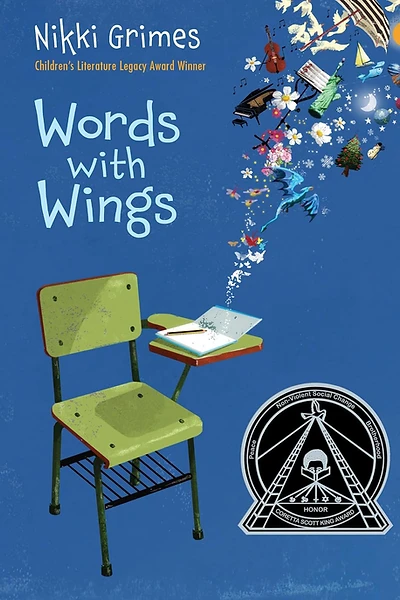
C GRIMES
Words with Wings
by Nikki Grimes
Pacing MaterialWords with Wings tells the story of Gabriel, a quiet, imaginative girl nicknamed Gabby, who copes with the upheaval of her parents' divorce and a difficult move to a new school by escaping into vivid daydreams. Written in spare, lyrical verse, the novel follows Gabby as she is scolded by teachers for 'not paying attention,' until a caring new teacher, Mr. Spicer, helps her see that her imagination is not a distraction but a gift—one that can be channeled into the power of words and poetry. As Gabby learns to balance her inner world with her outer responsibilities, she discovers her own voice and begins to reclaim daydreaming as a source of strength rather than shame.
Big Idea
Imagination and daydreaming, often dismissed as distractions, can be transformed into powerful tools for self-expression, resilience, and connection when given language and purpose.
Discussion Questions
- 1.Why do you think Gabby's daydreams get stronger during stressful moments in her life? What do daydreams do for her emotionally?
- 2.How does Mr. Spicer change Gabby's relationship with her own imagination? What made his approach different from other adults in her life?
- 3.Nikki Grimes writes this novel entirely in verse. How does the poetic form help capture the way Gabby's mind wanders and returns?
- 4.Have you ever been told to 'stop daydreaming' or 'pay attention'? How did that make you feel, and how does Gabby's story change how you think about that moment?
- 5.What role does her father's absence play in shaping Gabby's inner world? How does poetry help her process complicated feelings about family?
- 6.By the end of the book, how has Gabby's understanding of her own imagination shifted? What does the title 'Words with Wings' mean to you now?
Classroom Activity
Daydream to Poem: Giving Wings to Your Own Words
Students will keep a 'Daydream Journal' for one week, jotting down brief notes whenever their mind wanders during the day (in class, at home, on the bus). At the end of the week, each student selects one daydream and transforms it into a short free-verse poem, following Grimes's model of using concrete images and sensory details to ground an imaginative moment. Students will then illustrate or add a visual symbol representing their daydream, and share their poem in a 'Wings Circle' read-aloud, where classmates respond with one word that captures the feeling of the piece.
Lesson Plan
Learning Goals
- Explain how Mr. Spicer helps Gabby recognize her imagination as a strength, using an example from Words with Wings.
- Record imaginative moments through words, sketches, or dictated notes while practicing a balance between reflection and classroom responsibilities.
- Create a short free-verse poem that transforms a daydream into concrete images and sensory details.
- Share or listen to poems respectfully and identify a word that expresses the feeling of a classmate’s poem.
Activity Steps
- 1.Introduce the activity by reading selected poems from Words with Wings aloud. Discuss: How does Gabby feel when her daydreaming is criticized? What changes when Mr. Spicer encourages her? Invite students to notice how Grimes uses brief lines and vivid images rather than requiring rhyme.
- 2.Model a Daydream Journal entry with an imaginative prompt such as “A cloud becomes a doorway.” Sketch or jot what you imagine seeing, hearing, and feeling. Establish that students may capture ideas at appropriate pauses, rather than interrupting instruction or important tasks.
- 3.For one week, provide 3–5 minutes daily for students to record a remembered daydream from school, home, or a journey. Kindergarten–grade 1 students may sketch, label, or dictate; grades 2–5 students can write brief notes with sensory details. Offer an invented scene to anyone who prefers not to share personal experiences.
- 4.At the end of the week, have each student choose one entry and turn it into a short free-verse poem. Model changing a general statement into a concrete image—for example, “I imagined flying” becomes “My sneakers skim the treetops.” Younger students may dictate 2–4 lines; older students can experiment with line breaks and revise for precise language.
- 5.Ask students to illustrate their poems or add a visual symbol that represents their imagined scene. Have partners identify one vivid detail and suggest where another sensory detail might help the reader picture the daydream.
- 6.Hold a “Wings Circle.” Students may read their poems, ask an adult to read, or pass. After each reading, classmates offer one respectful word capturing the poem’s feeling. Close by asking how giving a daydream words helped Gabby—and how it helped them express an idea.
Standards Connections
- ELA: CCSS RL.K.3 / RL.1.3 / RL.3.3 / RL.5.3 — Discuss Gabby’s experiences, responses, and relationships with support appropriate to grade level.
- ELA: CCSS RL.2.4 / RL.4.5 — Explore how poetic language, imagery, and verse structure contribute to meaning.
- ELA: CCSS W.K.5 / W.1.5 / W.2.5 / W.3.5 / W.4.5 / W.5.5 — Strengthen writing through feedback and revision, with adult support as needed.
- ELA: CCSS SL.K.1–SL.5.1 — Participate in collaborative discussions, listen respectfully, and respond to others’ ideas.
- SEL: Self-awareness, self-management, and relationship skills — Recognize imagination as a strength, choose appropriate times to record ideas, and respond empathetically to classmates.
Pace-Write-Read Study with Pace-Write It!
Nikki Grimes uses the compressed, image-driven structure of verse to mirror the way Gabby's mind moves fluidly between reality and daydream. The pacing of Words with Wings is built on white space, restraint, and carefully chosen moments of stillness and motion, allowing young readers to feel the rhythm of a distracted, imaginative mind finding its footing. Below are 33 craft elements to explore with students, each paired with a close-reading observation and a hands-on writing task.
| Element | How to notice or teach it in the novel |
|---|---|
| Pace | Read: Notice how each poem is short—often less than a page—creating a quick, breathy pace that mimics the flicker of Gabby's attention drifting in and out of daydreams. Classroom Activity: Have students rewrite a paragraph from a prose book as three short verse poems, noticing how breaking it up changes the reading speed. |
| Plot | Read: Notice how the plot unfolds through small emotional shifts—Gabby's move, her father's absence, a new friendship—rather than big dramatic events. Classroom Activity: Ask students to map the 'small moments' plot of their own week and turn one into a poem. |
| Prosody | Read: Notice the natural, conversational rhythm of Gabby's voice, which rises and falls like actual speech rather than forced rhyme. Classroom Activity: Have students read a poem aloud twice—once quickly, once slowly—and discuss how the sound changes meaning. |
| Word pause | Read: Notice how Grimes ends lines mid-thought at key emotional beats, forcing the reader to pause before the next line lands. Classroom Activity: Students take a sentence and break it into three lines, choosing where the pause creates the most emotional impact. |
| Concept | Read: Notice how the book's central concept—daydreaming as both escape and gift—is introduced gradually through Gabby's shifting self-perception. Classroom Activity: Have students brainstorm a personal 'concept' (a strength others misunderstand) and write one poem exploring it. |
| Voice & World View | Read: Notice how Gabby's first-person voice reveals a child who sees the world through vivid, associative imagery rather than literal description. Classroom Activity: Ask students to describe their classroom using only imaginative comparisons, as Gabby would. |
| Setting & Place | Read: Notice how settings shift quickly between Gabby's real classroom and her imagined worlds, often within the same poem. Classroom Activity: Have students write a poem that moves from a real place to an imagined one in just four lines. |
| Point of View | Read: Notice how the first-person present-tense point of view keeps readers inside Gabby's immediate emotional experience. Classroom Activity: Students rewrite a personal memory in first-person present tense to notice the change in immediacy. |
| Original Characters | Read: Notice how Mr. Spicer is characterized through small, specific actions—like noticing Gabby's doodles—rather than lengthy description. Classroom Activity: Have students introduce an original character using only three small actions that reveal personality. |
| Dialogue | Read: Notice how dialogue is used sparingly and often embedded within the poem's lines rather than set apart, keeping focus on Gabby's internal response. Classroom Activity: Students write a six-line poem containing one line of dialogue woven naturally into the verse. |
| Details | Read: Notice how Grimes selects a few precise sensory details—like the described colors of a daydream—rather than exhaustive description. Classroom Activity: Have students choose one object and write only three sensory details that capture its essence. |
| Descriptions | Read: Notice how descriptions of daydreams are more vivid and detailed than descriptions of real-world settings, reflecting where Gabby's attention lives. Classroom Activity: Students write two short descriptions of the same place—one real, one imagined—and compare the language differences. |
| Strong First Lines | Read: Notice how many poems open with a striking, image-based first line that immediately signals emotional tone. Classroom Activity: Have students write five possible first lines for a poem about a daydream before choosing the strongest. |
| Immediacy & Engagement | Read: Notice how present-tense verse and short lines create urgency, pulling readers quickly through Gabby's emotional experience. Classroom Activity: Ask students to revise a slow paragraph into short present-tense lines to increase immediacy. |
| Story Scenes & Summaries & Unique Structures | Read: Notice how the verse novel structure alternates between scene-poems (a moment in time) and reflection-poems (Gabby processing feelings). Classroom Activity: Have students write one scene poem and one reflection poem about the same event. |
| Flashback & Flash Forward & Cliffhangers | Read: Notice how brief flashbacks to Gabby's father appear suddenly, mirroring how memory intrudes on daydreams. Classroom Activity: Students insert a two-line flashback into a poem about their present-day feelings. |
| Tension & Suspense & Surprise | Read: Notice how tension builds quietly through Gabby's fear of being 'in trouble' for daydreaming, rather than external danger. Classroom Activity: Have students write a poem where the tension comes from an internal fear, not an outside threat. |
| Page Turns and Chapter Breaks | Read: Notice how each poem functions as its own chapter, and the white space between poems acts as a pause encouraging reflection before turning the page. Classroom Activity: Students arrange three of their own poems in an order that creates the most meaningful 'page turn' moments. |
| Performance | Read: Notice how the rhythm of the lines invites oral performance, with natural breath points built into the line breaks. Classroom Activity: Have students perform a poem aloud twice, adjusting pacing based on the line breaks. |
| Personality | Read: Notice how Gabby's personality emerges through her unique way of noticing details others overlook. Classroom Activity: Ask students to write a poem that reveals their personality entirely through what they notice, not what they say. |
| Humor | Read: Notice the light, wry humor in some of Gabby's observations about school rules and being scolded. Classroom Activity: Have students write a humorous four-line poem about a time they got in trouble for something harmless. |
| Pause | Read: Notice how stanza breaks create intentional pauses that let emotional weight settle before moving to the next thought. Classroom Activity: Students add a stanza break in the middle of a poem and discuss how it changes the emotional pacing. |
| Poetry and Poetic Devices | Read: Notice Grimes's use of metaphor—wings, flight, and lightness—to symbolize imagination throughout the book. Classroom Activity: Have students choose one extended metaphor and use it across three separate poems. |
| Repetition | Read: Notice how certain images, like flying or wings, repeat throughout the book to reinforce the central theme. Classroom Activity: Students choose one image and repeat it in three different poems with slightly different meanings each time. |
| Rhythm | Read: Notice how short, clipped lines create a rhythm that mirrors Gabby's racing, wandering thoughts. Classroom Activity: Have students write a poem using only short lines (3-5 words) to create a fast rhythmic feel. |
| Punctuation | Read: Notice how minimal punctuation and reliance on line breaks control pacing instead of periods and commas. Classroom Activity: Students rewrite a poem removing all punctuation and using only line breaks to control pacing. |
| Questions | Read: Notice how Gabby often poses questions to herself within poems, revealing her uncertainty and inner conflict. Classroom Activity: Have students write a poem that includes two unanswered questions about their own feelings. |
| Compare-Contrast | Read: Notice how Grimes contrasts the gray, ordinary classroom with the vivid colors of Gabby's imagined worlds. Classroom Activity: Students write a poem contrasting a boring real setting with an exciting imagined one. |
| Objects | Read: Notice how small objects, like a paintbrush or a bird's feather, become symbolic touchpoints for Gabby's imagination. Classroom Activity: Have students choose one object from home and write a poem where it symbolizes a bigger feeling. |
| Threes | Read: Notice how images and phrases often appear in sets of three, creating a satisfying rhythmic pattern. Classroom Activity: Students write a three-line poem using a rule-of-three list of images. |
| Whitespace & Negative Space | Read: Notice how the empty space around each short poem gives visual weight to silence and reflection, matching Gabby's introspective nature. Classroom Activity: Have students format a poem with intentional white space, using placement on the page to show a pause or shift. |
| Art & Graphics | Read: Notice how the verse novel format itself acts as a visual/graphic choice, using line breaks like brushstrokes to shape meaning. Classroom Activity: Students pair one of their poems with a simple sketch that captures its central image. |
| Interactives & Gamification | Read: Notice how readers are invited to 'fill in' emotional gaps between poems, actively interpreting Gabby's unspoken feelings. Classroom Activity: Have students create a matching game pairing classmates' poem titles with the feelings they evoke. |
Pace-Write It!
Facilitate a 'Verse Pacing Workshop' where students select one prose paragraph from a personal narrative they've written and transform it into a three-poem sequence modeled on Grimes's style. Students should apply at least five of the craft elements above—such as line breaks for word pauses, an extended metaphor, and a strong first line—then perform their sequence aloud for the class, discussing how the pacing of verse changed the emotional experience of their story compared to the original prose version.