 K-3
K-3P DYCKMAN
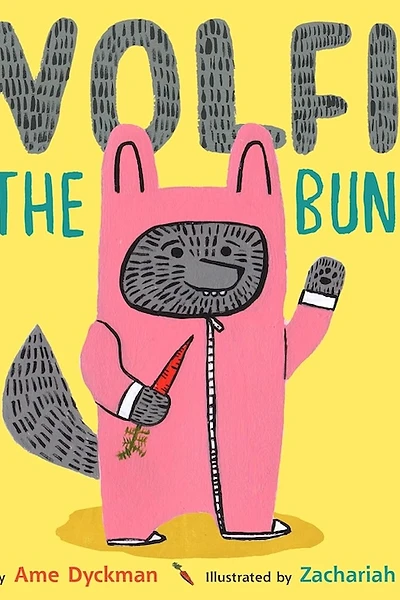
Wolfie the Bunny
by Ame Dyckman
Pacing MaterialA bunny family adopts a baby wolf, and big sister Dot is sure he's going to eat them all — until he proves he's family.
Big Idea
Family is built on love, not appearances, and being protective of someone makes you family.
Discussion Questions
- 1.Why is Dot so worried about Wolfie?
- 2.How do Dot's feelings change over the story?
- 3.What does it mean to be family?
- 4.When have you been wrong about someone?
Classroom Activity
My Family Portrait
Draw a portrait of your family — however you define it. Label each person and one thing that makes them special.
Lesson Plan
Learning Goals
- Explain what makes someone family beyond appearance
- Trace how Dot's feelings change from suspicion to love
- Create a family portrait celebrating what makes each member special
Activity Steps
- 1.Read the story, tracking Dot's feelings at each stage.
- 2.Discuss: 'Why was Dot wrong about Wolfie? What changed her mind?'
- 3.Model a family portrait with labels.
- 4.Students draw and label their own family portrait.
- 5.Share portraits and celebrate what makes each family unique.
Standards Connections
- ELA: RL.K.1 — Ask and answer questions about key details
- ELA: RL.K.2 — Retell stories, including key details
- ELA: RL.K.3 — Describe characters, setting, and events
- ELA: RL.3.6 — Acknowledge differences in characters' points of view
- ELA: SL.K.1 — Participate in collaborative conversations about the text
- ELA: W.K.3 — Write narratives recounting events with descriptive details
- SEL: Social Awareness
- SEL: Relationship Skills
- Art: VA:Re7 — Perceive and analyze artistic work
Pace-Write-Read Study with Pace-Write It!
Focus question: How does an author slow down or speed up a story so readers feel worry, laughter, and love? In Wolfie the Bunny by Ame Dyckman, a bunny family adopts a baby wolf, and Dot is convinced he will eat them all. The story uses pacing through page turns, repeated warnings, dialogue, and funny pauses to stretch Dot’s fear and then quickly shift toward acceptance and family.
| Element | How to notice or teach it in the novel |
|---|---|
| Pace | Read: Notice how the story speeds up when Dot panics about Wolfie and slows down when readers study her suspicious thoughts and the family’s reactions. Classroom Activity: Write 3 short sentences that speed up a scary moment and 3 longer sentences that slow down a worried moment about a new family member. |
| Plot | Read: Track the clear plot: the Bunny family brings home Wolfie, Dot fears he will eat them, tension grows, and Wolfie proves he belongs in the family. Classroom Activity: Make a 4-box plot map and write one sentence for each box: beginning, problem, big moment, ending. |
| Prosody | Read: Listen to how the read-aloud voice changes for Dot’s dramatic warnings, the calm parents, and the sweet baby sounds from Wolfie. Classroom Activity: Rewrite one Dot line and one parent line, then mark each with how you would read it aloud: loud, worried, calm, or surprised. |
| Word pause | Read: Notice where a reader naturally pauses before or after Dot’s fearful predictions, especially right before a reveal or page turn. Classroom Activity: Write a 4-line mini-scene and add slash marks / where a reader should pause for suspense. |
| Concept | Read: The big concept is that family can grow in unexpected ways, and acceptance takes time, especially when fear comes first. Classroom Activity: Write 2 sentences explaining what Dot learns about Wolfie by the end of the story. |
| Voice & World View | Read: The story leans into Dot’s worried, suspicious world view, so ordinary baby moments feel dangerous and funny at the same time. Classroom Activity: Write a short paragraph in the voice of a character who misunderstands someone new. |
| Setting & Place | Read: Notice how the home setting makes the story feel cozy, even while Dot imagines danger inside that safe family space. Classroom Activity: Describe one room in Dot’s house and explain how it could feel safe to one character but scary to Dot. |
| Point of View | Read: Even though the book is told in third person, readers stay close to Dot’s point of view, so her fear shapes the pacing and humor. Classroom Activity: Rewrite one moment from Wolfie’s point of view as if he is just a baby trying to belong. |
| Original Characters | Read: Dot is memorable because she is dramatic, protective, and funny, while Wolfie is a baby wolf whose innocence creates the twist in expectations. Classroom Activity: Invent an unusual family pair like Dot and Wolfie and write 3 sentences introducing them. |
| Dialogue | Read: Pay attention to how dialogue reveals Dot’s fear and the parents’ confidence, moving the story forward quickly. Classroom Activity: Write 6 lines of dialogue between an older sibling and a new baby or pet where one is worried and one is calm. |
| Details | Read: Small details about Dot watching, warning, and waiting help build her suspicion and keep the tension going. Classroom Activity: List 5 tiny details a character notices when they do not trust someone yet, then use 3 in a sentence set. |
| Descriptions | Read: The descriptions often help readers see the contrast between Dot’s scary ideas and Wolfie’s baby behavior. Classroom Activity: Write two descriptions of the same character: one from a fearful point of view and one from a loving point of view. |
| Strong First Lines | Read: Notice how the opening quickly introduces the unusual family situation and hooks readers with a problem right away. Classroom Activity: Write an opening line for a story about a surprising new family member that makes readers want to keep reading. |
| Immediacy & Engagement | Read: The story feels immediate because Dot reacts strongly in the moment, making readers want to see what Wolfie will do next. Classroom Activity: Write 4 sentences in which a character reacts right away to a surprising event using action and feeling words. |
| Story Scenes & Summaries & Unique Structures | Read: Some parts feel like full scenes with dialogue and tension, while other parts move quickly to the next important worry or moment. Classroom Activity: Write one detailed scene of Dot watching Wolfie and one summary sentence that skips ahead to later that day. |
| Flashback & Flash Forward & Cliffhangers | Read: This story mostly stays in the present, but it uses cliffhanger-like page turns so readers keep wondering if Dot is right about Wolfie. Classroom Activity: End a 5-sentence story with a cliffhanger question about what a new character will do next. |
| Tension & Suspense & Surprise | Read: Tension builds because Dot keeps expecting danger, suspense grows with each warning, and surprise comes when Wolfie acts like family instead of a threat. Classroom Activity: Write a short suspense paragraph where a character expects something scary but gets a surprising result. |
| Page Turns and Chapter Breaks | Read: In this picture book, page turns do the work that chapter breaks might do in a longer book, creating pauses before funny or tense reveals. Classroom Activity: Fold a paper into 4 pages and plan where a page turn should happen to surprise the reader. |
| Performance | Read: Wolfie the Bunny invites dramatic performance, especially for Dot’s bold warnings and the contrast with the adults’ calm voices. Classroom Activity: Practice reading one Dot line and one parent line aloud, then write a new line designed for a dramatic read-aloud. |
| Personality | Read: Dot’s strong personality shapes the pacing because her feelings are big, fast, and impossible to ignore. Classroom Activity: Write 5 personality words for Dot and use 2 of them in a sentence about how she acts. |
| Humor | Read: The humor comes from Dot’s over-the-top fears, the mismatch between what she expects and what baby Wolfie actually does, and the family’s calm response. Classroom Activity: Write a funny exaggeration about a baby, pet, or sibling that shows a character worrying too much. |
| Pause | Read: Notice how pauses before a reveal make readers lean in, especially when Dot watches Wolfie closely or predicts trouble. Classroom Activity: Write 3 short lines ending with ellipses or a line break to create a pause before the last line reveals the truth. |
| Poetry and Poetic Devices | Read: The language has a playful, lively sound, and repeated phrasing gives it a near-poetic bounce during read-aloud. Classroom Activity: Write a 4-line poem from Dot’s point of view using alliteration about Wolfie, like w, b, or s sounds. |
| Repetition | Read: Repetition helps build the joke and the tension because Dot keeps returning to the idea that Wolfie is dangerous. Classroom Activity: Write a repeated sentence starter, such as I watched or He might, and use it 3 times to build suspense. |
| Rhythm | Read: The rhythm of short and long lines helps the story feel quick, dramatic, and funny. Classroom Activity: Write one long sentence about Dot worrying and then two short sentences that punch in with fear or surprise. |
| Punctuation | Read: Exclamation marks, commas, and sentence breaks help show Dot’s dramatic feelings and control the speed of the reading. Classroom Activity: Write a 5-sentence mini-scene using at least one exclamation mark, one question mark, and one comma to shape pacing. |
| Questions | Read: Readers keep asking: Is Dot right? What will Wolfie do? How will this family work? Those questions keep the pages turning. Classroom Activity: Write 3 questions a reader might ask during the beginning, middle, and end of Dot and Wolfie’s story. |
| Compare-Contrast | Read: Compare Dot and Wolfie, fear and love, what Dot imagines and what actually happens; these contrasts create both humor and meaning. Classroom Activity: Make a T-chart comparing Dot and Wolfie, then write 2 compare-contrast sentences. |
| Objects | Read: Notice how everyday objects in the home can feel ordinary to the family but become clues or warning signs in Dot’s imagination. Classroom Activity: Choose one object from a home scene and write how it looks to a worried character and to a relaxed character. |
| Threes | Read: Look for places where actions, warnings, or examples could be grouped in threes to build a strong pattern in read-aloud storytelling. Classroom Activity: Write 3 things Dot thinks Wolfie might do, followed by a final sentence about what he really does instead. |
| Whitespace & Negative Space | Read: In a picture book, open space on the page can slow readers down and spotlight Dot’s expression, Wolfie’s smallness, or a tense pause. Classroom Activity: Create a 1-page storyboard with only one sentence and a lot of blank space to make the moment feel important. |
| Art & Graphics | Read: The illustrations help pace the story by showing facial expressions, distance between characters, and the contrast between Dot’s fear and Wolfie’s baby innocence. Classroom Activity: Draw a simple sketch of Dot watching Wolfie and add one caption that matches the mood. |
| Interactives & Gamification | Read: This book invites prediction games because readers can guess whether Dot’s warnings will come true or what Wolfie will do next. Classroom Activity: Write 3 prediction cards for classmates, each starting with Do you think Wolfie will..., and reveal the real outcome after reading. |
Pace-Write It!
20-Minute Classroom Flow Read (5 min): Read Wolfie the Bunny aloud, or reread a key section where Dot watches Wolfie and worries he will eat the family. Pause at a strong page turn and ask students to hold their prediction in their heads. Notice (5 min): Invite students to notice how Ame Dyckman uses repetition, dialogue, punctuation, and page turns to stretch Dot’s fear. Chart: What makes the story feel fast? What makes it slow down? Add examples such as Dot’s repeated warnings, exclamation marks, and the surprise of Wolfie acting lovingly. Write (7 min): Students write a short paced scene about a new family member, pet, or classmate who is misunderstood at first. Writing frame: At first, I thought ________. I watched ________ because ________. Then ________! But when ________, I realized ________. Encourage students to include one repeated phrase, one line of dialogue, and one punctuation mark that adds feeling. Share (3 min): Partners read their scenes aloud twice: first normally, then with dramatic pacing by pausing before the surprise line. Listeners name one place where the pacing built tension. Exit ticket: Write one sentence answering: How did Ame Dyckman make Dot’s worry feel big and funny at the same time?
Pace-Write-Read Connection
Teach this book using the Pace-Write-Read method — Tool 30: Contrast.
Open the Mastery Manual