
 K-3
K-3P PINCUS
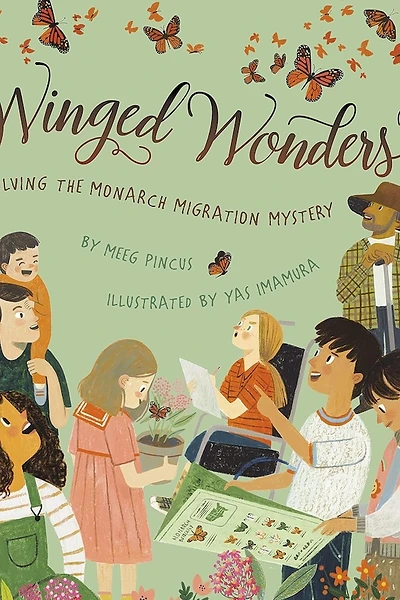
Winged Wonders: Solving the Monarch Migration Mystery
by Meeg Pincus
Pacing MaterialFor hundreds of years, people wondered where monarch butterflies went each fall. This is the story of the scientists, volunteers, and everyday people who solved the great monarch migration mystery.
Big Idea
Curiosity and teamwork can solve nature's biggest mysteries — and everyone, even kids, can be part of discovery.
Discussion Questions
- 1.Why was the monarch migration a mystery for so long?
- 2.How did different people help solve the mystery?
- 3.What role did tagging butterflies play?
- 4.How can ordinary people help scientists?
- 5.What would you want to discover about nature?
Classroom Activity
Tag-a-Butterfly
Design your own butterfly tag. Draw a monarch butterfly, create a tracking tag, and write where you think it might travel.
Lesson Plan
Learning Goals
- Explain how scientists, volunteers, and everyday people worked together to solve the monarch migration mystery.
- Describe migration as seasonal travel and identify Mexico as the winter destination of many monarchs from eastern North America.
- Create a model butterfly tracking tag and explain how a unique identification code helps researchers recognize an individual butterfly.
- Use drawing and writing or dictation to predict a monarch’s travel route and share a question about its journey.
Activity Steps
- 1.Read aloud "Winged Wonders: Solving the Monarch Migration Mystery" by Meeg Pincus. Pause to ask: What were people curious about? How did different people help solve the mystery?
- 2.Locate your community and Mexico on a map of North America. Explain that many monarchs from eastern North America travel south to Mexico in fall. Discuss what researchers might learn when a tagged butterfly is found in another place.
- 3.Have students draw and color a monarch with orange wings, black lines, and white spots. Invite them to name one feature that helps them recognize a monarch.
- 4.Give each student a small paper rectangle to design a pretend tracking tag with a unique code, such as MW01. Students attach it to their paper butterfly and record the same code, their classroom location, and today’s date on a tracking sheet. Explain that this is a model; real butterfly tagging requires special materials and guidance.
- 5.Ask students to draw an arrow on a simple map showing where they predict their monarch might travel. Have them write or dictate: "I predict my monarch will travel to ___ because ___." Clarify that a prediction is an idea to investigate, not a confirmed destination.
- 6.Pair students to exchange butterflies and record a pretend sighting using the butterfly’s code and a map location. Compare records, then discuss how shared observations helped the people in the book and how children can contribute by observing nature and asking questions.
Standards Connections
- ELA: RI.1.3 — Describe connections among the people, events, and ideas involved in solving the monarch migration mystery.
- ELA: W.1.8 — Recall information from the read-aloud to answer questions about monarch migration and tracking.
- ELA: SL.1.1 — Participate in collaborative conversations about predictions, observations, and teamwork.
- NGSS: Science and Engineering Practices — Develop and use a model; record and communicate observations.
- SEL: Relationship skills — Cooperate with a partner and recognize how people with different roles contribute to a shared discovery.
Pace-Write-Read Study with Pace-Write It!
Focus question: How does an author slow down and speed up a true science story to help readers feel the mystery and the discovery? In Winged Wonders: Solving the Monarch Migration Mystery by Meeg Pincus, readers follow the long search to learn where monarch butterflies go each fall. The pacing moves between big stretches of time, careful scientific steps, and exciting moments of discovery, helping young readers feel both the mystery and the solution.
| Element | How to notice or teach it in the novel |
|---|---|
| Pace | Read: Notice how Meeg Pincus moves quickly across hundreds of years of wondering, then slows down for key moments when scientists, volunteers, and everyday people gather clues about monarch butterflies. Classroom Activity: Write 3 short sentences that move fast through a big time period, then 3 longer sentences that slow down one important discovery moment. |
| Plot | Read: Notice how the plot is built like a real-life mystery: people wonder where monarchs go, they search for clues, they test ideas, and they finally solve the migration mystery. Classroom Activity: Make a 4-box plot map labeled mystery, search, clues, solution, and write one sentence for each box. |
| Prosody | Read: Listen for places where the language in this picture book sounds smooth, wondering, and excited, especially when the text describes monarchs traveling and people searching. Classroom Activity: Reread one page aloud with expression, then write 2 sentences you would read softly and 2 you would read with excitement. |
| Word pause | Read: Notice how key science and mystery words such as monarch, migration, mystery, and clues make readers stop and think. Classroom Activity: Choose 4 important words from the book and write a sentence after each one explaining why a reader might pause there. |
| Concept | Read: Notice that the big concept is that science discovery can take many people, much time, and careful observation to solve a question about nature. Classroom Activity: Write 2-3 sentences explaining the main science idea of the book and how people worked together to learn it. |
| Voice & World View | Read: Notice how the author’s voice sounds curious, respectful, and full of wonder about both monarch butterflies and the people who studied them. Classroom Activity: Write a short paragraph in a curious voice about an animal mystery you would want to solve. |
| Setting & Place | Read: Notice how place matters in this book because monarchs are seen in one place and then disappear, leading people to search across different regions until the migration route is understood. Classroom Activity: Write 3 sentences showing how a change in place can create a mystery in a nonfiction story. |
| Point of View | Read: Notice that the story is told from an outside narrator’s point of view, giving readers a wide view of many scientists, volunteers, and community members over time. Classroom Activity: Rewrite one event from the book from the point of view of a scientist, a volunteer, or even a monarch butterfly. |
| Original Characters | Read: Notice that the important real-life “characters” are not made-up heroes but scientists, volunteers, children, and everyday people whose work helped solve the monarch migration mystery. Classroom Activity: Pick one kind of helper from the book and write a character sketch showing how that person helped the discovery. |
| Dialogue | Read: Notice where you can imagine people asking questions like where did the monarchs go or sharing exciting new clues, even in a nonfiction text. Classroom Activity: Write 4 lines of imagined dialogue between two people in the book as they discuss a new monarch clue. |
| Details | Read: Notice the small details about monarch butterflies, their travel, and the careful work of tracking them that make the true story believable and interesting. Classroom Activity: Write 5 factual details from the book, then use at least 3 of them in a short nonfiction paragraph. |
| Descriptions | Read: Notice how the book describes monarchs and their journey in ways that help readers picture movement, distance, and wonder. Classroom Activity: Write 3 descriptive sentences about a monarch butterfly using color, motion, and place words. |
| Strong First Lines | Read: Notice how the opening quickly introduces the mystery of where monarch butterflies go, pulling readers into the search right away. Classroom Activity: Write your own strong first line for a nonfiction mystery about an animal or nature question. |
| Immediacy & Engagement | Read: Notice how the mystery keeps readers engaged because the question matters and the answer is not known at first. Classroom Activity: Write 2 sentences that make a reader feel they need to keep reading to find out what happens next. |
| Story Scenes & Summaries & Unique Structures | Read: Notice how Meeg Pincus blends summary of many years with focused scenes of searching and discovering, creating a structure that feels both historical and dramatic. Classroom Activity: Write one summary sentence that covers many years and one scene sentence that zooms in on a single moment. |
| Flashback & Flash Forward & Cliffhangers | Read: Notice how the book looks back across history to show how long the mystery lasted, and how each new clue can feel like a tiny cliffhanger before the next step in the search. Classroom Activity: Write a short paragraph that begins with “For many years…” and ends with a cliffhanger question. |
| Tension & Suspense & Surprise | Read: Notice the tension in not knowing where the monarchs go and the suspense as clue after clue appears before the surprising solution becomes clear. Classroom Activity: Write 3 sentences that build suspense about a nature mystery, saving the answer for the last sentence. |
| Page Turns and Chapter Breaks | Read: Notice how page turns in a picture book can hold a question—where are the monarchs now?—and then reveal a clue or new information on the next page. Classroom Activity: Create a two-page mini-book plan with a question on page 1 and the clue or reveal on page 2. |
| Performance | Read: Notice how this book could be performed with wonder in the mystery parts and excitement in the discovery parts. Classroom Activity: Practice reading one section aloud and mark where your voice should get quieter, slower, louder, or faster. |
| Personality | Read: Notice that the book gives personality to the search itself by making the scientific work feel determined, hopeful, and curious. Classroom Activity: Write a few sentences that give personality to a scientific investigation, as if the search were a character. |
| Humor | Read: Notice that this book is more full of wonder than jokes, but readers may smile at the idea that such a tiny butterfly kept such a huge secret from people for so long. Classroom Activity: Write one gentle, playful sentence about a monarch butterfly keeping its migration route a secret. |
| Pause | Read: Notice places where readers naturally pause to think about the long journey of the monarchs or the patience needed to solve the mystery. Classroom Activity: Put slash marks into a sentence from your own writing to show 3 good pause places for reading aloud. |
| Poetry and Poetic Devices | Read: Notice how the language can feel poetic when it describes butterfly movement, seasons changing, and the wonder of migration. Classroom Activity: Write a 4-line poem about monarch migration using one simile or personification. |
| Repetition | Read: Notice how repeating an idea such as people wondering, searching, and finding clues can build momentum in a nonfiction narrative. Classroom Activity: Write 3 sentences that repeat the same beginning words to show a growing search, such as “They watched…” or “They wondered…”. |
| Rhythm | Read: Notice how short and long sentences can create a rhythm that matches fluttering butterflies, waiting scientists, and exciting discoveries. Classroom Activity: Write one short sentence, one medium sentence, and one long sentence about the same monarch event. |
| Punctuation | Read: Notice how question marks fit the mystery and how commas and dashes can help the information flow clearly in a science story. Classroom Activity: Write 3 sentences about the book: one with a question mark, one with commas in a list, and one with a dash for emphasis. |
| Questions | Read: Notice that the whole book grows from one strong question: where do monarch butterflies go each fall? Classroom Activity: Make a list of 4 research questions you could ask if you were helping solve the monarch migration mystery. |
| Compare-Contrast | Read: Notice the contrast between what people used to know and what they later discovered, and between tiny butterflies and the enormous journey they make. Classroom Activity: Write 2 compare-contrast sentences using the frames “At first… but later…” and “Although… still…”. |
| Objects | Read: Notice the importance of real objects and tools connected to scientific discovery, such as tags, notes, maps, or other tracking materials used to follow monarchs. Classroom Activity: Choose one object a helper in the book might use and write 3 sentences explaining how it helps solve the mystery. |
| Threes | Read: Notice how ideas can be grouped in threes, such as scientists, volunteers, and everyday people all working together. Classroom Activity: Write a sentence that groups 3 kinds of helpers or 3 kinds of clues from the story. |
| Whitespace & Negative Space | Read: Notice how a picture book can use open space on the page to make the butterflies, the journey, or a key fact stand out and slow the reader down. Classroom Activity: Plan one picture-book page by deciding where you would leave blank space and where you would place one important sentence. |
| Art & Graphics | Read: Notice how the illustrations and visual layout likely help show movement, distance, seasons, and the growing understanding of the monarch migration mystery. Classroom Activity: Draw a simple labeled sketch, map, or sequence picture to match a paragraph you write about monarch migration. |
| Interactives & Gamification | Read: Notice how this book invites readers to become clue-hunters, tracking evidence the same way the real scientists and volunteers did. Classroom Activity: Create a “Solve the Monarch Mystery” clue card with one fact, one question, and one guess about where the butterflies go. |
Pace-Write It!
20-Minute Classroom Flow\nRead (5 min): Read aloud a section of Winged Wonders: Solving the Monarch Migration Mystery by Meeg Pincus that introduces the mystery and a later section that reveals a clue or discovery. Ask students to listen for where the story moves fast and where it slows down.\nNotice (5 min): Discuss: Where did the author skip across many years? Where did she slow down to highlight scientists, volunteers, or monarch butterflies? Chart student ideas under “Fast pacing” and “Slow pacing.”\nWrite (7 min): Students write a short nonfiction mystery paragraph about an animal or nature question using pacing. Writing frame: “For a long time, people wondered ____. They watched ____. They searched for clues in ____. Then one day, ____. At last, they discovered ____.” Encourage students to make the first sentence broad and fast, and the discovery sentence slower with details.\nShare (3 min): Partners read their paragraphs aloud and point to one sentence that moves quickly and one sentence that slows down. Invite 1-2 students to share how they used pacing like Meeg Pincus.\nExit ticket: Write one sentence answering: How did pacing help make the monarch migration mystery interesting to read?
Pace-Write-Read Connection
Teach this book using the Pace-Write-Read method — Tool 29: Questions.
Open the Mastery Manual