
 4-7
4-7M RHODES
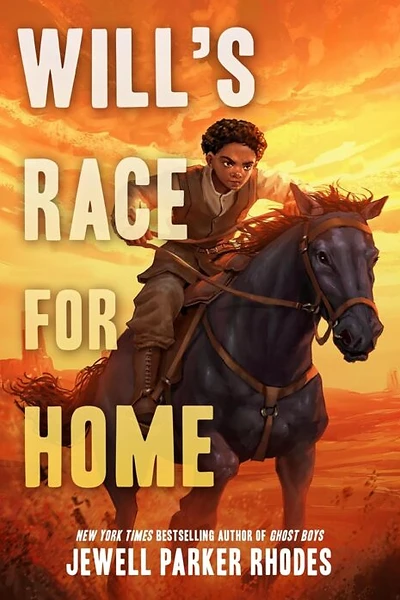
Will's Race for Home
by Jewell Parker Rhodes
Pacing MaterialA young boy races across a rugged landscape on horseback, determined to find his family and a place to call home against all odds.
Big Idea
Home is something you fight for, and the journey to find it shapes who you become.
Discussion Questions
- 1.What does 'home' mean to Will?
- 2.How does the journey change Will?
- 3.What obstacles does Will face, and how does he overcome them?
- 4.What does the horse represent in the story?
Classroom Activity
Trail Narrative
Research a historical trail or journey and write a first-person narrative from the perspective of someone traveling it.
Lesson Plan
Learning Goals
- Analyze character motivation
- Explore the theme of home and belonging
- Connect historical context to character journey
Standards Connections
- ELA: RL.4.1 — Ask and answer questions about key details
- ELA: RL.4.2 — Retell stories, including key details
- ELA: RL.4.3 — Describe characters, setting, and events
- ELA: RL.7.6 — Acknowledge differences in characters' points of view
- ELA: SL.4.1 — Participate in collaborative conversations about the text
- ELA: W.4.3 — Write narratives recounting events with descriptive details
- SEL: Relationship Skills
- SEL: Social Awareness
Pace-Write-Read Study with Pace-Write It!
Jewell Parker Rhodes builds the story around two races: Will and his father must reach Oklahoma in time for the 1889 land rush, while Will must grow into responsibilities he did not expect. The deadline drives the action; quieter moments let readers understand what owning a home would mean to the family. The publisher's description establishes the journey and its stakes, while Rhodes's educator resources offer historical context for discussion.
| Element | How to notice or teach it in the novel |
|---|---|
| Pace & plot | Track how the approaching land rush gives the journey a deadline. Obstacles on the road delay the characters and raise the stakes. |
| Prosody, word pause & performance | Read a tense passage and a reflective passage aloud. Compare changes in speed, emphasis, and silence; ask which words deserve a pause. |
| Concept | The question “What makes a place home?” gives the fast moving adventure an idea to return to. |
| Voice, worldview & point of view | Will’s perspective keeps readers close to what he understands, fears, and gradually learns about his father and their journey. |
| Setting & place | The route from Texas to Oklahoma creates forward motion. Terrain, distance, and the historical setting affect what the characters can do. |
| Original characters & personality | Will, his father, Belle the mule, and Caesar bring different strengths and uncertainties to the trip. Their relationships provide quieter beats between dangers. |
| Dialogue, details & descriptions | Compare a conversation with a stretch of travel description. Dialogue can make a moment feel immediate; selected details can slow readers long enough to picture a place or recognize a concern. |
| Strong first lines & engagement | Examine the opening page: what does Will notice, and what question makes you read on? Let students identify the hook in their own copies. |
| Scenes, summaries & structure | Mark where the narration dwells on an event and where it moves quickly across travel time. Ask why Rhodes gives some moments more space. |
| Flashback, flash forward & cliffhangers | Look for memories or withheld family history that change how Will understands the present. Use flash forward only if students find an actual jump to a future event; anticipating the land rush alone is not one. |
| Tension, suspense & surprise | The deadline, uncertain encounters, and questions about whom to trust keep readers expecting a change. Ask what readers know, what Will knows, and what remains uncertain. |
| Page turns & chapter breaks | Short chapters support a brisk reading pace. Check whether a particular chapter ends with a new problem, decision, or unanswered question before calling its ending a cliffhanger. |
| Humor & pause | Notice any moments of warmth or relief between difficult events. Ask how a brief change in mood affects the next tense scene. |
| Poetry, repetition & rhythm | Listen for repeated ideas such as land, freedom, and home, and for sentence rhythms that speed up or slow down a passage. The title also invites discussion of “Will” as a name and as determination. |
| Punctuation & questions | Choose a page and test how punctuation shapes a read aloud. List the questions Will asks or the reader holds; see when the story answers them. |
| Compare–contrast & threes | Compare Will’s understanding at the beginning and later in the journey, or compare what home means to Will, his father, and Caesar. “Threes” works well as a discussion structure; verify any claimed three-part pattern against the text. |
| Objects | Follow an object such as the land rush notice or Belle’s supplies. Ask how its practical purpose also reveals a character’s hopes or responsibilities. |
| Whitespace, art & graphics | Inspect the edition in hand for illustrations, page layout, and open space. Ask where a page invites a visual or emotional pause; avoid assuming every edition presents these features identically. |
| Interactives & gamification | These are classroom extensions, rather than features of the novel: students could build a pacing timeline, place “pause” markers on a read aloud passage, or sort scenes by the questions they leave open. |
Pace-Write It!
Give students three sticky notes labeled SPEED UP, SLOW DOWN, and PAUSE. As they read one chapter, have them mark one place for each label and explain which choice Rhodes made on the page—action, dialogue, description, sentence rhythm, or a chapter ending.