 K-5
K-5M COLMAN
Where Only Storms Grow
by Alyssa Colman
Pacing MaterialWhere Only Storms Grow is a historical middle-grade novel, rather than a picture book, set during the Dust Bowl. Alyssa Colman follows young protagonists confronting drought, destructive dust storms, and threats to their family’s security, exploring perseverance and the importance of human connection. This package therefore uses selected passages for grades 4–5 and teacher-created oral summaries for K–3, rather than assuming a whole-book picture-book read-aloud.
Big Idea
When people cannot control the conditions around them, their choices about helping, hoping, and persevering still matter. Writers can make readers feel that struggle by changing the pace of danger, reflection, and connection.
Discussion Questions
- 1.How does living through drought and dust storms affect what the young characters notice, want, and worry about?
- 2.Which choices show that a character is trying to protect someone else? What makes those choices difficult?
- 3.How can a place be both a beloved home and a source of danger? What evidence from the story helps you understand that tension?
- 4.Where does the story make you want to read quickly, and where does it invite you to slow down? What does the writing do differently in those places?
- 5.How does the story distinguish hoping for something from taking action? Can both help someone face uncertainty?
Classroom Activity
Before, During, After: A Dust-Storm Story
Students create a three-panel story showing a fictional family before, during, and after a Dust Bowl storm. Drawing on a teacher-selected passage from Where Only Storms Grow, they use longer, observant sentences before the storm, brief action sentences during it, and a reflective ending afterward. A helpful action connects the panels, emphasizing that the characters’ choices—not just the weather—drive a story.
Lesson Plan
Learning Goals
- Explain how the Dust Bowl setting creates a problem for the characters, using a detail from a selected passage or oral summary.
- Describe how a character’s actions reveal concern, fear, perseverance, or hope.
- Organize an original narrative into a clear beginning, middle, and ending.
- Experiment with sentence length, detail, and pauses to change narrative pace.
- Read or perform a short narrative expressively and revise it after listening to feedback.
Activity Steps
- 1.Introduce the historical setting with a brief, age-appropriate explanation: drought and damaged soil contributed to severe dust storms during the 1930s. Explain that the book is historical fiction, not a firsthand historical account.
- 2.Read a suitable excerpt involving the difficult environment and a character’s response. For K–3, offer an oral summary instead; ask students what the character faces and what the character can choose.
- 3.Model three panels labeled Before, During, and After. Write an original, detailed sentence in the first panel, two short action sentences in the second, and a sentence showing care or reflection in the third.
- 4.Have students draw and write their own three-panel stories. K–1 students may dictate captions; grades 2–3 can write one sentence per panel; grades 4–5 can write short paragraphs with a consistent point of view.
- 5.Partners read their stories aloud, identifying one place that feels fast and one place that feels slow. Writers revise a sentence or add a purposeful detail based on this feedback.
- 6.Share several examples and complete an exit response: ‘My character could not control ___, but could choose ___.’ Connect students’ answers to the novel.
Standards Connections
- ELA: CCSS RL.4.3 / RL.5.3 — Describe or compare characters, settings, and events using specific details; adjust expectations for younger students.
- ELA: CCSS W.3.3 / W.4.3 / W.5.3 — Develop narratives with an event sequence, descriptive details, and an appropriate conclusion.
- ELA: CCSS SL.1.1–SL.5.1 — Participate in collaborative conversations, listen to others, and build on their ideas.
- Social Studies: Historical understanding — Connect a historical-fiction setting to the environmental and human challenges of the Dust Bowl.
- SEL: Social awareness and responsible decision-making — Consider others’ needs and explain choices made under difficult circumstances.
Pace-Write-Read Study with Pace-Write It!
Where Only Storms Grow offers a pacing study built around the relationship between a difficult environment and the people living within it. The Dust Bowl setting gives writers a useful craft question: when should readers closely observe a place, and when should they move urgently through an event? In selected passages, students can investigate how description, action, dialogue, and reflection shape their experience of uncertainty. Treat these as questions to test against the text, rather than assuming every storm passage uses the same techniques. Use a Pace-Write-Read cycle: first notice how a passage moves, then try one technique in original writing, and finally read that writing aloud to hear its effect. Students can mark moments of observation, action, and emotional response, asking how each contributes to the story. A quieter moment can be just as important as a dangerous one because it gives readers time to understand what the characters stand to lose or why they keep going. Because this is a novel, use manageable excerpts rather than a picture-book page-by-page study. Grades 4–5 can compare passages directly; younger children can work with a teacher’s oral retelling and original model sentences. The workshop’s aim is not to imitate suffering or manufacture excitement, but to understand how deliberate writing choices help readers care about people facing hardship.
| Element | How to notice or teach it in the novel |
|---|---|
| 1. Pacing | Compare an excerpt focused on the Dust Bowl environment with one focused on an urgent response. Ask which feels faster and identify the sentence lengths, actions, or details that create that effect. |
| 2. Plot | Map a selected episode as problem, choice, and consequence. Distinguish what the weather causes from what a character’s decision changes. |
| 3. Prosody | Read a passage about difficult conditions aloud twice, varying speed and emphasis. Choose the delivery that best fits its meaning rather than automatically reading every storm-related sentence quickly. |
| 4. Word | Collect exact words from the excerpt that communicate dryness, dust, movement, or emotion. Discuss how replacing one precise word with a general word changes the reader’s experience. |
| 5. Concept | Explore the central contrast between an uncontrollable environment and meaningful human choices. Have students express that idea through an action in their stories rather than a stated moral. |
| 6. Voice & Worldview | Notice whether the selected passage presents hardship with fear, determination, affection, or another attitude. Ask what its language suggests about how the viewpoint character understands home and security. |
| 7. Point of View | Identify whose experiences readers can access in the excerpt and what remains unknown. Rewrite an original storm moment from another person’s perspective to see how attention and pacing change. |
| 8. Setting & Place | Identify details that make the Dust Bowl setting necessary to the story. Ask how the episode would change if the same characters lived somewhere without drought or dust storms. |
| 9. Original Characters | Study how a character becomes distinctive through a choice, worry, or habit in the passage. Students should give their own fictional character a specific concern rather than simply copying the novel’s protagonist. |
| 10. Dialogue | If the excerpt includes conversation, examine what it reveals about relationships under pressure. Try a brief exchange in an original scene and decide whether it increases urgency or gives readers breathing room. |
| 11. Details | Choose one concrete detail that helps readers understand the characters’ circumstances. Explain why that detail does more work than a general statement such as ‘Life was difficult.’ |
| 12. Descriptions | Examine how an environmental description affects both mood and reading speed. Students can write two original descriptions of dusty surroundings: one observant and one urgent. |
| 13. Firsts | Locate the first introduction of a problem, place, or important person in the assigned reading. Discuss what readers learn immediately and what the author leaves them wondering. |
| 14. Immediacy & Engagement | Find a moment that makes a character’s situation feel close and immediate. Test whether action, sensory information, or a pressing concern creates that engagement. |
| 15. Story Scenes, Summaries & Structures | Compare a moment presented step by step with a passage that compresses time. Explain why a novel about prolonged hardship needs both close-up scenes and summaries. |
| 16. Tension / Suspense / Surprise | Ask what readers fear or hope will happen during the selected episode. Separate suspense about an outcome from surprise when something unexpected actually occurs. |
| 17. Flashback, Flash-Forward, Cliffhanger | Check the assigned pages for a shift in time or an unresolved ending; name the device only when the text supports it. If none appears, students can experiment with a brief memory of life before the hardship in their own writing. |
| 18. Page Turns and Chapter Breaks | Examine an actual chapter ending to see what encourages continued reading. Distinguish an intentional chapter break from a page ending caused by the edition’s layout. |
| 19. Pace & Creativity | Rewrite an original response to an approaching dust storm at two speeds. Discuss how both versions can be effective when their pacing serves different purposes. |
| 20. Play | Use sentence-strip play to rearrange an original sequence about preparing for a storm. Keep this a craft experiment, not a game that trivializes historical hardship. |
| 21. Performance | Perform a brief passage with attention to its emotional changes. Listeners should explain how pauses, emphasis, and speed helped them understand the characters. |
| 22. Personality | Look for differing responses to the same difficult circumstance. Discuss how a character’s response reveals personality more effectively than a label such as ‘brave.’ |
| 23. Humor | Do not assume the novel uses humor in every episode; look for it only where the text supports it. If a lighter moment appears, discuss how it offers relief without making hardship seem unimportant. |
| 24. Pause | Find a moment when action gives way to observation or thought. Ask what emotional understanding readers gain from that pause. |
| 25. Poetry / Poetic Devices | Explore the title’s unusual pairing of storms with the verb ‘grow.’ Then look for figurative language in the selected passage and distinguish literal weather from metaphorical meaning. |
| 26. Repetition | Check for repeated words, concerns, or environmental details across assigned excerpts. Discuss whether the repetition suggests persistence, mounting pressure, or a change in meaning. |
| 27. Rhythm | Listen to the movement of sentences in a descriptive passage and an action passage. Students can vary sentence lengths to create a steady, interrupted, or rushing rhythm in original writing. |
| 28. Punctuation | Examine how the punctuation in an actual sentence organizes its meaning and supports its pace. Read punctuation as a guide to phrasing, not as a mechanical rule that every comma requires the same pause. |
| 29. Questions | Track a question readers carry through the episode, such as how a character will respond to danger or uncertainty. Notice when the text answers it, complicates it, or replaces it with another question. |
| 30. Compare-Contrast | Compare two characters’ responses or two moments in the same setting. Use specific evidence to explain differences rather than assuming everyone experiences hardship identically. |
| 31. Objects | Select an object actually mentioned in the excerpt and explain its practical or emotional importance. Students can give an ordinary household object a clear purpose in their own storm stories. |
| 32. Threes | Check whether the passage contains a meaningful three-part pattern; do not impose one if it does not. For practice, organize an original scene into noticing danger, making a choice, and showing its consequence. |
| 33. Lists | Look for any accumulation of details that makes the environment or a task feel demanding. Students can test a short list of preparations in original writing and decide whether it speeds or slows the scene. |
| 34. White Space & Negative Space | Study paragraph breaks and any section breaks in the available edition. Discuss how these give readers room to process action or emotion without assuming picture-book spreads. |
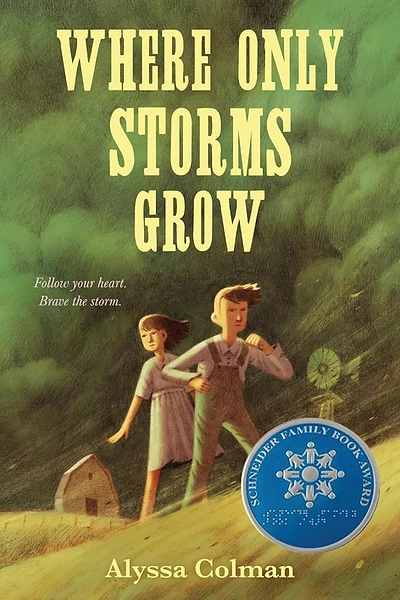
| 35. Art & Graphics | Treat the cover as a publisher’s visual interpretation, not evidence of events inside the novel. Pair the text with a reliably captioned Dust Bowl photograph and distinguish historical documentation from fictional description. |
| 36. Interactives & Gamification | Use a teacher-created ‘pace detective’ task in which students label observation, action, and reflection in an excerpt. This is an instructional extension, not an interactive feature claimed for the book. |
| 37. Placement | Notice where an important detail or emotional realization appears within a paragraph or scene. Move a detail in an original paragraph and discuss how its new position changes emphasis. |
| 38. Form | Discuss how the novel form allows sustained attention to hardship and relationships over time. Convert one episode into a three-panel storyboard and identify what the shorter form cannot fully preserve. |
| 39. Dummy | Make a folded-paper dummy, or rough booklet, for an original story inspired by the historical setting. This tests the students’ pacing across pages; it does not imply that Colman’s novel is a picture book. |
| 40. Passion | Ask which concern in the reading students most want others to understand: home, safety, perseverance, or mutual care. Let that concern guide a concrete character choice in their original writing. |
Pace-Write It!
20-minute Pace-Write-It! task — ‘One Storm, Two Speeds.’ Minutes 0–4: Read a short, age-appropriate excerpt from Where Only Storms Grow involving the Dust Bowl environment, or provide a teacher-created oral summary. Identify one environmental challenge and one human response. Minutes 4–7: Model two original sentences—not quotations from the book: ‘Dust gathered along the windowsill while the family watched the darkening sky.’ and ‘The sky vanished. They hurried inside.’ Discuss how detail and sentence length influence pace. Minutes 7–13: Students write a four-to-six-sentence fictional scene in the same historical setting, beginning with observation, moving into urgent action, and ending with one person helping another. Younger students draw three images and dictate captions. Minutes 13–17: Partners read aloud and point to one place that feels fast and one that feels slow, explaining why. Minutes 17–20: Writers revise one sentence and share how the change affects the reader. Remind students that their scenes are original historical-fiction practice, not additional events from Colman’s novel.