
R WHO WOULD WIN
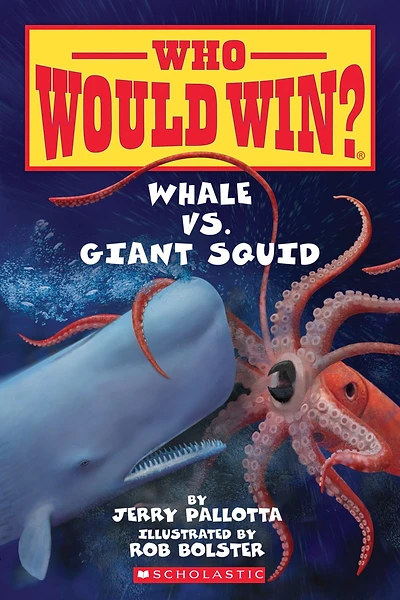
Whale vs. Giant Squid
by Jerry Pallotta, illustrated by Rob Bolster
Pacing MaterialJerry Pallotta's nonfiction "Who Would Win?" style easy reader pits two ocean giants against each other: the massive sperm whale and the mysterious giant squid. Through fact-filled spreads, readers learn about each creature's size, teeth, tentacles, diving depth, and defenses before the book imagines what would happen if these two titans ever met in the deep sea. Rob Bolster's illustrations bring the creatures to life with dramatic scale and detail, culminating in an exciting imagined showdown.
Big Idea
Real scientific facts about animal adaptations can be used to explore exciting hypothetical questions, teaching readers to think critically and compare evidence.
Discussion Questions
- 1.What physical features does the sperm whale have that help it survive deep-sea battles?
- 2.What physical features does the giant squid have that help it defend itself?
- 3.Why do you think the author chose to compare these two animals specifically?
- 4.Based on the facts in the book, do you agree with who the author predicts would win? Why or why not?
- 5.How does the illustrator use size and scale in the pictures to help you understand how big these animals really are?
- 6.What is the difference between a fact and a prediction in this book?
Classroom Activity
Ocean Giants Showdown: Build Your Own Comparison Battle
Students choose two animals (real or from other books) and research three facts about each: size, defense, and special ability. Using the book's format as a model, students create their own two-page "Who Would Win?" spread with labeled diagrams, comparison facts, and a predicted outcome, then present their battle to the class and justify their prediction using evidence.
Lesson Plan
Learning Goals
- Identify how the sperm whale’s size, teeth, and diving ability and the giant squid’s tentacles and defenses help them survive in the ocean.
- Distinguish factual animal information from the book’s imagined showdown.
- Gather and compare three facts about each of two animals: size, defense, and special ability.
- Create labeled diagrams and predict a showdown outcome supported by animal facts and habitat conditions.
- Present a prediction clearly and recognize that evidence may support more than one possible outcome.
Activity Steps
- 1.Read Whale vs. Giant Squid aloud, pausing at Rob Bolster’s illustrations to examine scale, teeth, and tentacles. Ask: “Which details are animal facts? Which part imagines what might happen?” Explain that the book uses nonfiction information to build a hypothetical showdown.
- 2.Build a class comparison chart for the sperm whale and giant squid with columns for size, defense, and special ability. Record facts from the book, noting the page or illustration where students found each detail. Discuss how deep-ocean conditions could affect an encounter.
- 3.Have students work individually or in pairs to choose two animals and gather one fact for each comparison category using teacher-selected books or reliable animal fact sheets. For K–2, provide picture fact cards and record dictated responses; for grades 3–5, have students take notes and name their sources. If using fictional animals, label story-based traits separately from scientific facts.
- 4.Fold a sheet of paper into a two-page spread modeled on the book. Place one animal on each page, draw and label its important features, and add its three comparison facts. Include measurements when available, using the same units to compare size.
- 5.Choose and name a setting for the encounter, then add a predicted outcome supported by at least two recorded facts. Offer the sentence frame: “I predict ___ because ___ and ___.” Encourage students to explain uncertainty rather than present the prediction as a proven fact.
- 6.Invite students to present their spreads in a class gallery walk or brief partner presentation. Listeners ask one evidence-based question. Finish by revisiting the sperm whale and giant squid: “How did facts help us make predictions, and what can’t we know from this imagined battle?”
Standards Connections
- ELA: CCSS RI.1.3 — Describe connections between pieces of information, using animal traits and survival as the focus.
- ELA: CCSS RI.3.7 — Use information from illustrations and text to demonstrate understanding of animal features and comparisons.
- ELA: CCSS W.2.8 / W.3.8 — Gather information from provided print or digital sources to answer a question.
- ELA: CCSS SL.1.1 / SL.3.1 — Participate in collaborative discussions, ask questions, and explain ideas about predicted outcomes.
- Science: NGSS 4-LS1-1 — Connect external animal structures, such as teeth and tentacles, to their functions in survival.
Pace-Write-Read Study with Pace-Write It!
Pallotta's book is a masterclass in using nonfiction structure to create narrative tension. By alternating facts and building toward a climactic hypothetical event, the book keeps young readers engaged while teaching real science. Below is a craft-by-craft breakdown of how this book uses story elements, even within a nonfiction format, to hook and hold readers.
| Element | How to notice or teach it in the novel |
|---|---|
| Pace | Read: Notice how short, fact-packed spreads move quickly, building momentum toward the climactic battle scene near the end. Classroom Activity: Have students outline the book's pacing on a timeline, marking where it speeds up and slows down, then write a paragraph explaining why the author made those choices. |
| Plot | Read: Notice the book's simple plot arc — introduce whale, introduce squid, compare features, then imagine a battle. Classroom Activity: Students diagram this four-part structure and use it as a template to plan their own compare-and-battle nonfiction story. |
| Prosody | Read: Notice how short, punchy sentences create a rhythm that's easy to read aloud and builds excitement. Classroom Activity: Students practice reading a page aloud, marking where their voice should speed up or slow down for effect. |
| Word pause | Read: Notice how phrases like "But wait..." or dashes create a beat before a surprising fact is revealed. Classroom Activity: Students insert a word-pause phrase into one of their own sentences to build suspense before a fact. |
| Concept | Read: Notice how the entire book is built on one simple but powerful concept — comparing two ocean giants to ask who would win. Classroom Activity: Students brainstorm three other "who would win" concept ideas and pick one to develop further. |
| Voice & World View | Read: Notice Pallotta's enthusiastic, slightly playful narrator voice that makes facts feel exciting rather than dry. Classroom Activity: Students rewrite one factual sentence from a textbook in Pallotta's excited, engaging voice. |
| Setting & Place | Read: Notice how the deep, dark ocean setting is established through details about depth, pressure, and darkness. Classroom Activity: Students write a short setting description of the deep ocean using at least three sensory details. |
| Point of View | Read: Notice how the narrator speaks directly to the reader with questions like "Which one would win?" Classroom Activity: Students rewrite a paragraph switching from third-person narration to direct reader address. |
| Original Characters | Read: Notice how the whale and squid are given personality and drama even though they are real animals, not invented characters. Classroom Activity: Students pick a real animal and write three sentences that give it personality, as if it were a character. |
| Dialogue | Read: Notice the absence of traditional dialogue, replaced by rhetorical questions that mimic conversation with the reader. Classroom Activity: Students write two rhetorical questions they could add to a nonfiction page to engage readers. |
| Details | Read: Notice specific numerical details like tentacle length, tooth count, and diving depth that make facts vivid and memorable. Classroom Activity: Students research one animal fact and turn it into a specific, numerical detail sentence. |
| Descriptions | Read: Notice vivid descriptions of textures and colors, like the squid's rubbery skin or the whale's massive jaw. Classroom Activity: Students write a two-sentence description of an animal feature using strong sensory language. |
| Strong First Lines | Read: Notice how the opening line immediately introduces the central hook — a matchup between two powerful animals. Classroom Activity: Students write three possible strong first lines for their own "who would win" story and choose the best one. |
| Immediacy & Engagement | Read: Notice how direct questions like "Which one would win?" pull readers immediately into the action. Classroom Activity: Students write an engaging opening question for their own nonfiction topic. |
| Story Scenes & Summaries & Unique Structures | Read: Notice the alternating structure — one spread on the whale, one on the squid — that organizes information clearly. Classroom Activity: Students create a two-column comparison chart summarizing facts about two animals, mimicking the book's structure. |
| Flashback & Flash Forward & Cliffhangers | Read: Notice how the ending imagines a future battle, creating a cliffhanger about the animals' possible encounter. Classroom Activity: Students write a short flash-forward paragraph imagining a future event based on facts they've learned. |
| Tension & Suspense & Surprise | Read: Notice how facts build suspense leading up to the imagined battle, keeping readers wondering who will win. Classroom Activity: Students write three fact sentences in increasing order of surprise to build suspense. |
| Page Turns and Chapter Breaks | Read: Notice how each page turn reveals a new fact or comparison, encouraging readers to keep turning pages. Classroom Activity: Students design a page-turn moment in their own book draft that ends with a question or surprising fact. |
| Performance | Read: Notice how the dramatic battle scene lends itself to expressive, voice-changing read-aloud performance. Classroom Activity: Students perform a dramatic read-aloud of the battle scene, using voice and gesture to show excitement. |
| Personality | Read: Notice how both animals are given distinct personalities — the whale as powerful hunter, the squid as mysterious defender. Classroom Activity: Students write one sentence describing the 'personality' of an animal based on its adaptations. |
| Humor | Read: Notice small humorous asides and playful comparisons that keep the tone light despite factual content. Classroom Activity: Students add one humorous sentence to a factual paragraph they've written. |
| Pause | Read: Notice full-page illustrations with minimal text that give readers a visual pause to absorb information. Classroom Activity: Students design a wordless illustration page for their own nonfiction book to create a visual pause. |
| Poetry and Poetic Devices | Read: Notice alliterative phrases like "deep dark depths" that add rhythm and memorability to the text. Classroom Activity: Students write an alliterative phrase describing an ocean animal or setting. |
| Repetition | Read: Notice the repeated comparison structure — size, then defense, then attack — used for both animals. Classroom Activity: Students use the same repeated structure to compare two new animals of their choice. |
| Rhythm | Read: Notice how short declarative sentences create a steady, energetic rhythm throughout the book. Classroom Activity: Students write three short declarative sentences about an animal fact to practice rhythmic writing. |
| Punctuation | Read: Notice frequent exclamation points and question marks that convey excitement and curiosity. Classroom Activity: Students revise a flat sentence by adding punctuation to increase its energy and emotion. |
| Questions | Read: Notice how questions are used throughout to engage curiosity and prompt prediction. Classroom Activity: Students write two questions they would ask if writing their own animal-comparison book. |
| Compare-Contrast | Read: Notice the book's entire structure relies on comparing size, weapons, and defenses between two animals. Classroom Activity: Students complete a Venn diagram comparing the whale and squid, then extend it to two new animals. |
| Objects | Read: Notice specific physical objects like teeth, tentacles, and suckers used as focal points for facts. Classroom Activity: Students choose one animal object/feature and write three facts about it. |
| Threes | Read: Notice how facts are often grouped in sets of three for balance and memorability, such as three defense strategies. Classroom Activity: Students write three facts about an animal, organized as a group of three. |
| Whitespace & Negative Space | Read: Notice how illustrations use large areas of blue ocean space to emphasize scale and depth. Classroom Activity: Students create an illustration using negative space to show how small or large an animal is compared to its environment. |
| Art & Graphics | Read: Notice how Bolster's illustrations use scale comparisons and labeled diagrams to reinforce facts visually. Classroom Activity: Students create a labeled diagram of an animal, including at least three key features. |
| Interactives & Gamification | Read: Notice how the 'who would win' format turns nonfiction reading into an interactive game of prediction and debate. Classroom Activity: Students hold a class debate predicting outcomes for their own who-would-win matchups, using facts as evidence. |
Pace-Write It!
In this workshop, students will explore how nonfiction writers use storytelling techniques — pacing, suspense, comparison, and voice — to make facts exciting. Working in pairs, students will select two animals, research key facts, and apply at least five of the craft elements above (such as Compare-Contrast, Strong First Lines, and Interactives & Gamification) to draft their own two-page "Who Would Win?" spread. The workshop concludes with a gallery walk where classmates vote on predicted outcomes based on the evidence presented, reinforcing both writing craft and scientific reasoning.