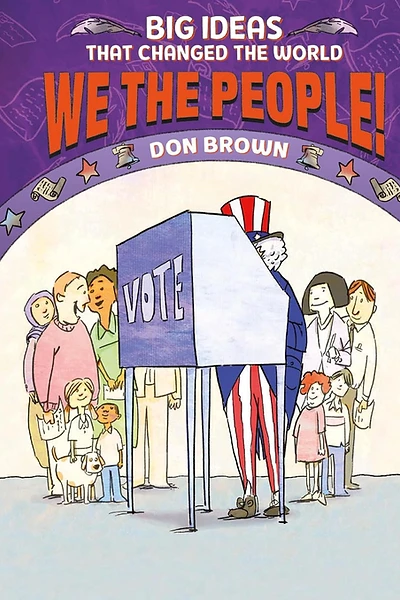
 3-7
3-7GN BROWN
We the People!
by Don Brown
Pacing MaterialA graphic novel history of the U.S. Constitution, from the Revolutionary War through the Constitutional Convention to the ongoing struggle for voting rights and democratic participation.
Big Idea
The Constitution is a living document, shaped by centuries of debate, amendment, and the ongoing fight for representation.
Discussion Questions
- 1.Why did the founders create a system of checks and balances?
- 2.How has the right to vote expanded since the Constitution was written?
- 3.What amendments have had the most impact on American life?
- 4.Why is civic participation important in a democracy?
Classroom Activity
Constitutional Convention Simulation
Students role-play delegates at the Constitutional Convention, debating key issues and drafting their own class constitution.
Lesson Plan
Learning Goals
- Understand the structure and purpose of the U.S. Constitution
- Examine the debates and compromises that shaped the document
- Trace the expansion of voting rights throughout American history
- Develop skills in civic discourse and democratic decision-making
Activity Steps
- 1.Introduce the historical context of the Constitutional Convention
- 2.Assign students roles as delegates with specific state interests
- 3.Debate key issues: representation, slavery, federal power
- 4.Draft a class constitution incorporating compromises
- 5.Reflect on how the Constitution continues to evolve today
Standards Connections
- ELA: RL.3.1 — Ask and answer questions about key details
- ELA: RL.3.2 — Retell stories, including key details
- ELA: RL.3.3 — Describe characters, setting, and events
- ELA: RL.7.6 — Acknowledge differences in characters' points of view
- ELA: SL.3.1 — Participate in collaborative conversations about the text
- ELA: W.3.3 — Write narratives recounting events with descriptive details
- SEL: Social Awareness
- SEL: Relationship Skills
- Art: VA:Re7 — Perceive and analyze artistic work
Pace-Write-Read Study with Pace-Write It!
Focus question: How does an author control pacing to help readers understand big historical events and feel the urgency of democracy? In We the People! by Don Brown, readers move quickly through major moments from the Revolutionary War to the Constitutional Convention and then into later struggles for voting rights. Brown uses graphic-novel panels, dialogue, captions, and shifts between summary and dramatic scenes to speed up important action, slow down key turning points, and show that the story of democracy is still unfolding.
| Element | How to notice or teach it in the novel |
|---|---|
| Pace | Read: Notice how Don Brown moves briskly across years of U.S. history but slows down for turning points such as the Constitutional Convention and later fights over voting rights. Classroom Activity: Write a short timeline paragraph about three moments in democracy, using one sentence to speed through time and one sentence to slow down the most important moment. |
| Plot | Read: Track the book’s historical plot from the Revolutionary War, to the weaknesses of the Articles of Confederation, to the writing of the Constitution, and then to ongoing struggles over who gets to participate in democracy. Classroom Activity: Write a 5-part plot summary using these headings: problem, pressure, meeting, decision, unfinished work. |
| Prosody | Read: Listen to how the captions and speech bubbles sound when read aloud; some parts feel fast and urgent, while others feel serious and weighty, matching debates about government and rights. Classroom Activity: Choose one page and mark where your voice should speed up, slow down, grow louder, or pause, then perform it. |
| Word pause | Read: Notice single powerful words and short phrases in captions or dialogue that make readers stop and think about liberty, rights, representation, and power. Classroom Activity: Write 4-6 short caption lines about a class decision, placing one intentional one-word line for emphasis. |
| Concept | Read: Focus on the central civics concept that government is created by people, but democracy must keep expanding to include more people. Classroom Activity: Write a mini-explanation beginning with “Democracy is not finished because…” and include two examples from the book. |
| Voice & World View | Read: Notice how Brown’s voice is informative, direct, and accessible, while his world view suggests that the Constitution matters but should also be examined through the lens of fairness and participation. Classroom Activity: Write three caption boxes in a clear nonfiction-story voice explaining whether rules should stay fixed or change over time. |
| Setting & Place | Read: Pay attention to how places such as battlefields, Philadelphia, the convention hall, and public spaces connected to voting shape the action and tone. Classroom Activity: Write a setting paragraph about one civic place where an important decision happens, showing how the place affects people’s choices. |
| Point of View | Read: Notice that the book often uses a broad historical point of view instead of staying with one person, which helps readers see the Constitution as a shared national story. Classroom Activity: Rewrite one event from the perspective of a delegate, a soldier, or a voter who was excluded. |
| Original Characters | Read: Although this is historical fiction in graphic-novel form, Brown presents real historical figures as vivid story participants, including delegates, leaders, and ordinary people affected by the Constitution and voting laws. Classroom Activity: Create an original bystander character who lives during the Constitutional Convention and write a journal entry about what they hear and feel. |
| Dialogue | Read: Study how speech bubbles make debates about government feel immediate, especially when people disagree about power, representation, and rights. Classroom Activity: Write a 6-line dialogue between two characters arguing about what makes a fair government. |
| Details | Read: Notice the specific historical details Brown includes—documents, debates, laws, protests, and changes in voting rights—to keep the story grounded in real events. Classroom Activity: Write a factual scene using at least four precise civics details from the book. |
| Descriptions | Read: Observe how brief visual and verbal descriptions quickly establish crowded meetings, tense debates, and the long struggle for participation in democracy. Classroom Activity: Describe the Constitutional Convention in 5-7 sentences using sensory details and a serious tone. |
| Strong First Lines | Read: Notice how opening lines and opening pages quickly launch readers into a big national problem: how to build a government that works. Classroom Activity: Write three possible opening lines for a graphic-history page about a rule, right, or protest. |
| Immediacy & Engagement | Read: See how Brown makes old history feel immediate by using active language, direct transitions, and expressive panels that pull readers into debates and consequences. Classroom Activity: Turn one historical summary from the book into a present-tense paragraph to make it feel more urgent. |
| Story Scenes & Summaries & Unique Structures | Read: Notice how the book alternates between scene-like moments, such as arguments and decisions, and summary sections that cover many years quickly. Classroom Activity: Write two parts about voting rights: first a 3-sentence scene, then a 3-sentence summary covering many years. |
| Flashback & Flash Forward & Cliffhangers | Read: Watch how the book reaches back to the Revolutionary War and forward to later democratic struggles, showing that the Constitution’s story does not end in 1787. Classroom Activity: Write a short passage that begins at the Convention, flashes forward to a later voting-rights struggle, and ends with a question cliffhanger. |
| Tension & Suspense & Surprise | Read: Notice the tension created by problems after the war, disagreements among delegates, and the surprising truth that freedom and voting rights were not shared equally. Classroom Activity: Write a suspenseful paragraph about a meeting where people must solve a government crisis before time runs out. |
| Page Turns and Chapter Breaks | Read: Pay attention to how page turns in the graphic-novel format reveal new ideas, new conflicts, or later historical periods at just the right moment. Classroom Activity: Plan a 4-panel page and decide what information to hide until the page turn for the strongest effect. |
| Performance | Read: The arguments in the book can be performed dramatically because different speakers bring urgency, frustration, hope, and disagreement to constitutional debates. Classroom Activity: In pairs, perform a short debate about representation or voting rights using expressive pacing and pauses. |
| Personality | Read: Notice how historical figures are shown with distinct personalities through expressions, posture, and concise lines, helping readers follow complex history. Classroom Activity: Write a character sketch of one delegate or citizen, showing personality through actions and speech. |
| Humor | Read: Look for places where visual touches or concise phrasing lighten a serious history just enough to keep readers engaged without losing the importance of the topic. Classroom Activity: Create a respectful comic-style caption that uses gentle humor to explain a confusing government problem. |
| Pause | Read: Notice where a panel, caption, or ending idea makes readers pause to think about fairness, power, and who was left out of “We the People.” Classroom Activity: Write a 5-line reflection that ends with a pause line: “But not everyone was included.” |
| Poetry and Poetic Devices | Read: Even though the book is not written as poetry, some phrases gain power through repetition, contrast, and compressed language about rights and democracy. Classroom Activity: Write a free-verse poem titled “We the People?” using repetition and contrast to show inclusion and exclusion. |
| Repetition | Read: Notice repeated ideas such as people, rights, government, voting, and participation, which reinforce the book’s message that democracy must be protected and expanded. Classroom Activity: Write a paragraph that repeats the phrase “A democracy works when…” three times for emphasis. |
| Rhythm | Read: Feel the rhythm created by short captions, quick panel shifts, and moments of slower explanation, especially when the book moves from war to debate to reform. Classroom Activity: Write 6-8 sentences that alternate short and long lines to mimic fast and slow pacing in history. |
| Punctuation | Read: Study how dashes, commas, ellipses, question marks, and exclamation points shape the speed and emotion of arguments about the Constitution and rights. Classroom Activity: Rewrite a plain sentence about voting rights three different ways using different punctuation to change the pacing. |
| Questions | Read: Notice the big civic questions under the story: Who gets power? Who gets represented? Who gets to vote? Who counts as “the people”? Classroom Activity: Write four essential questions a reader should ask while reading this book, then answer one in a short response. |
| Compare-Contrast | Read: Compare the promise of the Constitution with the reality that many groups still had to fight for voting rights and equal participation. Classroom Activity: Make a compare-contrast paragraph using the frame “The Constitution promised…, but in practice…”. |
| Objects | Read: Pay attention to important objects such as the Constitution itself, ballots, written laws, and other symbols of government and citizenship. Classroom Activity: Choose one object from the book and write a first-person monologue from that object’s point of view. |
| Threes | Read: Notice how history can be organized in sets of three, such as three major eras, three turning points, or three groups affected by democratic change. Classroom Activity: Write three connected sentences about three turning points in the story of U.S. democracy. |
| Whitespace & Negative Space | Read: In the graphic-novel format, notice how open space around panels or words can slow the reader and make a serious idea stand out. Classroom Activity: Sketch a simple one-page comic plan that uses one mostly empty panel to emphasize a powerful civic idea. |
| Art & Graphics | Read: Study how Brown’s illustrations, panel size, facial expressions, and visual sequencing help explain complex history and control pacing without long blocks of text. Classroom Activity: Create a 3-panel comic explaining one Constitution-related event from the book. |
| Interactives & Gamification | Read: Think about how readers can actively track the book’s movement through time, rights, and representation like a challenge or quest to understand democracy. Classroom Activity: Design a “Democracy Progress Tracker” with checkpoints from the Revolutionary War, the Constitutional Convention, and later voting-rights struggles, then add one writing note at each checkpoint. |
Pace-Write It!
20-Minute Classroom Flow\nRead (5 min): Read aloud 2-4 pages from We the People! by Don Brown that show a major shift in government or voting rights. Ask students to listen for where the story speeds up across years and where it slows down for an important debate or decision.\n\nNotice (5 min): Students turn and talk: Where did Brown summarize quickly? Where did he zoom in on a scene? What did the panels, captions, and dialogue do to control pacing? Chart student observations under these headings: Fast summary, Slow scene, Important pause.\n\nWrite (7 min): Students write a short graphic-history paragraph or script about a class rule, community decision, or historical event using pacing on purpose. Writing frame: “At first, __________. Over time, __________. But then, on one important day, __________. People argued, ‘__________’ and ‘__________.’ In that moment, __________. Even after that, __________.” Challenge students to add one short pause line such as “Not everyone agreed.” or “The question was not over.”\n\nShare (3 min): Partners read their pieces aloud with expression. Listeners name one place where the writing moved quickly and one place where it slowed down effectively.\n\nExit ticket: In one or two sentences, answer: How did Don Brown use pacing in We the People! to show that democracy is both a past event and an ongoing responsibility?