
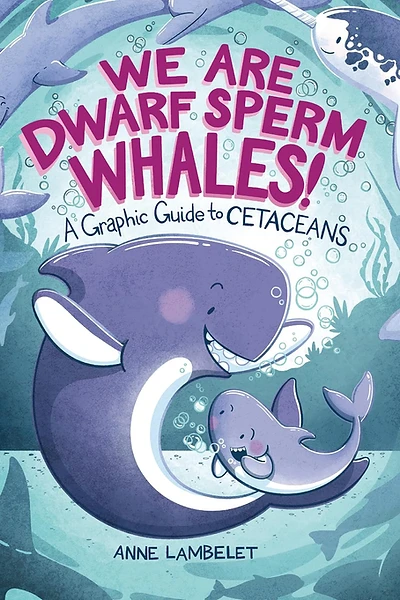
 2-5
2-5GN LAMBELET
We Are Dwarf Sperm Whales!
by Anne Lambelet
Pacing MaterialBig Idea
Marine biology is best understood through the lens of storytelling, where graphic novel formats allow readers to visualize complex scientific facts about cetaceans through engaging, character-driven narratives.
Discussion Questions
- 1.Why do you think the author chose a dwarf sperm whale named Kogi to be our guide instead of a human scientist?
- 2.How does the graphic novel format help you understand the difference between whales, dolphins, and porpoises better than a textbook might?
- 3.Kogi mentions that cetaceans are mammals like us; what are some similarities and differences between humans and whales?
- 4.The book describes dwarf sperm whales as 'stealth whales' because of their ink sacs; how does this adaptation help them survive in the ocean?
- 5.What did you learn about the ocean environment that surprised you the most while reading this guide?
Classroom Activity
Create Your Own Cetacean Comic Strip
Students will research one specific cetacean and create a one-page graphic novel panel that teaches a 'fun fact' about that animal, mimicking Anne Lambelet's style of using a friendly narrator.
Lesson Plan
Learning Goals
- Identify key physical and behavioral characteristics of cetaceans.
- Understand how graphic novel elements (panels, speech bubbles, captions) convey scientific information.
- Synthesize research into a creative, visual format.
- Practice clear communication of scientific concepts for a specific audience.
Activity Steps
- 1.Select a cetacean (dolphin, porpoise, or whale) to research using provided library resources.
- 2.Draft a short script where your chosen animal introduces itself to the reader.
- 3.Sketch a 3-4 panel comic strip that includes one scientific fact and one 'fun fact'.
- 4.Use speech bubbles for dialogue and captions for scientific explanations.
- 5.Review and edit for clarity, ensuring the tone is engaging and informative.
Standards Connections
- CCSS.ELA-LITERACY.RI.2.3: Describe the connection between a series of historical events, scientific ideas or concepts, or steps in technical procedures in a text.
- CCSS.ELA-LITERACY.RL.3.7: Explain how specific aspects of a text's illustrations contribute to what is conveyed by the words in a story.
- NGSS 3-LS4-2: Use evidence to construct an explanation for how the variations in characteristics among individuals of the same species may provide advantages in surviving.
- National Core Arts Standard VA:Cr2.1.2a: Experiment with various materials and tools to explore personal interests in a work of art or design.
Pace-Write-Read Study with Pace-Write It!
The 'Pace-Write-Read' study of 'We Are Dwarf Sperm Whales!' invites students to examine how graphic novels manipulate time and information. Unlike traditional prose, graphic novels rely on the physical layout of the page to dictate the speed at which a reader processes scientific data. By analyzing how Anne Lambelet balances dense facts with visual humor, students learn that pacing is not just about word count, but about the 'breathing room' provided by panels and white space. This study encourages students to view the book as a series of rhythmic beats. We will explore how the author uses the 'pause' of a page turn to build suspense or deliver a punchline, and how the visual 'prosody' of the art guides the reader's eye. Through this, students will develop a deeper appreciation for the intentionality behind every line, bubble, and splash of color in a graphic narrative.
| Element | How to notice or teach it in the novel |
|---|---|
| Pace | Observe how the author speeds up during action sequences and slows down for scientific definitions. |
| Plot | The plot follows a 'guided tour' structure where Kogi introduces the reader to the world of cetaceans. |
| Prosody | Teach students to read the dialogue with the enthusiasm of a tour guide, matching the character's friendly voice. |
| Word Pause | Look for single-word panels that emphasize a specific scientific term or a funny reaction. |
| Concept | The core concept is the classification and unique adaptations of cetaceans. |
| Voice & World View | Kogi speaks from the perspective of a 'stealth whale,' viewing the ocean as a home rather than a mystery. |
| Setting & Place | The setting is the vast, deep ocean, which is depicted as a vibrant, colorful, and busy environment. |
| Point of View | The story is told in the first person by Kogi, creating an immediate, personal connection. |
| Original Characters | Kogi is an original, anthropomorphized character who makes complex biology accessible. |
| Dialogue | Dialogue is used to break up heavy facts, making the information feel like a conversation. |
| Details | Notice the small details in the background, such as other sea creatures, that add depth to the setting. |
| Descriptions | The art provides the primary description, while the text provides the scientific context. |
| Strong First Lines | The opening hook invites the reader to join the 'deep dive' immediately. |
| Immediacy & Engagement | The direct address to the reader ('All fins on deck!') pulls the audience into the narrative. |
| Story Scenes & Summaries & Unique Structures | The book uses a hybrid structure, blending narrative scenes with informational 'fact-file' summaries. |
| Flashback & Flash Forward & Cliffhangers | The book uses 'teasers' at the end of sections to keep the reader moving to the next page. |
| Tension & Suspense & Surprise | The 'stealth whale' reveal creates a moment of surprise regarding the whale's defense mechanisms. |
| Page Turns and Chapter Breaks | Use the page turns to transition between different types of cetaceans. |
| Performance | Encourage students to act out Kogi's movements as they read the dialogue aloud. |
| Personality | Kogi is portrayed as humble and helpful, which makes the reader trust the information provided. |
| Humor | The author uses puns and funny character expressions to lighten the tone of scientific facts. |
| Pause | Identify panels with no text where the reader is meant to look at the art and 'breathe' before the next fact. |
| Poetry and Poetic Devices | Look for alliteration in the descriptions of sea life. |
| Repetition | The recurring theme of 'mammals breathing air' reinforces the main scientific takeaway. |
| Rhythm | The rhythm is established by the alternating pattern of 'fact' and 'reaction' panels. |
| Punctuation | Exclamation points are used to convey excitement and the 'fun' nature of the guide. |
| Questions | Kogi frequently asks the reader questions to check for understanding or spark curiosity. |
| Compare-Contrast | The book explicitly compares whales to land mammals like bears and tigers. |
| Objects | The ink sac is treated as a 'tool' or object that defines the dwarf sperm whale's identity. |
| Threes | Look for panels that group three facts together to create a balanced visual rhythm. |
| Whitespace & Negative Space | The blue ocean background acts as negative space, keeping the focus on the characters. |
| Art & Graphics | The art style is bright and accessible, which is essential for teaching complex biology to younger readers. |
| Interactives & Gamification | The book functions as a 'guide,' which is a form of interactive text that invites the reader to learn. |
Pace-Write It!
In 20 minutes, have students pick one page of the book and 're-pace' it by drawing a new panel layout that either slows down the information (adding more panels) or speeds it up (combining panels), then explain why their version changes the reader's experience.