 K-2
K-2P TABOR
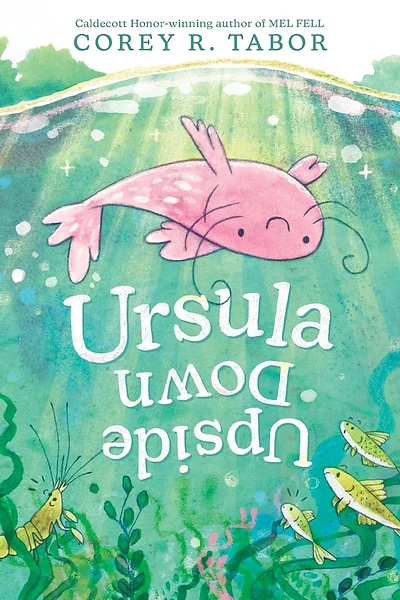
Ursula Down Upside
by Corey R. Tabor
Pacing MaterialA curious axolotl discovers the wonder of seeing the world from a different angle — upside down!
Big Idea
Looking at things from a new perspective can change how we understand the world.
Discussion Questions
- 1.What does Ursula see when she flips upside down?
- 2.Have you ever looked at something from a new angle?
- 3.Why is it important to be curious?
Classroom Activity
Upside-Down Observation Journal
Students flip their perspective by observing the classroom from a different angle and recording what they notice.
Lesson Plan
Learning Goals
- Practice careful observation
- Understand perspective
- Write descriptive sentences
Activity Steps
- 1.Read the story aloud
- 2.Students lie down or sit low to observe the room
- 3.Record three new things they notice
- 4.Share observations with the class
Standards Connections
- ELA: RL.K.1 — Ask and answer questions about key details
- ELA: RL.K.2 — Retell stories, including key details
- ELA: RL.K.3 — Describe characters, setting, and events
- ELA: RL.2.6 — Acknowledge differences in characters' points of view
- ELA: SL.K.1 — Participate in collaborative conversations about the text
- ELA: W.K.3 — Write narratives recounting events with descriptive details
- SEL: Social Awareness
- SEL: Relationship Skills
- Art: VA:Re7 — Perceive and analyze artistic work
Pace-Write-Read Study with Pace-Write It!
Focus question: How does changing the way we look at something change the story we tell about it? In Ursula Down Upside by Corey R. Tabor, a curious axolotl explores her world by turning upside down and noticing familiar things in a brand-new way. The pacing feels playful and thoughtful, slowing down for Ursula’s observations and discoveries, then moving quickly as readers turn pages to see each new upside-down surprise.
| Element | How to notice or teach it in the novel |
|---|---|
| Pace | Read: Notice how the story moves at a calm, curious pace as Ursula studies her surroundings, then speeds up a little when each new upside-down discovery appears. Classroom Activity: Write 3 short sentences about a character who changes how they look at one place, using one slow noticing sentence, one quick discovery sentence, and one reaction sentence. |
| Plot | Read: Notice the simple but satisfying plot: Ursula wonders, experiments by turning upside down, and discovers a new perspective on her underwater world. Classroom Activity: Draw and label a beginning-middle-end plot map for a character who solves a problem by looking at something in a different way. |
| Prosody | Read: Notice how the language invites expressive read-aloud, with moments that sound gentle, surprised, and delighted as Ursula explores. Classroom Activity: Write 4 read-aloud lines for a narrator describing one surprising discovery, and mark one word in each line to read with extra expression. |
| Word pause | Read: Notice where a reader might naturally pause before or after an important discovery Ursula makes, giving the surprise time to land. Classroom Activity: Write 2 sentences about seeing something familiar in a new way, and add a slash / where the reader should pause for effect. |
| Concept | Read: Notice that the big concept is perspective: Ursula learns that the same world can look different when you change your angle. Classroom Activity: Finish this frame: “When my character looked at _____ differently, they noticed _____.” Then add one more sentence telling why that mattered. |
| Voice & World View | Read: Notice the book’s warm, playful voice and the way Ursula’s curious worldview makes ordinary underwater details feel exciting. Classroom Activity: Write in the voice of a curious character who says what is interesting about one ordinary place. |
| Setting & Place | Read: Notice how the underwater setting shapes everything Ursula sees, from the floating feeling to the way objects and creatures appear from below. Classroom Activity: Write 3 setting details about a pond, tank, stream, or other watery place that a character could explore from a new angle. |
| Point of View | Read: Notice how the story centers Ursula’s experience so readers discover the upside-down world with her. Classroom Activity: Rewrite one small moment from the viewpoint of another underwater creature watching Ursula turn upside down. |
| Original Characters | Read: Notice how Ursula stands out as an original main character because she is an axolotl whose curiosity drives the story. Classroom Activity: Invent an animal character with one unusual habit that helps them discover something new. |
| Dialogue | Read: Notice how any spoken words or implied speech moments can help show wonder, confusion, or excitement without slowing the story too much. Classroom Activity: Write a short dialogue between Ursula and a friend about why looking upside down is interesting. |
| Details | Read: Notice the small visual and text details that help readers track what Ursula notices when the world shifts. Classroom Activity: Make a list of 5 tiny details a character could notice after changing their position, such as lying down, peeking under a table, or looking through water. |
| Descriptions | Read: Notice how descriptions help readers picture familiar things becoming unfamiliar when Ursula flips her view. Classroom Activity: Describe one classroom object from an upside-down view using at least 3 describing words. |
| Strong First Lines | Read: Notice how the opening quickly introduces Ursula and her curious way of seeing, inviting readers into the story right away. Classroom Activity: Write an opening line for a story about a character who explores the world in an unusual way. |
| Immediacy & Engagement | Read: Notice how readers feel close to Ursula’s discoveries because each moment focuses on what she is seeing and wondering right now. Classroom Activity: Write 3 present-tense sentences that make a reader feel they are discovering something alongside the character. |
| Story Scenes & Summaries & Unique Structures | Read: Notice how the book uses short scenes of observation and discovery rather than long explanations, creating a pattern of wonder. Classroom Activity: Plan a mini-book with 3 short scenes: normal view, changed view, and new understanding. |
| Flashback & Flash Forward & Cliffhangers | Read: Notice that this story mostly stays in the present, which keeps attention on Ursula’s immediate discoveries instead of jumping in time. Classroom Activity: Add a tiny cliffhanger ending to a page by writing: “Then my character saw something else...” and tell what readers would want to turn the page to see. |
| Tension & Suspense & Surprise | Read: Notice the gentle suspense as readers wonder what Ursula will notice next and the surprise when ordinary things look different upside down. Classroom Activity: Write 2 sentences that build suspense before a character makes a surprising discovery. |
| Page Turns and Chapter Breaks | Read: Notice how page turns can reveal each new upside-down image or idea, helping the pacing feel playful and surprising. Classroom Activity: Fold a paper into 4 pages and plan one page-turn surprise where the next page reveals the same object from a new angle. |
| Performance | Read: Notice how this book invites performance through body movement—readers can tilt their heads or pretend to turn like Ursula. Classroom Activity: Write 3 action lines for a partner read-aloud and add a motion students can do with each line. |
| Personality | Read: Notice how Ursula’s personality—curious, observant, and brave enough to try something unusual—drives the pacing of the whole story. Classroom Activity: Write a character card naming one personality trait that helps your character discover something new. |
| Humor | Read: Notice the gentle humor in the idea that simply turning upside down can make a whole world seem wonderfully different. Classroom Activity: Write a funny sentence about a character misunderstanding what they see because they are looking from a strange angle. |
| Pause | Read: Notice how the story creates quiet pause moments when Ursula studies what she sees before the next discovery. Classroom Activity: Write one sentence of action and one sentence of pause to show a character stopping to really look. |
| Poetry and Poetic Devices | Read: Notice the lyrical potential in repeated noticing and image-making as Ursula observes her watery world. Classroom Activity: Write a 3-line poem beginning with “Upside down, I see...” and include one simile. |
| Repetition | Read: Notice how repeated patterns of looking, noticing, and discovering help build rhythm and support young readers. Classroom Activity: Write 4 sentences that begin the same way, such as “Ursula saw...” or “From below...” to show repeated discoveries. |
| Rhythm | Read: Notice how the sentence lengths can create a gentle rhythm that matches floating underwater and sudden bursts of discovery. Classroom Activity: Write one long flowing sentence and one short surprising sentence about the same scene. |
| Punctuation | Read: Notice how punctuation can help show Ursula’s wonder, pauses, and excitement as her perspective changes. Classroom Activity: Write 3 sentences about a new discovery—one with a period, one with a question mark, and one with an exclamation mark. |
| Questions | Read: Notice how curiosity grows when readers and characters ask questions about what they are seeing. Classroom Activity: Write 3 questions Ursula might ask while exploring upside down, then answer one of them in a complete sentence. |
| Compare-Contrast | Read: Notice how the book naturally invites comparing the regular view and the upside-down view of the same world. Classroom Activity: Use this frame: “Right side up, I see ____. Upside down, I see ____.” Then add one sentence comparing the two. |
| Objects | Read: Notice how everyday objects or natural features become interesting when Ursula sees them from a different angle. Classroom Activity: Choose one object from the classroom and describe how it looks from above, below, and upside down. |
| Threes | Read: Notice how listing discoveries or details in groups of three can make the pacing feel complete and memorable. Classroom Activity: Write a sentence naming 3 things your character notices in a new view. |
| Whitespace & Negative Space | Read: Notice how open space in a picture book can slow readers down and help them focus on Ursula and what she notices. Classroom Activity: Make a sketch with lots of blank space around one important thing your character discovers, then write one sentence to match it. |
| Art & Graphics | Read: Notice how the illustrations are essential in showing perspective, helping readers understand Ursula’s upside-down discoveries even before reading all the words. Classroom Activity: Draw one scene twice—right side up and upside down—and write a caption for each version. |
| Interactives & Gamification | Read: Notice how this story invites playful interaction because readers can physically tilt their heads, turn the book, or predict what Ursula will notice next. Classroom Activity: Create a “Perspective Hunt” where students find 3 things in the room to sketch from an unusual angle and write one sentence about each. |
Pace-Write It!
20-Minute Classroom Flow Read (5 min): Read Ursula Down Upside by Corey R. Tabor aloud. Pause at key pages to let students notice how Ursula’s upside-down view changes what she sees. Notice (5 min): Ask: “What changed first—the world or Ursula’s point of view?” Chart student ideas under two headings: Right Side Up / Upside Down. Highlight how pacing slows when Ursula studies something and speeds up when a new discovery is revealed. Write (7 min): Students write a short perspective scene about a character looking at something in a new way. Writing frame: “My character is a ________. At first, they see ________. Then they look ________. Now they notice ________, ________, and ________. They feel ________ because ________.” Encourage students to include one question and one strong describing word. Share (3 min): Partners read their scenes aloud with expression. Listeners tell what detail helped them picture the new perspective. Exit ticket: Complete this sentence on a sticky note: “Changing perspective changes a story because ________.”