
 K-3
K-3P SAYRE
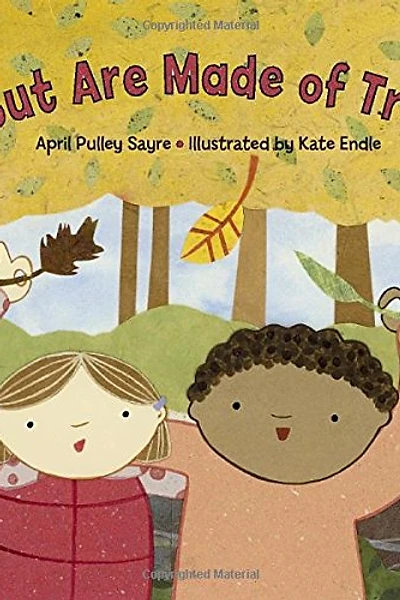
Trout Are Made of Trees
by April Pulley Sayre
Pacing MaterialDiscover the surprising connection between forest leaves, stream ecosystems, and the trout that swim in them — a lyrical exploration of how everything in nature is connected.
Big Idea
In nature, everything is connected — trees become streams, streams become fish, and fish become forests.
Discussion Questions
- 1.How do trees help trout? What is the connection between them?
- 2.What happens to leaves when they fall into a stream?
- 3.What other connections in nature did you notice in this book?
- 4.Why do you think the author chose this title?
- 5.How can we protect the connections in nature?
Classroom Activity
Nature Connection Chains
Students create paper chain links showing how different elements in an ecosystem are connected, based on the book's exploration of the tree-to-trout relationship.
Lesson Plan
Learning Goals
- Identify cause-and-effect relationships in ecosystems
- Understand the concept of interdependence in nature
- Observe and describe connections between living and non-living things
- Communicate scientific ideas through visual representation
Activity Steps
- 1.Read the book, pausing to chart each connection (leaves → stream → insects → trout).
- 2.Give students strips of paper to write or draw one element on each link.
- 3.Have students connect their links to form ecosystem chains.
- 4.Share chains and discuss what would happen if one link were removed.
- 5.Connect to a local ecosystem — what connections exist nearby?
Standards Connections
- ELA: RL.K.1 — Ask and answer questions about key details
- ELA: RL.K.2 — Retell stories, including key details
- ELA: RL.K.3 — Describe characters, setting, and events
- ELA: RL.3.6 — Acknowledge differences in characters' points of view
- ELA: SL.K.1 — Participate in collaborative conversations about the text
- ELA: W.K.3 — Write narratives recounting events with descriptive details
- SEL: Responsible Decision-Making
- Art: VA:Re7 — Perceive and analyze artistic work
Pace-Write-Read Study with Pace-Write It!
Focus question: How does an author slow down and speed up a nonfiction picture book to help us feel wonder and understand how everything in nature is connected? In Trout Are Made of Trees by April Pulley Sayre, readers follow the path from falling leaves in the forest to tiny stream life to trout in the water. The book uses lyrical language, short lines, page-by-page discoveries, and pauses created by illustrations and layout to pace ideas gently so readers can notice the ecosystem connection with awe.
| Element | How to notice or teach it in the novel |
|---|---|
| Pace | Read: Notice how Trout Are Made of Trees moves at a calm, observant pace as April Pulley Sayre traces the journey from leaves to stream life to trout, letting readers pause at each step in the ecosystem. Classroom Activity: Write 4 short lines that show a slow nature chain, such as seed to plant to bug to bird, using one idea per line. |
| Plot | Read: Notice that the book’s plot is a cause-and-effect sequence instead of a problem-and-solution story: trees drop leaves, leaves feed tiny organisms, and trout depend on that living system. Classroom Activity: Make a beginning-middle-end map for the ecosystem story and then write 3 sentences that tell how one event leads to the next. |
| Prosody | Read: Notice how the words in Trout Are Made of Trees sound musical when read aloud, with lines that invite readers to stress words like leaves, stream, and trout. Classroom Activity: Read one page aloud with a partner, clap the strong words, and then write 2 lines about nature that sound good when spoken aloud. |
| Word pause | Read: Notice how Sayre uses short phrases and line breaks to make readers pause and think about each part of the forest-stream-trout connection. Classroom Activity: Write a 3-line explanation of a nature process and place one important word alone on a line to create a pause. |
| Concept | Read: Notice that the big concept is interdependence—trout are connected to trees because an ecosystem links land, water, insects, and fish. Classroom Activity: Write one sentence that starts with “Everything is connected because…” and add 2 supporting details from the book. |
| Voice & World View | Read: Notice that the voice in Trout Are Made of Trees is full of wonder and respect for nature, showing a worldview that small things in an ecosystem matter. Classroom Activity: Write 3 sentences in a voice of wonder about something tiny in nature, such as moss, ants, or raindrops. |
| Setting & Place | Read: Notice the specific setting of forest and stream, where fallen leaves, moving water, underwater life, and trout create a real ecosystem place. Classroom Activity: Write a setting description of a local outdoor place using 4 details for what is above, on, and below the ground or water. |
| Point of View | Read: Notice that the book uses an outside narrator who guides readers through the ecosystem, helping us see the whole chain from tree to trout. Classroom Activity: Rewrite one part of the chain from the point of view of a leaf, an insect, or a trout using “I.” |
| Original Characters | Read: Notice that this nonfiction book does not center human characters; instead, leaves, stream insects, and trout become memorable living parts of the ecosystem story. Classroom Activity: Choose one nonhuman part of the book and write a short character card with “name,” “job in the ecosystem,” and “why I matter.” |
| Dialogue | Read: Notice that Trout Are Made of Trees does not rely on dialogue, which helps keep attention on images, facts, and flowing explanation. Classroom Activity: Add imagined dialogue between a leaf and a trout that teaches the ecosystem connection in 4 lines. |
| Details | Read: Notice the precise details about leaves breaking down, tiny organisms feeding, and trout living in streams, which make the science understandable and vivid. Classroom Activity: Write 3 exact details you learned from the book and use them in a short explanatory paragraph. |
| Descriptions | Read: Notice how April Pulley Sayre describes natural processes in ways that help readers picture movement, texture, and life in the stream. Classroom Activity: Describe one scene from the book—the falling leaves, the stream bed, or the trout—using at least 3 sensory details. |
| Strong First Lines | Read: Notice how the opening quickly sparks curiosity with the surprising idea that trout are connected to trees, making readers want to know how. Classroom Activity: Write your own surprising first line about nature, such as “Owls are made of grass” or “Bees are made of flowers,” and plan to explain it. |
| Immediacy & Engagement | Read: Notice how the book keeps readers engaged by revealing the ecosystem link step by step, so each page feels like a fresh discovery. Classroom Activity: Write 5 short sentences that reveal an idea one step at a time, saving the biggest connection for the last sentence. |
| Story Scenes & Summaries & Unique Structures | Read: Notice that the book mixes moment-by-moment scenes of nature with summarized explanation, creating a unique poetic nonfiction structure. Classroom Activity: Write one “scene” sentence showing something happening right now in nature and one “summary” sentence explaining why it matters. |
| Flashback & Flash Forward & Cliffhangers | Read: Notice that the book does not use flashbacks or cliffhangers in a dramatic way, but it does make readers look backward to fallen leaves and forward to the trout that depend on them. Classroom Activity: Write 2 sentences—one that looks back to where something came from and one that looks ahead to what it will become. |
| Tension & Suspense & Surprise | Read: Notice that the surprise in Trout Are Made of Trees comes from the unexpected scientific connection between trees and fish, not from danger or conflict. Classroom Activity: Write a “surprise connection” paragraph that begins with “You might think ___ and ___ have nothing to do with each other, but…” |
| Page Turns and Chapter Breaks | Read: Notice how page turns help pace the book by letting one part of the ecosystem be discovered before the next connection is revealed. Classroom Activity: Plan a 4-page mini-book about a nature cycle and decide what surprise or new fact will be revealed on each page turn. |
| Performance | Read: Notice that this book is strong for performance because the lyrical lines, pauses, and repeated natural ideas can be read slowly and expressively. Classroom Activity: Practice performing 3 lines from the book or your own writing, deciding where to slow down, pause, and emphasize words. |
| Personality | Read: Notice that the book’s personality is quiet, curious, and full of awe, matching the theme of wonder in ecosystems. Classroom Activity: Write a short nature paragraph in a calm, amazed personality, using words like notice, drift, shimmer, or beneath. |
| Humor | Read: Notice that Trout Are Made of Trees is not mainly humorous; its tone is thoughtful and wondrous, which fits its realistic nonfiction style. Classroom Activity: Write two versions of one nature sentence—one serious and wondrous like this book, and one silly—and compare which matches the topic better. |
| Pause | Read: Notice how readers naturally pause to study the illustrations and think between short sections, which deepens understanding of the tree-stream-trout relationship. Classroom Activity: Draft a 4-line piece and mark with slashes where a reader should pause to think. |
| Poetry and Poetic Devices | Read: Notice that April Pulley Sayre uses poetic nonfiction techniques such as imagery, short lines, and sound play to make ecosystem science feel beautiful. Classroom Activity: Write a 4-line poem explaining a science idea, using one image and one example of alliteration. |
| Repetition | Read: Notice how the central idea of connection repeats across the book, helping readers remember that trout depend on what trees give to the stream. Classroom Activity: Write 5 lines that repeat the same opening words, such as “Because of the trees…” to build an idea. |
| Rhythm | Read: Notice the gentle rhythm created by brief phrases and flowing ideas, which mirrors water moving through the stream habitat. Classroom Activity: Write 3 lines with a smooth rhythm about moving water, wind, or falling leaves, and read them aloud to test the flow. |
| Punctuation | Read: Notice how punctuation in Trout Are Made of Trees helps control pacing, telling readers when to stop, continue, or marvel at a new idea. Classroom Activity: Write one sentence about an ecosystem three ways—with a period, a dash, and an exclamation point—and discuss how the pacing changes. |
| Questions | Read: Notice that the book invites readers to ask how trout can possibly be “made of” trees, and that question drives attention through the text. Classroom Activity: Write 3 wonder questions about a habitat, using words like how, why, and what if. |
| Compare-Contrast | Read: Notice how the book connects two things that seem different—forest leaves above water and trout below water—and shows their relationship. Classroom Activity: Create a compare-contrast chart for tree and trout, then write 2 sentences explaining how they are different and how they are connected. |
| Objects | Read: Notice how simple natural objects—leaves, rocks, water, insects—carry big meaning in the book because they are part of the ecosystem chain. Classroom Activity: Pick one object from nature and write 3 sentences explaining its job in helping another living thing survive. |
| Threes | Read: Notice places where ideas can be grouped in threes, such as tree, stream, trout, to make the connection memorable and well paced. Classroom Activity: Write a sentence or short poem that uses a pattern of three connected nature words. |
| Whitespace & Negative Space | Read: Notice how space on the page gives readers time to breathe, look closely, and absorb the book’s quiet scientific wonder. Classroom Activity: Write a short poem with only 4 lines and leave space between ideas so each line stands out. |
| Art & Graphics | Read: Notice how the photographs and visual layout help explain the realistic ecosystem, showing details of leaves, water, and trout that support the text’s pacing. Classroom Activity: Sketch a simple labeled diagram of the tree-to-trout chain and write a caption for each part. |
| Interactives & Gamification | Read: Notice that while the book itself is not a game, its chain of connections invites readers to trace and match how one part of nature affects another. Classroom Activity: Create a card-matching game with parts of the ecosystem from the book—tree, leaf, insect, stream, trout—and write one sentence for each match explaining the connection. |
Pace-Write It!
20-Minute Classroom Flow Read (5 min): Read Trout Are Made of Trees by April Pulley Sayre aloud. Pause at key pages showing leaves falling, tiny stream life feeding, and trout swimming. Ask students to listen for how the author helps us discover one connection at a time. Notice (5 min): Chart what students notice about pacing: short lines, page turns, repetition of ideas, quiet pauses, and surprising connections between trees and trout. Discuss how the book feels calm and wondrous instead of fast and dramatic. Write (7 min): Students write their own short ecosystem piece that reveals a surprising connection step by step. Writing frame: “You might think ___ and ___ are far apart. But first, ___. Then, ___. Next, ___. That is why ___ needs ___.” Encourage students to use short lines or sentences to slow the reader down. Share (3 min): Students read their pieces aloud to a partner or the class, practicing expressive pacing by pausing after each step in the chain. Exit ticket: Write one sentence answering: “How did April Pulley Sayre’s pacing help you understand that everything in nature is connected?”