 K-2
K-2P NARWHAL
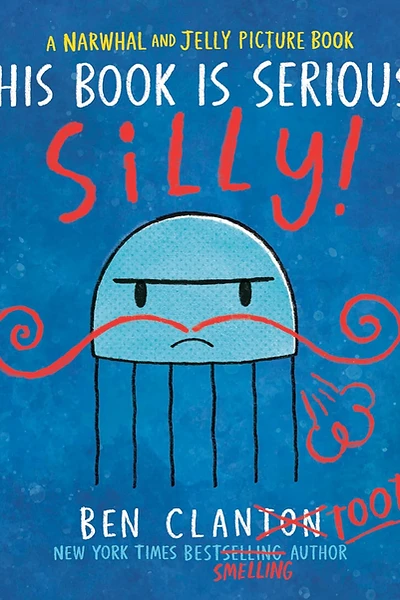
This Book Is Seriously Silly
by Ben Clanton
Pacing MaterialNarwhal and Jelly return in this hilarious metafictional romp that plays with the very idea of what a book can be. The characters interact directly with the reader, creating moments of pure absurdity and joy through broken fourth-wall antics.
Big Idea
Reading is an active and playful experience that encourages creative engagement beyond just decoding words.
Discussion Questions
- 1.How do you know Narwhal and Jelly are talking to you?
- 2.What made you laugh the most while reading this?
- 3.Why is it fun for characters to break the rules of a book?
- 4.If you could talk to a book character, what would you ask?
- 5.How does the author use the pictures to make the story sillier?
Classroom Activity
Interactive Story Workshop
Students will collaborate to create a short, interactive comic strip where characters break the fourth wall to talk to the audience.
Lesson Plan
Learning Goals
- Identify the characteristics of metafiction
- Demonstrate understanding of interactive storytelling
- Practice creative writing with humor
Activity Steps
- 1.Brainstorm silly scenarios where a character needs help from the reader
- 2.Draft a short script featuring a main character and an interactive element
- 3.Draw the characters leaving speech bubbles open for the reader
- 4.Add 'reader response' sections to the story pages
- 5.Share the comic with a partner to see if they follow the interactive instructions
Standards Connections
- CCSS.ELA-LITERACY.RL.K.1
- SEL.1.1 Self-awareness
- VA.K.CR1.1
Pace-Write-Read Study with Pace-Write It!
Focus question: How does an author make a silly story feel fast, funny, and full of surprises? In This Book Is Seriously Silly by Ben Clanton, Narwhal and Jelly bounce through a playful story that talks directly to the reader and keeps changing what might happen next. The pacing feels lively because the book uses quick dialogue, page-turn surprises, repeated jokes, and metafictional interruptions to create joy, anticipation, and laughter.
| Element | How to notice or teach it in the novel |
|---|---|
| Pace | Read: Notice how This Book Is Seriously Silly moves quickly with short bursts of action, talk, and surprise as Narwhal and Jelly react to the book itself. Classroom Activity: Write 3 very short sentences and 1 longer sentence about a silly problem a character has, using the short sentences to speed the moment up. |
| Plot | Read: Notice that the plot is built around playful interruptions and the funny idea that Narwhal and Jelly know they are inside a book. Classroom Activity: Write a beginning, middle, and end for a silly metafiction story where a character realizes the page is controlling what happens. |
| Prosody | Read: Listen to how the words sound when Narwhal and Jelly speak with excitement, confusion, and delight; the read-aloud flow helps the jokes land. Classroom Activity: Write 4 lines of dialogue for two characters and read them aloud to make one line sound surprised, one line sound whispery, and one line sound extra excited. |
| Word pause | Read: Notice where Ben Clanton uses single words, line breaks, or a sudden stop so the reader pauses before the next joke. Classroom Activity: Write a silly moment that ends with a one-word line to make readers stop and wait for the punch line. |
| Concept | Read: Notice the big idea that a book can be playful, talk back, and become part of the joke while still celebrating friendship and joy. Classroom Activity: Write 2 sentences explaining a new silly book rule, such as 'In this book, the pictures keep changing the story.' |
| Voice & World View | Read: Notice the cheerful, goofy, welcoming voice that makes everything feel playful and safe, even when the story gets absurd. Classroom Activity: Write a short narration in a happy, silly voice that invites the reader to join your character’s joke. |
| Setting & Place | Read: Notice how the setting is not just underwater with Narwhal and Jelly, but also the book world itself, where pages and reading become part of the setting. Classroom Activity: Write about a place that is both a regular setting and a book-setting, like a classroom inside a storybook. |
| Point of View | Read: Notice how the story feels close to Narwhal and Jelly but also reaches out to the reader, making the reader feel like part of the action. Classroom Activity: Write 3 sentences in which a character speaks to 'you' and pulls the reader into the story. |
| Original Characters | Read: Notice how Narwhal’s bubbly silliness and Jelly’s thoughtful reactions make their friendship funny and memorable. Classroom Activity: Invent two sea-creature friends with opposite personalities and write how their differences create one silly scene. |
| Dialogue | Read: Notice how much of the humor comes through quick back-and-forth dialogue between Narwhal and Jelly. Classroom Activity: Write a 6-line dialogue where one character has a wild idea and the other character responds with questions. |
| Details | Read: Notice the small funny details that make scenes pop, especially when Narwhal and Jelly react to strange things happening in the book. Classroom Activity: Add 3 tiny silly details to a scene, such as a wobbling hat, a squeaky bubble, or a page that seems to wiggle. |
| Descriptions | Read: Notice that the descriptions stay simple and playful so the story never slows down too much. Classroom Activity: Describe a ridiculous object in 2 sentences using clear, funny details children can picture right away. |
| Strong First Lines | Read: Notice how the opening quickly signals that this is not an ordinary book and prepares readers for humor and surprise. Classroom Activity: Write an opening line for a silly story that tells readers right away something strange is happening in the book. |
| Immediacy & Engagement | Read: Notice how the book grabs attention by directly involving the reader in Narwhal and Jelly’s silly experience. Classroom Activity: Write 3 lines that begin with commands or invitations like 'Look,' 'Wait,' or 'Turn the page if you dare!'. |
| Story Scenes & Summaries & Unique Structures | Read: Notice how the book leans on short scenes, comic timing, and unusual metafictional structure instead of long summaries. Classroom Activity: Plan a story in 3 tiny scenes on separate lines, each with one funny event that changes the page. |
| Flashback & Flash Forward & Cliffhangers | Read: Notice that even in a playful picture book, suspense can build when a page ends before the next silly reveal. Classroom Activity: End your scene with a cliffhanger line such as 'But then the book did something even stranger...'. |
| Tension & Suspense & Surprise | Read: Notice how the tension stays light and funny as readers wonder what absurd thing will happen next to Narwhal and Jelly. Classroom Activity: Write a surprise ending to a scene where the problem is solved in the silliest possible way. |
| Page Turns and Chapter Breaks | Read: Notice how page turns help deliver jokes, especially when the setup happens first and the funny reveal comes after the turn. Classroom Activity: Fold a paper into 2 parts and write the setup on one side and the surprise on the other side. |
| Performance | Read: Notice how this story almost begs to be performed with dramatic pauses, silly voices, and expressive faces for Narwhal and Jelly. Classroom Activity: Mark your dialogue with performance notes like [gasp], [whisper], or [shout] and practice reading it aloud. |
| Personality | Read: Notice how Narwhal’s playful energy and Jelly’s calmer thinking shape the speed and humor of the story. Classroom Activity: Write 2 speech bubbles for a super-silly character and 2 for a careful character reacting to the same event. |
| Humor | Read: Notice how the humor comes from absurdity, surprise, friendliness, and the joke that the book knows it is a book. Classroom Activity: Write a joke scene where the page, picture, or words cause the funny problem. |
| Pause | Read: Notice how pauses make the funny moments bigger by giving readers a beat to think before laughing. Classroom Activity: Add an ellipsis or line break in one place in your writing to create a dramatic silly pause. |
| Poetry and Poetic Devices | Read: Notice that even in prose, playful sounds and repeated phrasing can make Narwhal and Jelly’s world feel musical. Classroom Activity: Write a 3-line silly chant for Narwhal and Jelly using rhyme or alliteration. |
| Repetition | Read: Notice how repeating words, ideas, or reactions helps build humor and lets young readers join in. Classroom Activity: Choose one funny phrase and repeat it 3 times in your scene, changing the meaning a little each time. |
| Rhythm | Read: Notice the bouncy rhythm created by short dialogue turns, quick reactions, and playful text placement. Classroom Activity: Write a scene with alternating short and long sentences to make it sound lively like a read-aloud. |
| Punctuation | Read: Notice how question marks, exclamation points, and dots help show Narwhal and Jelly’s surprise, excitement, and pauses. Classroom Activity: Rewrite one plain sentence 3 ways using different punctuation to change the feeling. |
| Questions | Read: Notice how characters and text may ask questions that pull the reader deeper into the silly game of the story. Classroom Activity: Write 3 questions a character might ask the reader during a strange book moment. |
| Compare-Contrast | Read: Notice the contrast between Narwhal’s carefree silliness and Jelly’s more grounded responses, and how that contrast creates comedy. Classroom Activity: Make a T-chart comparing how two characters react to the same silly problem, then write 2 sentences using those differences. |
| Objects | Read: Notice how objects in a humorous metafiction book can become part of the joke, especially when story parts feel alive or interactive. Classroom Activity: Invent one magical silly object, like a giggle page or a bouncing bookmark, and write what it does. |
| Threes | Read: Notice how comedy often gets stronger when something happens three times, with the third time being the funniest. Classroom Activity: Write a rule-of-three scene where a character tries something silly three times and the last try has the biggest surprise. |
| Whitespace & Negative Space | Read: Notice how open space on the page can slow the reader down, spotlight a joke, or make a character’s reaction stand out. Classroom Activity: Create a mini page layout leaving blank space around one important funny line. |
| Art & Graphics | Read: Notice how the illustrations and graphic-style layout work with the words so Narwhal and Jelly’s expressions and timing become funnier. Classroom Activity: Draw one panel or page for your scene and add one caption or speech bubble that depends on the picture to be funny. |
| Interactives & Gamification | Read: Notice how This Book Is Seriously Silly invites the reader into the joke, almost like a game where turning pages and responding are part of the fun. Classroom Activity: Write an interactive page that tells the reader to do something silly, such as clap, guess, or turn the page carefully. |
Pace-Write It!
20-Minute Classroom Flow\n\nRead (5 min): Read aloud a lively section of This Book Is Seriously Silly by Ben Clanton. Pause to let students hear Narwhal and Jelly’s quick dialogue, the direct talk to the reader, and the surprise of the page turns.\n\nNotice (5 min): Ask: 'Where did the book speed up? Where did it pause before a joke?' Chart student observations under these headings: short dialogue, repeated words, punctuation, page-turn surprise, talking to the reader.\n\nWrite (7 min): Students write their own mini silly metafiction scene. Encourage them to make the reader part of the story and to use one pause and one surprise. Writing frame: 'This book was supposed to be about ____. But then ____ said, "____!" I looked at the page and noticed ____. "Wait..." said ____. Dear reader, can you ____? When you turn the page, ____!'\n\nShare (3 min): Students read their favorite line to a partner or the class using a dramatic voice. Listeners identify one pacing move they heard, such as repetition, pause, or surprise.\n\nExit ticket: Write one sentence answering: 'How did I make my silly story move fast or pause for a joke?'