 1-4
1-4P PATTON
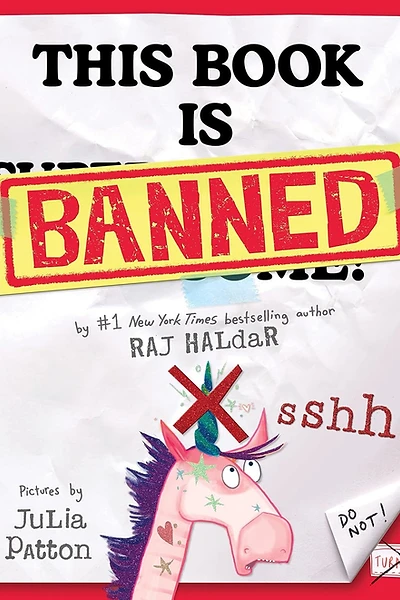
This Book Is Banned
by Raj Haldar, pictures by Julia Patton
Pacing MaterialA hilarious, thought-provoking picture book where the narrator bans things for increasingly absurd reasons, leading readers to question who gets to decide what's allowed.
Big Idea
Banning things often starts with silly reasons but can grow into something serious — critical thinking means asking who decides and why.
Discussion Questions
- 1.What does it mean for a book to be banned?
- 2.Why did the narrator start banning things? Was it a good reason?
- 3.Who should decide what people can read?
- 4.Can you think of a time a rule didn't make sense?
Classroom Activity
Ban or Keep Debate
Students hold a 'ban or keep' debate: in groups, they pick a familiar classroom item (a book, a toy, a game) and argue whether it should be banned, then the class votes.
Lesson Plan
Learning Goals
- Define censorship in simple terms.
- Distinguish between rules that protect and rules that limit.
- Construct an argument for or against banning something.
- Practice respectful disagreement in a debate.
Activity Steps
- 1.Read the book, noting the absurd reasons things get banned.
- 2.Introduce the concept of censorship in age-appropriate terms.
- 3.Groups pick an item and prepare arguments for and against banning it.
- 4.Hold a class debate and vote.
- 5.Reflect on who decides what's 'allowed.'
Standards Connections
- ELA: RL.1.1 — Ask and answer questions about key details
- ELA: RL.1.2 — Retell stories, including key details
- ELA: RL.1.3 — Describe characters, setting, and events
- ELA: RL.4.6 — Acknowledge differences in characters' points of view
- ELA: SL.1.1 — Participate in collaborative conversations about the text
- ELA: W.1.3 — Write narratives recounting events with descriptive details
- SEL: Social Awareness
- SEL: Relationship Skills
- Art: VA:Re7 — Perceive and analyze artistic work
Pace-Write-Read Study with Pace-Write It!
Focus question: How does an author speed up and slow down a story to help readers question what is fair? In This Book Is Banned by Raj Haldar, with pictures by Julia Patton, a playful narrator keeps banning more and more things for sillier and sillier reasons. The pacing moves quickly through surprising claims, pauses for readers to think, and uses page turns and illustrations to build humor while inviting children to question who gets to make the rules.
| Element | How to notice or teach it in the novel |
|---|---|
| Pace | Read: Notice how This Book Is Banned starts with a bold idea and then quickly piles on more bans, making the story feel faster and more ridiculous as the narrator's rules grow. Classroom Activity: Write 4 short sentences that begin with one rule and then speed up by adding three more increasingly silly rules. |
| Plot | Read: Notice that the plot grows from one banning idea into a bigger conflict about fairness, choice, and who decides what is allowed. Classroom Activity: Write a beginning-middle-end plan for a mini story in which a character bans something ordinary and then learns that the rule is unfair. |
| Prosody | Read: Listen to the way the narrator's words sound bossy, dramatic, and playful when read aloud, which helps the book's jokes land. Classroom Activity: Write 3 read-aloud lines for a pretend narrator who says a rule in a dramatic voice, and mark which words should be stressed. |
| Word pause | Read: Notice places where a single strong word or short phrase makes readers stop and think about the absurd logic in the bans. Classroom Activity: Write a sentence about banning something, then add a one-word line underneath for emphasis, such as 'Really?' or 'Banished!' |
| Concept | Read: Notice that the big concept is not just banning books, but thinking critically about power, rules, and freedom to choose. Classroom Activity: Write 2 sentences explaining what lesson This Book Is Banned teaches about making decisions for other people. |
| Voice & World View | Read: Notice how the narrator's confident, controlling voice shows a world view where one person thinks they should decide everything, which the book invites readers to challenge. Classroom Activity: Write a short paragraph in a bossy narrator voice that reveals how your speaker thinks everyone should follow their opinion. |
| Setting & Place | Read: Notice that even without a single detailed realistic setting, the book creates a world of rules and restrictions through the narrator's declarations and Julia Patton's playful illustrations. Classroom Activity: Write 3 sentences that create a place where too many rules exist, such as a classroom, playground, or library. |
| Point of View | Read: Notice that the story is driven by the narrator's point of view, and readers must decide whether to trust that perspective. Classroom Activity: Rewrite one banning statement from the point of view of a child who disagrees with the narrator. |
| Original Characters | Read: Notice that the narrator becomes a memorable character through attitude, not just appearance, and the readers almost become characters too because the book talks to them. Classroom Activity: Invent an original rule-maker character and list 3 traits that make that character funny and frustrating. |
| Dialogue | Read: Notice how the book's direct address can feel like a conversation between the narrator and the reader, even when quotation marks are not the main feature. Classroom Activity: Write a 4-line dialogue between the narrator of This Book Is Banned and a child who asks, 'Who made that rule?' |
| Details | Read: Notice the specific examples of what gets banned and the reasons given, because those details make the argument seem serious at first and silly later. Classroom Activity: Write a list of 5 detailed things a pretend narrator might ban, each with a tiny reason. |
| Descriptions | Read: Notice how the descriptions of banned things and the reactions around them help build the book's absurd, funny tone. Classroom Activity: Describe one ordinary object as if a dramatic narrator thinks it is extremely dangerous or unacceptable. |
| Strong First Lines | Read: Notice how the opening immediately grabs attention by making a bold statement that sparks curiosity and disagreement. Classroom Activity: Write 3 different first lines for a story that begins with a surprising rule. |
| Immediacy & Engagement | Read: Notice how the book pulls readers in right away by making them feel talked to and challenged, as if the narrator expects them to react. Classroom Activity: Write 2 sentences that directly address the reader and make them want to answer back. |
| Story Scenes & Summaries & Unique Structures | Read: Notice that the book uses a repeated claim-and-example structure instead of a long traditional scene, which keeps the reading brisk and focused on the idea. Classroom Activity: Create a 5-part pattern for your own piece: rule, reason, example, reaction, lesson. |
| Flashback & Flash Forward & Cliffhangers | Read: Notice that this picture book mostly stays in the present argument, but page-by-page reveals can act like mini cliffhangers because readers wonder what the narrator will ban next. Classroom Activity: Write 3 lines ending each one with a cliffhanger phrase such as 'But then the rule got bigger...' |
| Tension & Suspense & Surprise | Read: Notice the tension between the narrator's authority and the reader's common sense, and how surprise grows as the bans become more absurd. Classroom Activity: Write a short paragraph in which a rule starts normal but ends with a surprising twist that shows the rule makes no sense. |
| Page Turns and Chapter Breaks | Read: Notice how page turns in This Book Is Banned can set up a claim on one page and deliver the funny or surprising follow-up on the next page. Classroom Activity: Fold paper into 2 pages and write a setup line on page 1 and a surprise reveal on page 2. |
| Performance | Read: Notice how this book invites expressive reading with dramatic pauses, louder rule words, and a mock-serious tone. Classroom Activity: Mark up 4 lines from your own writing with arrows or symbols to show where to pause, whisper, or sound bossy. |
| Personality | Read: Notice that the narrator's big personality drives the pacing because every new opinion feels strong, stubborn, and exaggerated. Classroom Activity: Write a character sketch of a rule-making narrator with 3 personality traits and 1 favorite phrase. |
| Humor | Read: Notice that humor comes from exaggeration, silly logic, and the growing mismatch between what is being banned and what should be fair. Classroom Activity: Write 3 humorous banning reasons for harmless things like socks, crayons, or sandwiches. |
| Pause | Read: Notice the moments where readers naturally pause to think, laugh, or disagree with the narrator's logic. Classroom Activity: Write a short passage and add slash marks to show 3 places where a reader should pause for effect. |
| Poetry and Poetic Devices | Read: Notice how sound play, repeated phrasing, and compact lines can make parts of the book feel almost poetic even inside a prose picture book. Classroom Activity: Write a 4-line chant about a silly ban using alliteration or rhyme. |
| Repetition | Read: Notice how repeated banning language creates rhythm and helps the joke build each time the narrator adds another rule. Classroom Activity: Write 5 lines that all begin with 'No more...' to create repetition with a growing effect. |
| Rhythm | Read: Notice the pattern of statement, reaction, and escalation that gives the book a steady rhythm as the argument rolls forward. Classroom Activity: Clap out a pattern and then write 4 sentences that match that quick, repeating rhythm. |
| Punctuation | Read: Notice how punctuation such as exclamation points, commas, and question marks can shape the bossy, surprised, and playful sound of the narrator. Classroom Activity: Write the same banning sentence 3 ways using different punctuation to change the feeling. |
| Questions | Read: Notice that the book encourages readers to ask questions about authority, fairness, and why someone would ban things in the first place. Classroom Activity: Write 4 questions a child reader might ask the narrator of This Book Is Banned. |
| Compare-Contrast | Read: Notice the contrast between what the narrator says should be banned and what readers probably believe should be allowed. Classroom Activity: Make a T-chart comparing the narrator's rule with your own opinion, then write 2 compare-contrast sentences. |
| Objects | Read: Notice how everyday objects and activities become important because the narrator treats them as if they are worth banning. Classroom Activity: Choose one ordinary object and write 3 sentences showing how it becomes the center of a silly argument. |
| Threes | Read: Notice how groups of three examples or reasons can make ideas sound funnier and more complete in a picture book like this one. Classroom Activity: Write a set of 3 banning reasons that grow from sensible to ridiculous. |
| Whitespace & Negative Space | Read: Notice how space on the page can slow readers down, spotlight a bold statement, and let the joke or idea breathe in a picture book by Raj Haldar and Julia Patton. Classroom Activity: Write one short line in large space on a page, then explain why leaving room around it makes it stronger. |
| Art & Graphics | Read: Notice how Julia Patton's illustrations help pace the story by adding visual jokes, reactions, and clues that may deepen or challenge the narrator's words. Classroom Activity: Draw a quick sketch to go with a banning sentence and add one visual detail that makes the sentence funnier or more thoughtful. |
| Interactives & Gamification | Read: Notice how the book invites readers to mentally argue back, predict the next ban, and decide for themselves what is fair, making the reading feel interactive. Classroom Activity: Create a class game called 'Ban or Not?' where you write 4 items and classmates vote, then explain their thinking in one sentence each. |
Pace-Write It!
20-Minute Classroom Flow\nRead (5 min): Read This Book Is Banned aloud with dramatic expression. Pause at key moments to let students react when the narrator gives increasingly absurd reasons for banning things.\nNotice (5 min): Ask: How did the pacing speed up as the bans piled up? How did Raj Haldar's narrator voice and Julia Patton's illustrations make you laugh and think at the same time? Chart what students notice: repetition, page turns, bold opinions, pauses, and surprise.\nWrite (7 min): Students write their own short 'banning' piece that begins seriously and becomes silly, then ends with a lesson or question about fairness. Writing frame: '___ is banned. Why? Because ___. And if ___ is banned, then ___ should be banned too. And if that is banned, then ___! Wait... who gets to decide ___?' Encourage students to use repetition and one dramatic page-turn-style surprise.\nShare (3 min): Partners read their pieces aloud in a mock-serious narrator voice. Listeners identify one place where the pacing sped up and one place where the writer used a strong pause.\nExit ticket: Write one sentence answering: How did pacing help This Book Is Banned make its message about fairness and critical thinking stronger?