
 1-4
1-4P HEAVENRICH
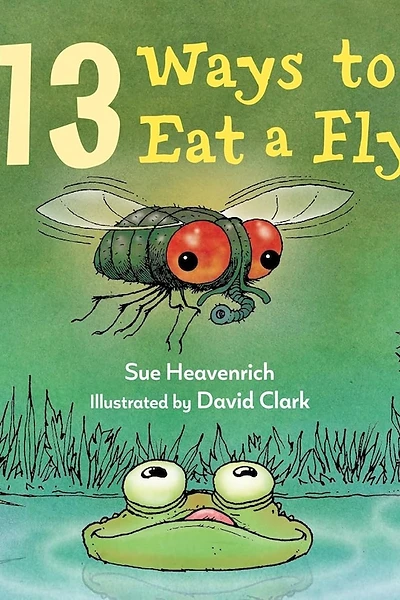
13 Ways to Eat a Fly
by Sue Heavenrich
Pacing MaterialA counting book with a twist — thirteen predators and the surprising ways they catch and eat flies.
Big Idea
Even the smallest creatures play a role in the food web, and there is wonder in paying attention to tiny things.
Discussion Questions
- 1.Which fly-eater was most surprising to you?
- 2.How does counting help tell this story?
- 3.What is a food web, and where do flies fit in?
- 4.Why do small creatures matter?
Classroom Activity
Food Web Map
Draw a food web showing flies, three predators from the book, and what eats them. Add arrows to show the flow of energy.
Lesson Plan
Learning Goals
- Explain what a food web is and where flies fit in it
- Identify three predators from the book and how they catch flies
- Draw a food web with arrows showing the flow of energy
Activity Steps
- 1.Read the story, counting each predator and how it catches flies.
- 2.Discuss: 'What is a food web? Why do even small creatures matter?'
- 3.Model drawing a food web: flies in the center, predators around them, arrows showing energy flow.
- 4.Students draw their own food web with at least three predators from the book.
- 5.Share webs and add one more predator or prey to a class web.
Standards Connections
- ELA: RL.1.1 — Ask and answer questions about key details
- ELA: RL.1.2 — Retell stories, including key details
- ELA: RL.1.3 — Describe characters, setting, and events
- ELA: RL.4.6 — Acknowledge differences in characters' points of view
- ELA: SL.1.1 — Participate in collaborative conversations about the text
- ELA: W.1.3 — Write narratives recounting events with descriptive details
- SEL: Social Awareness
- SEL: Relationship Skills
- Art: VA:Re7 — Perceive and analyze artistic work
Pace-Write-Read Study with Pace-Write It!
Focus question: How does an author make a small creature like a fly feel important and exciting across many short pages? In 13 Ways to Eat a Fly by Sue Heavenrich, each page reveals a new predator and a new way the fly might be caught, turning a simple counting book into a fast, surprising sequence. The pacing moves quickly through short bursts of action, page turns, and repeated structure, while building suspense about what will happen to the fly next.
| Element | How to notice or teach it in the novel |
|---|---|
| Pace | Read: Notice how 13 Ways to Eat a Fly moves in quick steps from one predator to the next, so the fly is always in danger and the reader keeps going. Classroom Activity: Write a 5-page mini counting book called 5 Ways to Catch a Bug, using one fast action on each page. |
| Plot | Read: Notice that the plot is simple but strong: a fly moves through the world while predators such as frogs, birds, and other creatures try to catch and eat it in different ways. Classroom Activity: Make a beginning-middle-end plot map showing how the fly’s danger grows across the book, then write your own short predator-and-prey plot. |
| Prosody | Read: Listen to how the words in 13 Ways to Eat a Fly sound when read aloud, especially the lively, snappy lines that match sudden movements like snapping, darting, or gulping. Classroom Activity: Choose one page and practice reading it aloud in a voice that matches the predator’s movement, then write 3 lines meant to be read dramatically. |
| Word pause | Read: Notice where short phrases and line breaks make you slow down right before the fly is caught, creating a tiny pause before the action lands. Classroom Activity: Write 4 sentences about an animal hunting, adding a pause with a dash or line break before the final action word. |
| Concept | Read: Notice how Sue Heavenrich combines counting with animal behavior, showing that something as small as a fly matters in a food web full of predators. Classroom Activity: Write a nonfiction-inspired fiction page that teaches one true fact about an animal while telling a tiny story. |
| Voice & World View | Read: Notice the playful, curious voice that treats the fly and each predator as worth noticing, helping readers appreciate small creatures instead of ignoring them. Classroom Activity: Write 5 sentences in a curious, nature-loving voice about a tiny animal most people overlook. |
| Setting & Place | Read: Notice how the settings shift through natural places where predators might find a fly, making the world feel full of hidden action. Classroom Activity: Draw and label one outdoor setting from the book’s world, then write 3 sentences showing how that place helps a predator hunt. |
| Point of View | Read: Notice that the book tells the action from an outside point of view, letting readers watch the fly and the predators from a broad perspective. Classroom Activity: Rewrite one page from the fly’s point of view, starting with “I buzzed…”. |
| Original Characters | Read: Notice that even though the characters are animals, each predator feels distinct because it catches the fly in its own special way. Classroom Activity: Invent an original predator character and write how it would become number 14 in the book. |
| Dialogue | Read: Notice that the book relies more on action and structure than on dialogue, which keeps the pacing brisk and focused on the chase. Classroom Activity: Add 2 speech bubbles to one predator scene, giving the fly and the predator each one line of dialogue. |
| Details | Read: Notice the specific details about how each predator catches a fly, which make the book interesting instead of repetitive. Classroom Activity: Write a sentence that tells exactly how one animal catches food, using at least 2 specific action details. |
| Descriptions | Read: Notice how the descriptions are short but vivid, helping readers picture quick movements and surprising eating methods. Classroom Activity: Describe a bug in 3 strong sentences so readers can clearly see it and imagine its movement. |
| Strong First Lines | Read: Notice how the opening quickly sets up the counting idea and the fly’s problem, pulling readers right into the pattern of danger. Classroom Activity: Write 3 different first lines for a bug story that begin with action or trouble. |
| Immediacy & Engagement | Read: Notice how each new predator creates an immediate problem for the fly, making readers want to turn the page right away. Classroom Activity: Write 4 short sentences that each begin with a new danger, such as “Then…” or “Suddenly…”. |
| Story Scenes & Summaries & Unique Structures | Read: Notice how the book uses a repeated counting structure instead of a long traditional story scene, and each page works like a tiny episode. Classroom Activity: Create a 6-box storyboard in which each box is one small scene in a repeated pattern. |
| Flashback & Flash Forward & Cliffhangers | Read: Notice that the book stays in the present action, but the page turns work almost like little cliffhangers because readers wonder what predator comes next. Classroom Activity: End 3 short pages of your own animal book with a cliffhanger question such as “But was the bug safe?”. |
| Tension & Suspense & Surprise | Read: Notice how tension grows because the fly keeps escaping one danger only to meet another, and surprise comes from the unusual predators and methods. Classroom Activity: Write a suspenseful 5-sentence scene in which a tiny creature escapes one problem and meets a bigger one. |
| Page Turns and Chapter Breaks | Read: Notice how page turns in 13 Ways to Eat a Fly help reveal each new predator, making the next number feel like a surprise. Classroom Activity: Fold paper into 4 pages and plan what secret or new danger will be revealed only after each page turn. |
| Performance | Read: Notice how this book invites performance with counting, dramatic pauses, and expressive reading for each predator’s attack. Classroom Activity: Practice performing one page with a partner, then write stage directions like “pause,” “whisper,” or “snap” beside your own lines. |
| Personality | Read: Notice how the predators show personality through their hunting styles, even without long character descriptions. Classroom Activity: Pick one predator type and write 4 sentences showing its personality through action only. |
| Humor | Read: Notice the humor in the twist on an ordinary counting book, where instead of counting toys or animals, readers count ways to eat a fly. Classroom Activity: Write a funny counting-book idea with a surprising topic, such as ways to lose a sandwich or ways a squirrel steals snacks. |
| Pause | Read: Notice how the book creates pauses before the moment of capture, giving readers a second to predict what will happen. Classroom Activity: Write 3 lines about a chase and place the word “pause” in your draft where you want listeners to stop and feel suspense. |
| Poetry and Poetic Devices | Read: Notice how the repeated structure, sound play, and short lines give parts of 13 Ways to Eat a Fly a poetic feel. Classroom Activity: Write a 4-line poem about a buzzing fly using alliteration, such as “busy buzzing bug”. |
| Repetition | Read: Notice how repetition of the counting pattern helps readers predict the structure while enjoying each new twist. Classroom Activity: Write a repeated sentence frame for your own book, such as “That is one way to catch a…” and use it 4 times. |
| Rhythm | Read: Notice the rhythm created by short phrases, repeated patterns, and quick action words that keep the book moving. Classroom Activity: Clap the rhythm of one page, then write 2 new rhythmic lines about an animal hunt. |
| Punctuation | Read: Notice how punctuation helps control speed in this book—commas can slow readers a little, while exclamation points can sharpen surprise. Classroom Activity: Rewrite one plain sentence about a bug in 3 ways using different punctuation to change the pacing. |
| Questions | Read: Notice the questions readers naturally ask: Which predator is next? Will the fly escape? How many ways are left? Classroom Activity: Write 3 reader questions that could make someone want to keep reading your own animal story. |
| Compare-Contrast | Read: Notice how each predator is similar because each wants the fly, but different in body, strategy, and speed. Classroom Activity: Complete a compare-contrast chart for 2 predators from the book, then write 2 sentences using “both” and “but”. |
| Objects | Read: Notice the importance of small objects and body tools—tongues, beaks, webs, or other catching parts—that help predators trap the fly. Classroom Activity: Choose one important object or body part from a predator and write 3 sentences explaining how it helps in the hunt. |
| Threes | Read: Notice how readers can group details in threes to make retelling easier, such as three predators, three ways of catching, or three surprising moments. Classroom Activity: Write a set of 3 action words for one predator, then build a sentence using all three. |
| Whitespace & Negative Space | Read: Notice how picture books like 13 Ways to Eat a Fly use open space on the page so the eye can focus on the fly, the predator, and the moment of action. Classroom Activity: Design one picture-book page with only 1 sentence and a sketch plan showing where the blank space will help the action stand out. |
| Art & Graphics | Read: Notice how the illustrations support pacing by showing size, motion, and the danger facing the tiny fly from each predator. Classroom Activity: Draw a mock page for number 14 and add arrows or labels to show how the art would guide a reader’s eye. |
| Interactives & Gamification | Read: Notice how the counting structure turns reading into a kind of guessing game because readers can predict, count, and anticipate each new way to eat a fly. Classroom Activity: Create a class guessing game called “What’s Predator #5?” and write 3 clue cards for your invented animal. |
Pace-Write It!
20-Minute Classroom Flow Read (5 min): Read aloud 13 Ways to Eat a Fly by Sue Heavenrich. Pause at a few page turns and ask students to predict what kind of predator might come next and how it might catch the fly. Notice (5 min): Chart what students notice about pacing: counting pattern, repeated structure, short action-filled language, surprise page turns, and the way each predator creates a new problem for the fly. Ask: How does the author make a tiny fly feel important? Write (7 min): Students write their own short piece titled ___ Ways to Catch a ___. Encourage them to use counting, repetition, and one surprise on each page or line. Writing frame: “1 way to catch a ___ is by ___. 2 ways to catch a ___ are by ___ and ___. Another creature waits… Then ___.” Students may continue for 3-5 ways. Share (3 min): Partners read their pieces aloud with dramatic pacing, adding a pause before the final action on each line. Invite 2-3 students to share with the class. Exit ticket: Write one sentence answering: “One way Sue Heavenrich uses pacing in 13 Ways to Eat a Fly is ___.”
Pace-Write-Read Connection
Teach this book using the Pace-Write-Read method — Tool 33: Lists.
Open the Mastery Manual