 3-7
3-7C NO SAM
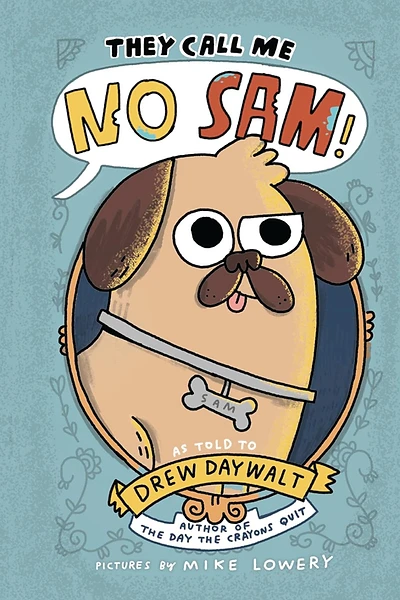
They Call Me No Sam!
by Drew Daywalt
Pacing MaterialSam, a spirited pug, tells the story of joining a human family and trying to protect them, even when his dog-centered understanding of the world leads to trouble. His confident explanations and the humans’ frequent corrections create a funny gap between what Sam intends and what actually happens. Although listed here as a picture book, They Call Me No Sam! is an illustrated chapter book; use selected scenes for younger listeners and longer reading sequences for older students.
Big Idea
A character’s perspective shapes how a story is told—and can make ordinary events surprisingly funny. Readers can appreciate Sam’s protective intentions while considering how his actions affect others.
Discussion Questions
- 1.Why does Sam think his actions are helpful? Choose a moment and explain what he understands differently from the humans.
- 2.What does the title suggest about the words Sam hears and how he interprets them?
- 3.When do you understand something that Sam does not? How does that difference make the story funny?
- 4.How do Mike Lowery’s illustrations help us understand Sam’s personality or the consequences of his choices?
- 5.What could Sam and his family do to understand one another better without changing everything that makes Sam himself?
Classroom Activity
Sam’s Side of the Story
Students create a four-panel illustrated story showing a household event from Sam’s viewpoint. Each story pairs Sam’s confident explanation with visual clues that reveal what a human might understand differently. Students experiment with a slow setup, a quick action, a pause, and a funny reveal, then read their stories aloud to test the pacing. Clearly label new adventures as student-created stories rather than events from the book.
Lesson Plan
Learning Goals
- Explain how Sam’s first-person perspective influences readers’ understanding of events.
- Use evidence from words and illustrations to distinguish a character’s intention from an action’s effect.
- Create a logically sequenced illustrated narrative with a setup, action, consequence, and ending.
- Revise sentence length, punctuation, or panel placement to influence reading pace.
- Use expressive oral reading to communicate character voice and humor.
Activity Steps
- 1.Read a selected scene in which Sam’s interpretation differs from the humans’ response. Ask students to identify what Sam wants and what actually happens.
- 2.Make a two-column chart labeled “Sam thinks” and “A human might think.” Record observations supported by the selected scene’s words and pictures.
- 3.Model a new, clearly invented scenario: Sam mistakes a harmless household object for a threat. Think aloud about how to make his protective reasoning understandable.
- 4.Have students fold paper into four panels: setup, Sam’s action, a pause or reaction, and the reveal. Add first-person narration, pictures, and optional human dialogue.
- 5.Partners read each story aloud, marking where they naturally speed up, slow down, or pause. Writers revise one pacing choice.
- 6.Share several stories and complete an exit response: “My pacing choice was ___, and it helped the reader ___.”
Standards Connections
- ELA: CCSS RL.K.3—With prompting and support, identify characters, settings, and major events; use oral responses and picture sequencing in kindergarten.
- ELA: CCSS RL.1.7 and RL.2.7—Use illustrations and text to describe characters, setting, plot, and meaning.
- ELA: CCSS RL.3.6—Distinguish the reader’s own point of view from that of the narrator or characters.
- ELA: CCSS W.3.3, W.4.3, and W.5.3—Develop narratives using sequence, description, dialogue, and pacing as appropriate to grade level.
- SEL: Social awareness and relationship skills—Consider different perspectives and distinguish helpful intentions from helpful effects.
Pace-Write-Read Study with Pace-Write It!
They Call Me No Sam! offers a lively study of how viewpoint creates both voice and pace. Sam tells his story with the confidence of a dog who believes his own explanations. Readers, however, can recognize a different meaning in the humans’ responses and in Mike Lowery’s illustrations. That gap invites prediction: What will Sam do next, and how will everyone else react? Study a selected scene twice. First, read for enjoyment; then reread to notice where explanation delays an action, where short language makes an event feel sudden, and where an illustration gives readers time to register a joke. Because this is an illustrated chapter book, examine actual page turns and chapter endings rather than assuming the structure of a short picture book. Treat devices such as flashbacks or patterns of three as things to check for, not features to presume are present. In the Pace-Write-Read cycle, students notice one craft move, try it in an original Sam-inspired scene, and read their draft aloud to hear its effect. Kindergarten and first-grade students can dictate captions and perform their panels; older students can develop fuller narration and revise the difference between Sam’s account and the reader’s understanding.
| Element | How to notice or teach it in the novel |
|---|---|
| 1. Pacing | Trace how a selected Sam episode moves from his explanation to action and then to the humans’ response. Ask students where the telling feels quick or slow and which words or pictures create that effect. |
| 2. Plot | Map an episode as Sam’s goal, his choice, and its consequence. Discuss how his wish to protect his family can drive trouble rather than solve it. |
| 3. Prosody | Read Sam’s narration with conviction, then adjust tone for a human correction. Compare how stress and pauses help listeners hear the mismatch between the two perspectives. |
| 4. Word | Examine the title’s words “No Sam” and discuss how separating or grouping words changes meaning. Find another word in the selected passage that reveals Sam’s attitude. |
| 5. Concept | Identify the central storytelling concept: a dog explains human life through dog logic. Have students turn an ordinary household event into a problem that would seem important to Sam. |
| 6. Voice & Worldview | Notice how Sam’s protective confidence shapes his explanations. Ask students to write a sentence that sounds like this particular pug rather than a neutral reporter. |
| 7. Point of View | Distinguish what Sam reports from what readers infer. Retell a brief incident from a human’s perspective and discuss what changes. |
| 8. Setting & Place | Study how Sam experiences his family’s everyday surroundings differently from a human. Identify which setting details matter because of his size, interests, or understanding. |
| 9. Original Characters | Explain what makes Sam more specific than simply “a naughty dog”: his motives, certainty, and interpretations. Build a character profile using evidence from the chosen reading. |
| 10. Dialogue | Contrast human speech with Sam’s interpretation of it, beginning with the title. In student drafts, use a brief spoken correction to interrupt a longer explanation. |
| 11. Details | Select one small textual or visual detail that helps readers recognize what Sam misunderstands. Explain why that detail matters to the joke. |
| 12. Descriptions | Compare how Sam describes something with how a human might describe the same thing. Try a description that reveals the observer’s beliefs instead of merely listing appearances. |
| 13. Firsts | Examine Sam’s introduction to his family and unfamiliar experiences. Discuss how encountering something for the first time gives a writer opportunities for surprise and mistaken assumptions. |
| 14. Immediacy & Engagement | Notice how access to Sam’s thoughts brings readers close to his decisions. Ask students to begin their scene at the moment he notices a possible problem. |
| 15. Story Scenes, Summaries & Structures | Compare a passage that tells events broadly with one that unfolds through action and response. Discuss why a funny misunderstanding may deserve a full scene rather than a quick summary. |
| 16. Tension / Suspense / Surprise | Pause before the consequence of one of Sam’s choices and invite predictions. Identify whether the enjoyment comes from uncertainty, an unexpected result, or knowing trouble is coming before Sam does. |
| 17. Flashback, Flash-Forward, Cliffhanger | Check the selected chapters for shifts in time or unresolved endings, naming only devices actually present. As an extension, students can end an invented Sam scene just before the humans discover his action. |
| 18. Page Turns and Chapter Breaks | Inspect an actual page turn or chapter ending for a question, unfinished action, or comic reveal. Discuss how the break influences the desire to keep reading. |
| 19. Pace & Creativity | Rewrite the same Sam-inspired event once with a long explanation and once with short action sentences. Compare which version best serves the intended joke. |
| 20. Play | Use the title to explore playful misunderstanding rather than random silliness. Invite students to invent another phrase a dog might interpret differently from its human speaker. |
| 21. Performance | Perform a selected exchange with a narrator and human speakers. Rehearse the pause between Sam’s confident reasoning and the response that challenges it. |
| 22. Personality | Collect examples of Sam’s confidence, loyalty, and impulsiveness from the reading. Ask how those traits affect both his actions and the length or emphasis of his explanations. |
| 23. Humor | Identify what Sam believes and what the reader understands in a funny moment. Discuss how the joke can arise from that difference while still allowing readers to care about him. |
| 24. Pause | Test a short silence before reading a human reaction or showing an illustration. Ask whether the pause gives listeners time to anticipate or recognize the joke. |
| 25. Poetry / Poetic Devices | Listen for sound patterns, repeated language, or exaggeration in the selected prose without treating the book as verse. Students can try one sound-based phrase in an invented Sam narration and test whether it improves the voice. |
| 26. Repetition | Use the title’s corrective phrase as a starting point for discussing repeated language. Track actual repetitions in the reading and ask whether each recurrence changes the joke or increases anticipation. |
| 27. Rhythm | Read a stretch of Sam’s narration aloud and listen to how sentence lengths alternate. Mark where the rhythm shifts from explaining to acting or reacting. |
| 28. Punctuation | Examine the exclamation mark in the title and punctuation in a selected passage. Read a student sentence with different punctuation to hear how urgency, confidence, or hesitation changes. |
| 29. Questions | Ask what question keeps readers moving through a Sam episode, such as how his family will respond. Students can build their scene around a question that the final panel answers. |
| 30. Compare-Contrast | Compare Sam’s intention with the result of his action. Use a two-column chart to show how the same event can support different interpretations. |
| 31. Objects | Choose an object actually shown or mentioned in the selected scene and explain its role in Sam’s understanding. For original writing, let an ordinary object become important because Sam misreads its purpose. |
| 32. Threes | Check whether a chosen passage groups actions or details in threes; do not assume it does. As a writing experiment, give Sam two small mistaken predictions followed by a larger third one. |
| 33. Lists | Look for any lists in Sam’s explanations and discuss whether they build momentum or reveal priorities. Students can invent a short list of what their version of Sam thinks requires protection. |
| 34. White Space & Negative Space | Inspect how space around text and illustrations affects where the eye stops. In student panels, leave room around the reveal so it is not buried beneath explanation. |
| 35. Art & Graphics | Study Lowery’s drawings alongside Sam’s narration for expressions, actions, or consequences that add meaning. Ask what readers would miss if they encountered the words without the pictures. |
| 36. Interactives & Gamification | Turn a selected scene into a classroom prediction game: pause, choose Sam’s likely next move, and justify the choice. This is a teaching adaptation, not a claim that the book contains built-in game features. |
| 37. Placement | Notice whether readers encounter an explanation, picture, or reaction first on a selected page. Rearrange those components in a student draft to test how placement changes the reveal. |
| 38. Form | Discuss how the illustrated chapter-book form combines sustained narration with visual humor. Compare what a four-panel adaptation can preserve and what it must leave out. |
| 39. Dummy | Create a folded-paper miniature book for an original Sam-inspired incident. Move the reveal to different pages and read each version to test the page-turn effect. |
| 40. Passion | Discuss how Sam’s strong investment in protecting his family makes his choices feel purposeful. Ask students to give their narrator something deeply important to pursue, even when the approach is mistaken. |
Pace-Write It!
20-minute task: “No, Sam—Wait for the Reveal!” Minutes 0–3: Reread a brief moment from the book where Sam’s understanding differs from a human’s; name the difference without inventing quotations. Minutes 3–5: Students choose a harmless household object for a new, clearly labeled imagined adventure—for example, a slipper that Sam decides needs investigating. Minutes 5–12: Make four panels: Sam notices the object; he confidently explains his concern; he acts; the picture and a brief human response reveal the misunderstanding. Give the explanation more space, make the action sentence short, and place the reveal in the final panel. Minutes 12–17: Partners read aloud, pausing before panel four; kindergarten–grade 1 students may dictate captions or tell the story orally, while grades 2–5 write narration and dialogue. Minutes 17–20: Revise one sentence, pause, or picture placement, then finish with: “I changed ___ to make the reader ___.”