 K-3
K-3P MCINERNY
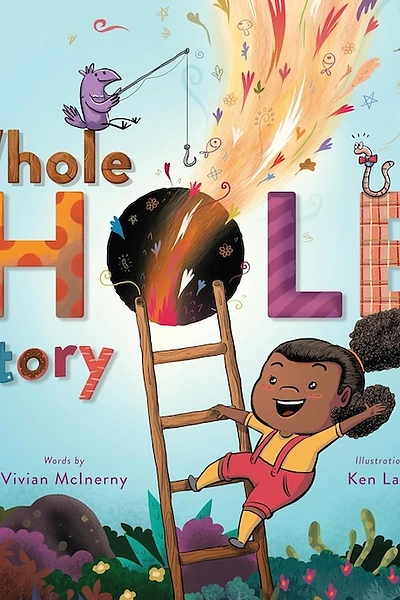
The Whole HOLE Story
by Vivian McInerny
Pacing MaterialA hole isn't just an empty space — it's a tunnel, a home, a beginning, and an invitation to imagine what's on the other side.
Big Idea
Empty spaces are full of possibility, and how you look at something changes what you see.
Discussion Questions
- 1.What are some things a hole could be?
- 2.How does the story change your idea of 'nothing'?
- 3.What's on the other side of a hole you'd like to explore?
- 4.Can an empty space be full?
Classroom Activity
Through the Hole
Draw a hole and what's on the other side. Show why someone would want to look through it.
Lesson Plan
Learning Goals
- Identify ways a hole can become a tunnel, a home, or an opening to something new in The Whole HOLE Story.
- Explain how looking at an empty space differently can reveal new possibilities.
- Create a drawing of a hole and an imagined scene on the other side.
- Use details in a drawing and an oral explanation or caption to show why someone would want to look through the hole.
Activity Steps
- 1.Read The Whole HOLE Story aloud. Pause at illustrations featuring holes and ask, “What might this opening lead to?” and “What makes you want to look closer?” Compare predictions with what the book reveals.
- 2.Discuss the book’s big idea: an empty space can be full of possibility. Invite students to suggest how the same hole might be a tunnel, an animal’s home, or the beginning of an adventure.
- 3.Model drawing a large hole on paper and adding a glimpse of something beyond it. Think aloud about an inviting detail, such as a winding path or a friendly creature, without completing the scene for students.
- 4.Have students draw their own hole and what is on the other side. Ask them to include at least two details that would make someone curious enough to look through it.
- 5.Invite students to dictate or write a caption beginning, “Look through my hole because…” Younger students may explain orally; older students may add sentences describing what a viewer would discover.
- 6.Hold a partner share or gallery walk. Have viewers name a detail that draws them in, then let each artist explain their idea. Close by asking, “How did your imagination turn an empty space into something new?”
Standards Connections
- ELA: RL.K.7 — Describe the relationship between illustrations and the story in which they appear.
- ELA: SL.1.1 — Participate in collaborative conversations about grade-level texts and topics.
- ELA: SL.2.5 — Create drawings or other visual displays to clarify ideas, thoughts, and feelings.
- ELA: SL.3.4 — Report on a topic with appropriate facts and relevant descriptive details.
- Visual Arts: Creating — Generate and develop imaginative artistic ideas using visual details.
Pace-Write-Read Study with Pace-Write It!
Focus question: How can an author slow us down and speed us up to help us imagine something ordinary in a new way? In The Whole HOLE Story by Vivian McInerny, a simple hole becomes many things—a tunnel, a home, a mystery, and a doorway to wonder. The pacing moves gently from observation to imagination, using short ideas, page turns, and playful shifts in perspective to help readers pause, predict, and rethink what a hole can be.
| Element | How to notice or teach it in the novel |
|---|---|
| Pace | Read: Notice how The Whole HOLE Story moves at an unhurried, thoughtful pace as each new idea about the hole is revealed one at a time. The slow pacing gives readers space to wonder what the hole means from different perspectives. Classroom Activity: Write 4 short sentences about one ordinary object, revealing one new idea per sentence to control the pace of your reader’s thinking. |
| Plot | Read: The plot in this realistic picture book is built less around big action and more around a growing chain of ideas: a hole starts as an empty space, then becomes a tunnel, a home, a beginning, and an invitation to imagine. The movement of the book comes from curiosity building across the pages. Classroom Activity: Create a beginning-middle-end plan for a mini piece called The Whole ______ Story, showing how one small object changes meaning across the piece. |
| Prosody | Read: Listen to how the language in The Whole HOLE Story likely sounds when read aloud—gentle, curious, and reflective—matching the theme of perspective. The phrasing invites readers to stress key words like hole, tunnel, home, and other side. Classroom Activity: Read one page aloud with a partner and mark 3 words you would say with extra expression, then write your own 2-line read-aloud sentence about a familiar object. |
| Word pause | Read: Notice where single important words or short phrases about the hole may make you stop and think. In a book about curiosity and perspective, those small pauses help the idea of the hole expand in the reader’s mind. Classroom Activity: Write a sentence about an object and add one dash or line break to create a thinking pause for your reader. |
| Concept | Read: The big concept in The Whole HOLE Story is that something that seems empty can actually be full of meaning, use, and possibility. The hole becomes a way to explore curiosity and perspective. Classroom Activity: Finish this idea in writing: 'At first, I thought _____ was just _____, but now I think it could also be _____.' |
| Voice & World View | Read: The voice of The Whole HOLE Story feels open, playful, and thoughtful, encouraging readers to see the world as full of hidden possibilities. The world view suggests that looking again can change what we understand. Classroom Activity: Write 3 sentences in a curious voice about something small you usually ignore, such as a crack, puddle, or shadow. |
| Setting & Place | Read: Even though a hole seems simple, its meaning changes depending on place—it could be in the ground, in a wall, in nature, or near a home. Place helps readers imagine how the hole becomes a tunnel, shelter, or starting point. Classroom Activity: Choose one place for a hole and write 3 setting details that change what the hole means there. |
| Point of View | Read: The Whole HOLE Story depends on point of view because a hole looks different depending on who is noticing it. A child, an animal, or a person passing by might all understand the same hole in different ways. Classroom Activity: Write 3 short lines about the same hole from 3 points of view: a child, an animal, and a gardener. |
| Original Characters | Read: This book may not center one traditional main character; instead, the 'characters' can be the different users and observers of the hole, making the idea itself feel alive. That makes the book original because perspective drives the story. Classroom Activity: Invent one character who would care a lot about a hole and write 2 sentences explaining why. |
| Dialogue | Read: Even if The Whole HOLE Story is not dialogue-heavy, readers can imagine what different people or creatures might say when they discover the hole. Dialogue could reveal surprise, worry, excitement, or curiosity. Classroom Activity: Write a 2-line conversation between a child and a rabbit about what the hole might be used for. |
| Details | Read: Small details help the hole feel real and meaningful—its size, shape, edge, depth, and what may be around it. These details support the realistic style while opening space for imagination. Classroom Activity: Make a quick detail list of 5 words that describe a hole, then use 3 of them in one sentence. |
| Descriptions | Read: Description in The Whole HOLE Story likely helps the reader picture the hole in more than one way, shifting from plain description to imaginative description. This helps pacing because each new description adds a fresh layer. Classroom Activity: Write one plain description of a hole and one imaginative description of the same hole. |
| Strong First Lines | Read: A strong opening in a book like The Whole HOLE Story would immediately make readers rethink a simple hole. The first line likely sets up both curiosity and surprise. Classroom Activity: Write 3 possible first lines for a piece about an ordinary object that suddenly seems special. |
| Immediacy & Engagement | Read: The book stays engaging by taking a familiar thing and asking readers to look closer right away. Because children know what a hole is, they can quickly connect and then become curious as the meaning grows. Classroom Activity: Write an opening sentence that starts with 'Look closely at _____' and makes your reader want to keep going. |
| Story Scenes & Summaries & Unique Structures | Read: The Whole HOLE Story likely uses a list-like or layered structure instead of a traditional action scene, building idea after idea about the hole. That unique structure creates pacing through accumulation. Classroom Activity: Write a 5-line piece where each line begins with 'A _____ is...' and adds a new way to understand the same thing. |
| Flashback & Flash Forward & Cliffhangers | Read: This book may not use full flashbacks or cliffhangers, but it does create forward-thinking by inviting readers to wonder what lies on the other side of the hole or what might happen next. That wondering acts like a gentle cliffhanger. Classroom Activity: End your short piece with the line 'And on the other side...' then leave space for the reader to imagine. |
| Tension & Suspense & Surprise | Read: The suspense in The Whole HOLE Story is quiet rather than scary; readers keep turning pages to discover the next surprising way a hole can be understood. Surprise comes from changing perspective. Classroom Activity: Write 3 sentences that begin with 'You might think...,' 'But really...,' and 'The surprise is...' about one object. |
| Page Turns and Chapter Breaks | Read: In a picture book like The Whole HOLE Story, page turns are important because each turn can reveal a new possibility for the hole. The pause before turning helps build curiosity and pacing. Classroom Activity: Fold a paper into 4 parts and plan one new idea for an object on each 'page' so each page turn reveals something new. |
| Performance | Read: This book invites performance through expression, pauses, and gestures, such as leaning forward to peer into an imaginary hole or widening your eyes at a new idea. Performance helps readers feel the pacing physically. Classroom Activity: Practice reading one line with a pause and a gesture, then write one line meant to be performed dramatically. |
| Personality | Read: Even though the hole is not a person, the book gives it a kind of personality by showing how active, useful, and mysterious it can be. Readers begin to think of the hole as important rather than empty. Classroom Activity: Personify an object by writing 'My _____ is the kind of thing that...' and finish the idea in 2 ways. |
| Humor | Read: Humor in The Whole HOLE Story may come from the surprise of treating a plain hole like the star of an entire story. The playful seriousness of looking deeply at something so ordinary can make readers smile. Classroom Activity: Write a funny sentence that acts as if a very ordinary object is extremely important. |
| Pause | Read: The book’s theme of curiosity depends on pauses—moments when readers stop, look, and imagine. Those pauses are part of the meaning because they teach readers to notice. Classroom Activity: After writing 3 sentences, add one blank line between two of them and decide why that pause matters. |
| Poetry and Poetic Devices | Read: The Whole HOLE Story may use poetic language, repeated sounds, or image-rich phrases to make the hole feel larger than life. Poetic devices support the reflective pacing and imaginative tone. Classroom Activity: Write a 2-line poem about a hole using alliteration, such as 'hidden hole' or 'deep, dark door.' |
| Repetition | Read: Repetition can help a picture book like The Whole HOLE Story build rhythm and deepen meaning, especially if the word hole or a sentence pattern appears again and again. Each repetition adds a slightly new perspective. Classroom Activity: Write 4 lines beginning with 'A hole can be...' and change the ending each time. |
| Rhythm | Read: The rhythm of the sentences likely alternates between short, simple statements and slightly longer reflective ones, helping the book feel calm and thoughtful. Rhythm helps shape the reading pace. Classroom Activity: Write one short sentence and one longer sentence about the same object, then read them aloud to hear the difference. |
| Punctuation | Read: Punctuation in The Whole HOLE Story may help signal wonder, pause, and emphasis, especially when the author wants readers to stop and think about a new possibility. A question mark, dash, or period can change the pacing. Classroom Activity: Write the same sentence about a hole three ways—with a period, a question mark, and an exclamation point—and discuss how the feeling changes. |
| Questions | Read: Questions fit this book perfectly because the whole story grows from wondering what a hole is and what it might lead to. Questions invite readers into the book’s curious perspective. Classroom Activity: Write 3 questions a character could ask after noticing a hole for the first time. |
| Compare-Contrast | Read: The Whole HOLE Story compares a hole as 'empty' with a hole as full of possibility. That contrast helps readers see how perspective changes meaning. Classroom Activity: Draw a T-chart labeled 'Seems like' and 'Could also be,' then write 3 ideas about one everyday object. |
| Objects | Read: The central object of this book—the hole—shows that an object or feature does not need to be flashy to carry a whole story. The hole anchors the theme of curiosity and imaginative thinking. Classroom Activity: Choose one overlooked object and write 5 ways it could matter to different people or animals. |
| Threes | Read: Picture books often build strong pacing through groups of three, and this book’s expanding ideas about the hole can be organized in memorable sets. Threes help young readers track growing meaning. Classroom Activity: Write 3 ways a hole could be useful, 3 ways it could be mysterious, and 3 words to describe it. |
| Whitespace & Negative Space | Read: Because this book is about a hole—an empty space—whitespace and negative space are especially meaningful. Open space on a page can mirror the hole itself and slow readers down to notice what is not filled in. Classroom Activity: Create a mini page with one sentence and lots of blank space around it to show the feeling of emptiness or wondering. |
| Art & Graphics | Read: In a picture book like The Whole HOLE Story, the illustrations are essential for showing how one hole can be seen in different ways. The art likely helps readers shift perspective and notice scale, place, and possibility. Classroom Activity: Draw the same hole from two different viewpoints and write one sentence under each picture. |
| Interactives & Gamification | Read: This book naturally invites interactive reading because children can guess what the hole might be before each page turn or act out who might use it. The guessing itself supports pacing by creating anticipation. Classroom Activity: Play 'What could it be?' with a partner: show a sketch of an object, let your partner guess 3 possibilities, then write the most surprising one into a sentence frame. |
Pace-Write It!
20-Minute Classroom Flow\nRead (5 min): Read The Whole HOLE Story by Vivian McInerny aloud. Pause at key page turns and ask students to silently think: What else could this hole be?\nNotice (5 min): Reread 2-3 pages and notice how the author slows pacing by giving one new idea at a time, using repetition, questions, and page turns. Create a quick class chart: 'At first it seems... / Then it becomes...'\nWrite (7 min): Students write their own short piece about an ordinary object or space. Writing frame: 'At first, _____ seemed like just a _____. But then I noticed _____. To _____, it could be _____. To _____, it could be _____. Maybe it is also _____. I wonder _____.' Encourage students to use 4-6 short lines, one new idea per line, to copy the book’s pacing.\nShare (3 min): Partners read their pieces aloud slowly, pausing after each line. Listeners name the line where their thinking changed.\nExit ticket: Write one sentence answering: How did slowing down help you see an ordinary thing in a new way?
Pace-Write-Read Connection
Teach this book using the Pace-Write-Read method — Tool 34: White Space & Negative Space.
Open the Mastery Manual