
 7-12
7-12GN BROWN
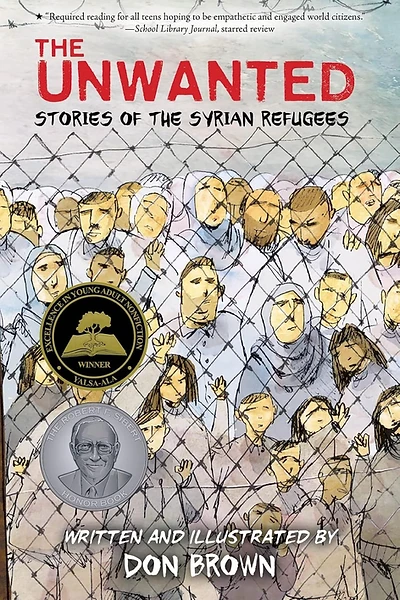
The Unwanted: Stories of the Syrian Refugees
by Don Brown
Pacing MaterialA graphic novel chronicling the Syrian refugee crisis through the stories of those who fled, illuminating the humanitarian tragedy with watercolor illustrations and factual reporting.
Big Idea
The Syrian refugee crisis is a complex humanitarian tragedy that challenges our global responsibility to protect human dignity, safety, and the rights of the displaced.
Discussion Questions
- 1.How does the visual format of a graphic novel change your emotional connection to the historical facts presented in the book?
- 2.In what ways do the refugees' stories challenge common misconceptions about why people leave their homes?
- 3.Discuss the role of international borders in the book—do they protect people, or do they serve as obstacles to human survival?
- 4.How does Don Brown use color and line work to reflect the instability and danger experienced by the characters?
- 5.What does the title 'The Unwanted' imply about the way the world has responded to this crisis, and how does this affect the characters' sense of self-worth?
Classroom Activity
Mapping the Journey: Cartography of Displacement
Students will trace the physical and emotional journeys of the refugees depicted in the book by creating a multi-layered map that combines geographical reality with personal narrative moments.
Lesson Plan
Learning Goals
- Analyze how the author conveys complex political events through personal narratives.
- Identify the geopolitical factors contributing to the Syrian refugee crisis.
- Evaluate the ethical obligations of nations toward displaced populations.
- Synthesize visual and textual information to construct a historical narrative.
Activity Steps
- 1.Students will work in small groups to select a specific refugee's journey described in the book.
- 2.Using large chart paper, draw the route taken from Syria toward Europe.
- 3.Incorporate specific watercolor-style sketches or key quotes from the text at different stops along the journey.
- 4.Add annotation bubbles that explain the challenges faced at each border or crossing point.
- 5.Present the maps to the class, focusing on the human impact of these political borders.
Standards Connections
- CCSS.ELA-LITERACY.RH.9-10.7: Integrate visual information with other information in print texts.
- CCSS.ELA-LITERACY.SL.9-10.1: Participate in collaborative discussions.
- Social Studies: Global Perspective on Human Rights.
- Visual Literacy: Analyzing graphic narrative conventions.
Pace-Write-Read Study with Pace-Write It!
Don Brown’s 'The Unwanted' is a masterclass in journalistic graphic storytelling, demonstrating how to pace heavy historical information alongside intimate, visceral human tragedy. The author balances fast-paced, terrifying sequences of flight with quiet, reflective pauses that emphasize the permanence of loss. By alternating between wide-angle geopolitical summaries and close-up, individual character sketches, Brown teaches students how to manage the 'pacing of perspective' in nonfiction writing. Students will learn that writing is not just about words, but about how much space those words occupy on the page. In this text, silence—both in the whitespace of the illustrations and the brevity of the captions—acts as a rhetorical device that compels the reader to sit with the gravity of the Syrian crisis.
| Element | How to notice or teach it in the novel |
|---|---|
| Pace | Notice how the narrative accelerates during boat crossings and decelerates during scenes of displacement camps. |
| Plot | Observe how the plot is driven by the necessity of survival rather than traditional character-arc goals. |
| Prosody | Examine the cadence of the captions to understand how the author maintains a somber, respectful tone. |
| Word Pause | Look for single-word captions that force a rhythmic stop, emphasizing the weight of the refugee experience. |
| Concept | The book centers on the concept of 'the unwanted,' framing the entire historical crisis around this central theme. |
| Voice & World View | Identify the author's objective yet compassionate voice as a witness to history. |
| Setting & Place | Track how the shifting geography—from war-torn streets to vast seas—dictates the tone of the panels. |
| Point of View | Discuss how the author moves from a bird's-eye view of geopolitical conflict to the eye-level view of a terrified child. |
| Original Characters | Note how anonymous refugees are transformed into distinct individuals through specific, evocative details. |
| Dialogue | Analyze how brief, sparse dialogue highlights the desperation and confusion of the characters. |
| Details | Focus on how small, specific physical details, like a torn shoe or a life jacket, symbolize broader humanitarian failures. |
| Descriptions | Notice the use of sensory-based descriptions that emphasize the cold, hunger, and physical exhaustion of the journey. |
| Strong First Lines | Examine how the opening panels immediately establish the scale of the Syrian conflict. |
| Immediacy & Engagement | Observe the use of watercolor illustrations to create a sense of raw, immediate reality. |
| Story Scenes & Summaries & Unique Structures | Look for the juxtaposition of macro-level history boxes and micro-level character scenes. |
| Flashback & Flash Forward & Cliffhangers | Identify how the author uses flashbacks to show life before the war, heightening the tragedy of the present. |
| Tension & Suspense & Surprise | Analyze how suspense is built through silence and the looming uncertainty of borders. |
| Page Turns and Chapter Breaks | Observe how page turns are used to deliver shocking or heavy narrative revelations. |
| Performance | Consider how the visual character expressions act as a performance of grief and anxiety. |
| Personality | Identify how character personality is shown through actions and resilience rather than dialogue. |
| Humor | Note the absence of humor, which signals the seriousness of the subject matter. |
| Pause | Analyze the 'silent panels' where the art allows the reader to pause and process a tragedy. |
| Poetry and Poetic Devices | Look for metaphorical imagery in the illustrations that represents the loss of home. |
| Repetition | Note how the repetition of travel imagery emphasizes the endless, cyclical nature of the refugees' plight. |
| Rhythm | The alternating between action and reflection sets a rhythm of 'survival then suffering.' |
| Punctuation | Observe the intentional use of short, blunt sentences and ellipses to indicate speech patterns. |
| Questions | The book asks implicit questions about human nature through the refusal of nations to help. |
| Compare-Contrast | Contrast the perspectives of the refugees with the bureaucratic responses of governments. |
| Objects | Focus on the symbolic use of life jackets, boats, and barbed wire. |
| Threes | Observe how the author groups scenes into three panels to show the sequence of a refugee's decision-making process. |
| Whitespace & Negative Space | Notice how the use of color-faded edges creates a sense of emptiness and loss around the characters. |
| Art & Graphics | The watercolor medium evokes a fluidity and instability that mirrors the refugees' lives. |
| Interactives & Gamification | Consider the layout of the book as an 'interactive journey' that forces the reader to track the physical movement of refugees. |
Pace-Write It!
Choose one two-page spread from the book. Using a blank storyboard template, re-write the captions to change the pacing: transform one long summary panel into three smaller, dialogue-driven panels to increase the immediacy of the character's emotional reaction.