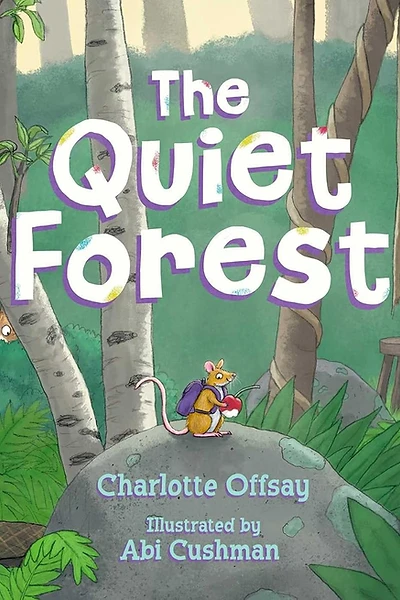
 K-2
K-2P OFFSAY
The Quiet Forest
by Charlotte Offsay, Illustrated by Abi Cushman
Pacing MaterialBig Idea
Small actions can have large, unexpected consequences, but through cooperation and mindfulness, we can restore peace and balance to our community.
Discussion Questions
- 1.How does the mouse's small mistake change the forest from quiet to loud?
- 2.Why do you think the author chose to make the story 'cumulative'—adding more animals as the story goes on?
- 3.How do the animals feel when the forest is loud versus when it is quiet?
- 4.What role does the bear cub play in helping the other animals?
- 5.If you were in the forest, what is one thing you would do to help bring the quiet back?
Classroom Activity
The Forest Chain Reaction
Students will create a visual 'cause and effect' chain to map out how the mouse's initial action leads to the loud forest, reinforcing the cumulative structure of the story.
Lesson Plan
Learning Goals
- Identify the sequence of events in a cumulative story.
- Explain the cause-and-effect relationship between the characters' actions.
- Demonstrate understanding of how alliteration and onomatopoeia enhance the reading experience.
- Collaborate with peers to retell the story using visual aids.
Activity Steps
- 1.Read the book aloud, pausing to identify each new animal and the sound they make.
- 2.Provide students with paper strips and markers to draw one animal or event from the story per strip.
- 3.Guide students to link their strips together in the correct order to form a long 'story chain'.
- 4.Have students practice retelling the story by following their chain from start to finish.
- 5.Display the chains in the classroom to show the cumulative nature of the plot.
Standards Connections
- CCSS.ELA-LITERACY.RL.K.3: Describe characters, settings, and major events in a story.
- CCSS.ELA-LITERACY.RL.1.2: Retell stories, including key details.
- CCSS.SEL.1.A: Recognize and label emotions in self and others.
- CCSS.VA.Cr1.1: Engage in exploration and imaginative play with materials.
Pace-Write-Read Study with Pace-Write It!
Pacing in a cumulative picture book like 'The Quiet Forest' is a deliberate architectural choice. By utilizing a repetitive structure, the author builds momentum, mirroring the 'snowball effect' of the plot. As the story progresses, the rhythm accelerates, drawing the reader into the escalating chaos of the forest. This pacing study invites students to notice how the author uses language and structure to control the speed of the narrative. By examining the transition from silence to noise and back to silence, students learn how authors manipulate time and tension to create a satisfying, rhythmic reading experience.
| Element | How to notice or teach it in the novel |
|---|---|
| Pace | The pace starts slow and steady, then accelerates as more animals join the chaos, before slowing down again at the resolution. |
| Plot | The plot follows a classic cumulative structure where one small mishap triggers a chain reaction of events. |
| Prosody | Encourage students to read with varying volume and speed to match the escalating noise of the forest animals. |
| Word Pause | Use pauses after onomatopoeic words to let the 'sound' of the forest sink in before moving to the next action. |
| Concept | The core concept is cause-and-effect, showing how one small action can impact an entire community. |
| Voice & World View | The voice is playful and observational, viewing the forest as a shared home that requires collective care. |
| Setting & Place | The forest is a character itself, shifting from a peaceful, quiet space to a loud, chaotic environment. |
| Point of View | The story is told from a third-person omniscient perspective, allowing us to see the entire chain reaction unfold. |
| Original Characters | The characters are relatable animals whose reactions to the noise drive the story forward. |
| Dialogue | Dialogue is minimal, relying instead on animal sounds and descriptive actions to convey the story. |
| Details | Notice the specific details in the illustrations that show how each animal contributes to the growing noise. |
| Descriptions | The descriptions focus on sensory details, specifically sound and movement, to bring the forest to life. |
| Strong First Lines | The opening establishes the 'quiet' baseline, which makes the later noise more impactful. |
| Immediacy & Engagement | The use of onomatopoeia creates immediate engagement, inviting children to make the sounds along with the reader. |
| Story Scenes & Summaries & Unique Structures | The cumulative structure is the unique backbone of this story, making it predictable and fun for young readers. |
| Flashback & Flash Forward & Cliffhangers | The story moves linearly, but each page turn acts as a mini-cliffhanger as we wait to see which animal joins the noise next. |
| Tension & Suspense & Surprise | Tension builds as the forest gets louder, creating suspense about whether the animals will ever find peace again. |
| Page Turns and Chapter Breaks | Page turns are used to reveal the next animal in the chain, building anticipation with every flip. |
| Performance | This book is perfect for a performance-style read-aloud where the teacher and students act out the animal sounds. |
| Personality | Each animal has a distinct personality shown through their specific sound and reaction to the chaos. |
| Humor | The humor comes from the absurdity of the chain reaction and the contrast between the quiet start and the loud middle. |
| Pause | Use a long pause at the climax of the noise to emphasize the transition back to quiet. |
| Poetry and Poetic Devices | The book uses alliteration and onomatopoeia to create a musical, poetic quality to the prose. |
| Repetition | Repetition is key to the cumulative structure, helping students predict what comes next. |
| Rhythm | The rhythm of the text mimics the snowballing effect of the plot, getting faster and more frantic. |
| Punctuation | Exclamation points are used to emphasize the loud sounds, while periods signal the return to calm. |
| Questions | The text asks questions that invite the reader to consider how the animals feel and what they might do. |
| Compare-Contrast | Compare the beginning of the book (quiet) to the middle (loud) and the end (restored quiet). |
| Objects | Objects in the forest are often the catalysts for the animals' mishaps. |
| Threes | Look for groups of three or more animals interacting to show the scale of the noise. |
| Whitespace & Negative Space | The illustrations use space to emphasize the emptiness of the quiet forest versus the crowded, noisy pages. |
| Art & Graphics | The art uses vibrant colors and expressive animal faces to convey the mood of the forest. |
| Interactives & Gamification | The book functions as an interactive game where students can 'spot' the next animal or predict the next sound. |
Pace-Write It!
In 20 minutes, have students work in pairs to 're-pace' a scene. Ask them to choose one animal from the book and write a new, short sound effect for them. Then, have them practice reading their page with a 'fast' pace and a 'slow' pace to see how it changes the feeling of the story.