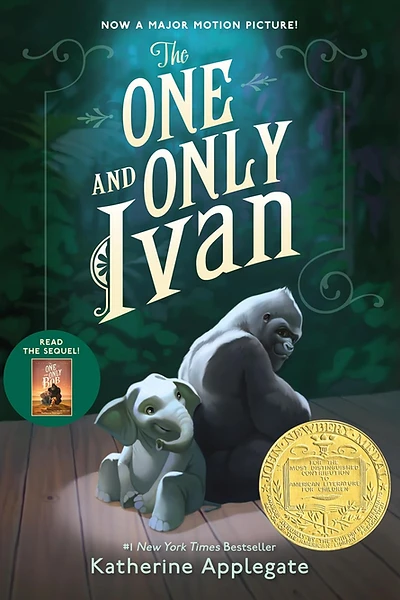
 3-6
3-6M APPLEGATE
The One and Only Ivan
by Katherine Applegate
Pacing MaterialA silverback gorilla living in a mall circus promises to protect a baby elephant and find them both a better home.
Big Idea
Art and friendship can awaken courage, and even one small voice can change a life when it speaks up for others.
Discussion Questions
- 1.How does Ivan use art to express himself?
- 2.What promise does Ivan make to Stella, and why?
- 3.How does Ivan's view of himself change?
- 4.What does 'home' mean in this story?
- 5.How does the short, poetic style affect the reading?
Classroom Activity
Ivan's Mural
Create a mural that Ivan might paint to tell his story. Include three images and a short caption that captures his promise.
Lesson Plan
Learning Goals
- Analyze how art and friendship awaken courage
- Create a mural that tells a character's story
Activity Steps
- 1.Read selected passages, focusing on Ivan's promise to Stella.
- 2.Discuss: 'How does Ivan use art to express himself?'
- 3.As a class, plan a mural of Ivan's story with 3 key images.
- 4.Small groups each create one panel of the mural.
- 5.Assemble and display the mural with a caption.
Standards Connections
- ELA: RL.3.1 — Ask and answer questions about key details
- ELA: RL.3.2 — Retell stories, including key details
- ELA: RL.3.3 — Describe characters, setting, and events
- ELA: RL.6.6 — Acknowledge differences in characters' points of view
- ELA: SL.3.1 — Participate in collaborative conversations about the text
- ELA: W.3.3 — Write narratives recounting events with descriptive details
- SEL: Social Awareness
- SEL: Relationship Skills
Pace-Write-Read Study with Pace-Write It!
Focus question: How does an author slow down and speed up a story to help readers feel hope, worry, and determination? In The One and Only Ivan by Katherine Applegate, short chapters, spare language, and meaningful pauses help readers experience Ivan’s thoughts as he watches life in the mall circus change. The pacing shifts from quiet reflection to urgent action as Ivan’s promise to Ruby pushes the story forward and deepens the theme of determination.
| Element | How to notice or teach it in the novel |
|---|---|
| Pace | Read: Notice how Katherine Applegate uses very short chapters and brief sentences to create a calm, thoughtful pace for Ivan’s everyday life, then speeds the story up when Ruby arrives and Ivan becomes determined to help her. Classroom Activity: Write two short paragraphs about one character’s day—make the first slow and reflective like Ivan thinking in his glass domain, and the second quicker and more urgent like a moment when a problem must be solved. |
| Plot | Read: Track how the plot moves from Ivan’s ordinary routines with Stella, Bob, and Mack to the turning point of Ruby’s arrival and Ivan’s promise to find a better home. Classroom Activity: Create a 5-step plot ladder for Ivan’s determination, then write one new mini-scene that could fit between his promise to Stella and the public noticing his art. |
| Prosody | Read: Listen to the rhythm of Ivan’s narration—his voice is steady, measured, and often poetic, which makes even simple observations feel important. Classroom Activity: Choose a scene with Ivan and Ruby and rewrite it as a read-aloud passage, paying attention to where your voice would slow, soften, or strengthen. |
| Word pause | Read: Notice how single-word lines and very short phrases make readers pause and think, especially when Ivan faces sadness, memory, or responsibility. Classroom Activity: Write a 6-8 line reflection from Ivan’s point of view using at least three one-word lines to create meaningful pauses. |
| Concept | Read: Pay attention to how the big idea of determination grows through Ivan’s promise to Stella and his effort to protect Ruby and imagine freedom. Classroom Activity: Write a short response explaining how one moment in the book shows determination, then add a new scene in which another character, like Julia or Bob, shows determination too. |
| Voice & World View | Read: Notice that Ivan’s voice is calm, observant, and a little ironic, and that he sees humans, cages, and art through a gorilla’s world view. Classroom Activity: Write a journal entry about the mall circus from Bob’s or Ruby’s world view, using details that show how that character understands the world differently from Ivan. |
| Setting & Place | Read: Study how the Exit 8 Big Top Mall and Video Arcade feels both ordinary and sad, and how the confined setting shapes the story’s emotional pace. Classroom Activity: Describe one place from the book—the glass domain, the ring, or the billboard space—using sensory details that make the place feel limiting or hopeful. |
| Point of View | Read: Notice how first-person point of view keeps readers close to Ivan’s thoughts, making his changes in feeling immediate and personal. Classroom Activity: Rewrite an important moment, such as Ruby’s arrival or Stella’s advice, from Julia’s first-person point of view. |
| Original Characters | Read: Pay attention to how Katherine Applegate makes Ivan, Ruby, Stella, Bob, Julia, and Mack each feel distinct and memorable with just a few details. Classroom Activity: Invent a new animal character who lives near Ivan and write a short character sketch showing how that character might help or challenge Ivan’s plan. |
| Dialogue | Read: Notice that dialogue is often brief but meaningful, especially in conversations between Ivan and Stella, Ivan and Bob, and Ivan and Ruby. Classroom Activity: Write a dialogue scene in which Ruby asks Ivan a difficult question about the zoo, and show Ivan’s determination through what he says and what he avoids saying. |
| Details | Read: Notice the small, precise details about art supplies, the glass domain, the sounds of the mall, and animal habits that make the story feel real. Classroom Activity: Make a list of five tiny details from Ivan’s life, then use them in a new paragraph that reveals his mood without directly naming the feeling. |
| Descriptions | Read: Study how Applegate’s descriptions are simple but powerful, helping readers picture Ivan’s world without long passages. Classroom Activity: Describe Ruby the first time Ivan sees her, using clear, strong images and keeping your sentences short like the novel’s style. |
| Strong First Lines | Read: Notice how many chapters begin with direct, interesting first lines that quickly focus attention on one thought, memory, or image. Classroom Activity: Write three possible first lines for a new chapter about Ivan’s plan to help Ruby, and make each line hook the reader right away. |
| Immediacy & Engagement | Read: Notice how the short chapters and close point of view make readers feel like they are experiencing events alongside Ivan in the moment. Classroom Activity: Write a short scene in present tense from Ivan’s perspective as he watches people react to his drawings, making the moment feel immediate. |
| Story Scenes & Summaries & Unique Structures | Read: Notice how the novel blends quick scene snapshots with brief summaries, and how the many short titled chapters create a unique, fast-moving structure. Classroom Activity: Write one scene and one summary about the same event in Ivan’s life, then explain which version feels faster and why. |
| Flashback & Flash Forward & Cliffhangers | Read: Pay attention to Ivan’s memories of the jungle and his family, and notice how chapters sometimes end with a thought that makes you want to keep reading. Classroom Activity: Write a short flashback from Ivan’s past that connects to his promise to Ruby, ending with a cliffhanger line. |
| Tension & Suspense & Surprise | Read: Notice how tension builds as readers wonder whether Ivan’s art will work, whether humans will understand, and whether Ruby will remain trapped. Classroom Activity: Write a suspenseful paragraph about the moment before someone important notices Ivan’s paintings, using short sentences and a final surprise detail. |
| Page Turns and Chapter Breaks | Read: Study how chapter breaks often land after a strong image, question, or realization, encouraging readers to turn the page. Classroom Activity: Draft two very short chapters about Ivan making a plan, and end the first chapter with a line that creates curiosity. |
| Performance | Read: Notice how the circus performances in the ring contrast with Ivan’s private, thoughtful inner life, creating two different kinds of pacing. Classroom Activity: Write a scene that shows the difference between what the audience sees during a performance and what Ivan is really thinking. |
| Personality | Read: Notice how Ivan’s dry humor, Stella’s wisdom, Bob’s sarcasm, Ruby’s innocence, and Julia’s kindness shape the tone and movement of the story. Classroom Activity: Choose one character and write five lines of narration or dialogue that clearly show that character’s personality. |
| Humor | Read: Look for gentle humor, especially in Ivan’s observations about humans and in Bob’s comments, and notice how humor gives readers a pause from heavier moments. Classroom Activity: Write a funny exchange between Bob and Ivan about one strange human habit seen at the mall. |
| Pause | Read: Notice how the story often pauses for a memory, image, or single thought, allowing readers to reflect on captivity, friendship, and hope. Classroom Activity: Write a brief pause moment in which Ivan stops in the middle of action to notice one object that reminds him why he must keep his promise. |
| Poetry and Poetic Devices | Read: Notice the poetic style of the prose, including imagery, repetition, and carefully chosen words that make Ivan’s thoughts sound lyrical. Classroom Activity: Write a 6-line free-verse poem from Stella to Ruby about strength and hope, using at least one image from the book. |
| Repetition | Read: Pay attention to repeated ideas, words, and promises, especially Ivan’s promise to Stella and recurring thoughts about home, art, and freedom. Classroom Activity: Write a paragraph about determination that repeats one important phrase three times for emphasis, as if Ivan is reminding himself not to give up. |
| Rhythm | Read: Listen to the rhythm created by short sentences, fragments, and line breaks in Ivan’s narration. Classroom Activity: Write a short passage about Ivan painting, using a mix of very short and slightly longer sentences to create a thoughtful rhythm. |
| Punctuation | Read: Notice how punctuation—especially periods, dashes, and question marks—helps control pacing and emotion in Ivan’s spare narration. Classroom Activity: Rewrite a simple paragraph two ways: one version with quick, clipped punctuation to create urgency, and one version with longer pauses to create reflection. |
| Questions | Read: Notice how questions, spoken or unspoken, push the story forward: What is a zoo really like? Can art change anything? Will Ruby be safe? Classroom Activity: Write four questions Ruby might ask Ivan, then answer one of them in Ivan’s voice. |
| Compare-Contrast | Read: Pay attention to contrasts between the jungle and the mall, freedom and captivity, performance and truth, adults and children, and despair and hope. Classroom Activity: Write a compare-contrast paragraph about Ivan’s glass domain and the home he imagines for Ruby. |
| Objects | Read: Notice how objects such as crayons, paint, signs, the TV, the domain glass, and Ivan’s pictures carry meaning and move the story ahead. Classroom Activity: Choose one object from the book and write from its point of view, explaining how it witnesses Ivan’s determination. |
| Threes | Read: Look for places where ideas, images, or actions can be grouped in threes to make them memorable, such as three feelings Ivan has, three things Ruby changes, or three signs of hope. Classroom Activity: Write a sentence set or short paragraph that uses a pattern of three to describe Ivan’s plan or Ruby’s impact on the group. |
| Whitespace & Negative Space | Read: Notice how the short chapters, brief paragraphs, and empty space on the page slow readers down and give each idea room to matter. Classroom Activity: Write a page in the style of the book using short paragraphs and intentional blank space to emphasize one powerful moment. |
| Art & Graphics | Read: Although the novel is mostly text, art inside the story is essential because Ivan’s drawings become his way to communicate and create change. Classroom Activity: Sketch or imagine one sign Ivan might make for Ruby’s future home, then write the chapter that would go with that image. |
| Interactives & Gamification | Read: Notice how readers can track clues and patterns—promises, pictures, memories, and reactions—to predict how Ivan’s plan might succeed. Classroom Activity: Create a simple class challenge called “Help Ivan Send the Message” with three steps students must complete: identify a clue, write a chapter title, and add one sentence that moves the plan forward. |
Pace-Write It!
20-Minute Classroom Flow Read (5 min): Read aloud two or three short chapters that show Ivan’s reflective voice and his growing determination to help Ruby, such as a section with Stella’s guidance, Ruby’s questions, or Ivan’s painting plan. Notice (5 min): Ask students: How do the short chapters change the pace? Where does the author make us pause? What words, line breaks, or chapter endings make us want to keep reading? Chart student observations under two headings: Slows the pace and Speeds the pace. Write (7 min): Students write a short original chapter in the style of The One and Only Ivan. Writing frame: “I watch ____. I remember ____. Stella told me ____. Ruby needs ____. So I will ____.” Encourage students to use 5-8 short paragraphs, at least one one-word line, and one ending that makes the reader want to turn the page. Share (3 min): Partners read their chapter aloud and identify one pacing move they heard, such as a pause, repetition, short sentence, or cliffhanger ending. Exit ticket: Write one sentence answering: How does Katherine Applegate use pacing to help readers understand Ivan’s determination?
Pace-Write-Read Connection
Teach this book using the Pace-Write-Read method — Tool 34: White Space & Negative Space.
Open the Mastery Manual