
 2-5
2-5R HOFFMANN
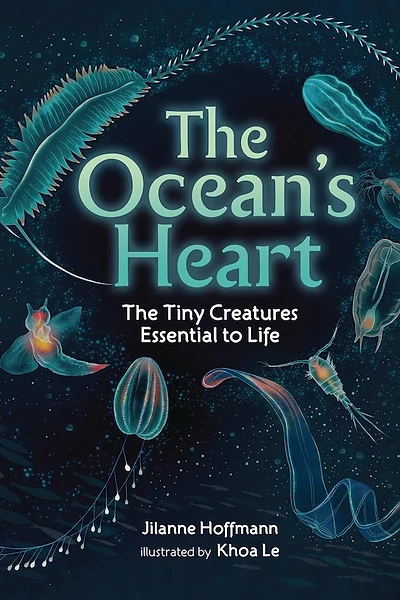
The Ocean's Heart
by Jilanne Hoffmann, illustrated by Khoa Le
Pacing MaterialA luminous exploration of the microscopic plankton that produce half the oxygen on Earth — the tiny creatures that are the heart of the ocean and essential to all life.
Big Idea
The smallest creatures can have the biggest impact — plankton are the foundation of all life in the ocean, and on Earth.
Discussion Questions
- 1.What is plankton and why is it important?
- 2.How can something so tiny be essential to life?
- 3.What would happen if plankton disappeared?
- 4.What other tiny things have a big impact?
Classroom Activity
Tiny Creature Profile
Students create a 'tiny creature' profile — researching and illustrating a microscopic ocean organism.
Lesson Plan
Learning Goals
- Explain the role of plankton in the ocean ecosystem.
- Describe how microscopic organisms support life on Earth.
- Research and profile a tiny ocean creature.
- Communicate scientific information through illustration.
Activity Steps
- 1.Read the book, noting how plankton are essential to life on Earth.
- 2.Discuss what 'essential' means and why tiny things matter.
- 3.Students research one microscopic ocean creature.
- 4.Create a profile with a drawing, size comparison, and one fun fact.
Standards Connections
- ELA: RI.2.1 — Ask and answer questions about key details
- ELA: RI.2.2 — Identify main topic and retell key details
- ELA: RI.2.3 — Describe connection between events
- ELA: RI.5.6 — Acknowledge differences in characters' points of view
- ELA: SL.2.1 — Participate in collaborative conversations about the text
- ELA: W.2.3 — Write narratives recounting events with descriptive details
- SEL: Responsible Decision-Making
Pace-Write-Read Study with Pace-Write It!
Focus question: How can a nonfiction writer make tiny creatures feel huge, urgent, and important? The Ocean's Heart: The Tiny Creatures Essential to Life by Jilanne Hoffmann, illustrated by Khoa Le, is a lyrical nonfiction picture book about zooplankton and their nightly migration through the ocean. The book presents these tiny creatures as essential to the ocean food web, using poetic science writing and luminous art to make a mostly invisible world feel dramatic and alive.
| Element | How to notice or teach it in the novel |
|---|---|
| Pace | Read: The book moves with the nightly migration: deep ocean, upward journey, feeding, danger, return. Classroom Activity: Write a 5-step movement sequence for a tiny creature. |
| Plot | Read: The plot is survival: zooplankton rise, search for food, avoid predators, and support the food web. Classroom Activity: Create a nonfiction plot chain: "To survive, ___ must ___." |
| Prosody | Read: The prose is lyrical and read-aloud friendly, with ocean-like flow. Classroom Activity: Read your draft aloud and smooth any bumpy sentence. |
| Word pause | Read: Short lines can slow readers down inside the dark, deep ocean. Classroom Activity: Break one science sentence into 3 short lines. |
| Concept | Read: The big idea: tiny life can hold up a huge ecosystem. Classroom Activity: Write one sentence: "Small does not mean ___." |
| Voice & World View | Read: The voice treats the ocean as mysterious, connected, and alive with hidden motion. Classroom Activity: Write with a voice of wonder and careful observation. |
| Setting & Place | Read: The setting is the ocean's twilight zone and surface waters. Classroom Activity: Describe one underwater place using light, depth, and motion. |
| Point of View | Read: The book uses nonfiction observer point of view, guiding readers into a hidden world. Classroom Activity: Write as a narrator showing readers what they cannot normally see. |
| Original Characters | Read: There are no invented characters; zooplankton become the real-life stars. Classroom Activity: Make a "cast" of real organisms in your ecosystem. |
| Dialogue | Read: The book relies on poetic narration, not dialogue. Classroom Activity: Add a labeled "imagined thought" only if it teaches a real fact. |
| Details | Read: Scientific details include zooplankton, migration, predators, feeding, and the food web. Classroom Activity: Add 3 exact science nouns to your piece. |
| Descriptions | Read: Descriptions build mood through darkness, glow, motion, and scale. Classroom Activity: Use one light word, one movement word, and one size word. |
| Strong First Lines | Read: A strong opening can begin deep below the surface with something tiny but powerful. Classroom Activity: Start with a small creature in a big place. |
| Immediacy & Engagement | Read: The journey creates urgency because the animals must move and survive each night. Classroom Activity: Begin with action: "Every night…" |
| Story Scenes, Summaries & Unique Structures | Read: The structure works like a migration cycle, blending poetic scene with science explanation. Classroom Activity: Structure your page as a cycle: down, up, feed, hide, return. |
| Flashback, Flash Forward & Cliffhangers | Read: The book's suspense comes from what might happen during the night journey. Classroom Activity: End one section with: "But the water is not empty." |
| Tension, Suspense & Surprise | Read: Tension comes from size contrast: tiny animals in a huge, risky ocean. Classroom Activity: Use a contrast sentence: "They are tiny, but ___." |
| Page Turns and Chapter Breaks | Read: Page turns can reveal depth, predators, movement, or the larger food web. Classroom Activity: Mark 3 page turns: deep, danger, connection. |
| Performance | Read: The lyrical text invites slow, expressive reading. Classroom Activity: Perform one paragraph like waves: soft, rising, soft again. |
| Personality | Read: The book's personality is quiet, wondrous, suspenseful, and science-rich. Classroom Activity: Choose one mood word and revise your verbs to match it. |
| Humor | Read: Humor is not the main tool; wonder and surprise do most of the pacing work. Classroom Activity: Add one surprising fact without turning the tone silly. |
| Pause | Read: Pauses help readers feel the darkness and scale of the ocean. Classroom Activity: Place your most important sentence alone. |
| Poetry and Poetic Devices | Read: The book uses lyrical nonfiction tools: rhythm, image, contrast, and repetition. Classroom Activity: Add one poetic device: alliteration, repetition, or metaphor. |
| Repetition | Read: Repeated movement patterns can echo the nightly migration. Classroom Activity: Repeat a phrase such as "up they go" or "down they drift." |
| Rhythm | Read: Rhythm can imitate swimming, pulsing, drifting, and rising. Classroom Activity: Use verbs that move: drift, pulse, rise, paddle, sink. |
| Punctuation | Read: Punctuation can create suspense, pause, or wonder. Classroom Activity: Use an ellipsis, dash, or colon to reveal a science surprise. |
| Questions | Read: The topic invites inquiry: What lives below? Why rise at night? Who depends on them? Classroom Activity: Write 3 "I wonder" questions about an unseen ecosystem. |
| Compare-Contrast | Read: The book contrasts tiny bodies with enormous importance. Classroom Activity: Create a two-column list: "Tiny / Mighty." |
| Objects | Read: A tiny zooplankton body becomes the central object of attention. Classroom Activity: Pick one small natural object and show its big role. |
| Threes | Read: Three-part lists can build rhythm and science detail. Classroom Activity: Write a three-part list of actions: "They ___, ___, and ___." |
| Whitespace & Negative Space | Read: Dark ocean scenes and open space can make tiny creatures stand out. Classroom Activity: Leave space around one small but important word. |
| Art & Graphics | Read: Khoa Le's illustrations help show scale, glow, and movement in the ocean. Classroom Activity: Sketch a spread with tiny creatures against a large dark background. |
| Interactives & Gamification | Read: The migration can become a "survival path" activity. Classroom Activity: Make a game board: rise, feed, avoid danger, return. |
Pace-Write It!
20-Minute Classroom Flow: 1. Read (5 min) — Read one spread or short section aloud. Students listen for movement words and notice how the art makes tiny creatures visible. 2. Notice (5 min) — Students mark: one movement word, one science fact, one contrast, one suspense moment, one place where the page slows down. 3. Write (7 min) — Write a lyrical nonfiction "tiny but mighty" page using this frame: Far below / inside / beneath ___, tiny ___ begin to ___. They are smaller than ___, but they help ___. Every night, they ___. Without them, ___. 4. Share (3 min) — Students read one line aloud. Classmates listen for the pacing move: rhythm, contrast, pause, repetition, or surprise. Exit ticket: What makes The Ocean's Heart feel powerful: the tiny-big contrast, the ocean setting, the nightly migration, the poetic language, or the art? Write one sentence explaining your choice.