 3-7
3-7M MISFITS
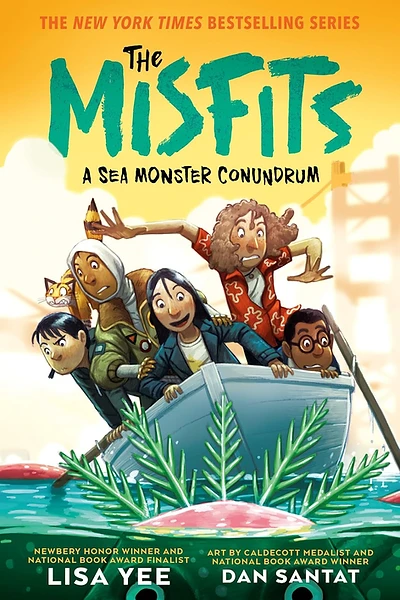
The Misfits: A Sea Monster Conundrum
by Lisa Yee, art by Dan Santat
Pacing MaterialThe Misfits face a sea monster mystery on the water.
Big Idea
True heroism lies in embracing one's unique quirks and working collaboratively to solve mysteries, proving that being a 'misfit' is a strength rather than a weakness.
Discussion Questions
- 1.How do the Misfits use their individual 'flaws' as advantages when facing the sea monster conundrum?
- 2.Why does Lisa Yee choose to emphasize the characters' differences rather than their similarities in high-stakes situations?
- 3.How does the setting of the sea influence the tone of the mystery, and why is this environment challenging for the Misfits?
- 4.Discuss the balance of humor and danger in the narrative; how does Dan Santat's art style enhance this balance?
- 5.If you were a member of the Misfits, which unique skill would you contribute to solving the mystery?
Classroom Activity
The Misfit Blueprint: Design Your Own Monster-Hunting Gadget
Students will design a specialized gadget or invention that helps their own unique persona solve a specific problem, reflecting how the Misfits utilize their personal traits as tools.
Lesson Plan
Learning Goals
- Analyze how character traits drive narrative action.
- Practice creative problem-solving through design thinking.
- Explain the connection between individual identity and collective success in a group setting.
Activity Steps
- 1.Identify a specific 'misfit' personality trait or quirk that could be seen as an advantage.
- 2.Sketch a gadget that turns that specific quirk into a problem-solving tool for a sea adventure.
- 3.Label the components of the gadget and explain its function in a short paragraph.
- 4.Present the gadget to the class, explaining how it aids the team in a monster encounter.
- 5.Reflect on how this invention mirrors the collaborative spirit of the Misfits.
Standards Connections
- ELA: RL.4.3 (Describe characters in a story)
- ELA: W.4.3 (Write narratives to develop experiences)
- SEL: Relationship Skills
- Art: Visual Arts Processes and Media
Pace-Write-Read Study with Pace-Write It!
In 'The Misfits: A Sea Monster Conundrum,' Lisa Yee masterfully orchestrates a fast-paced, humorous adventure by balancing character-driven dialogue with rapid-fire action sequences. The book serves as an excellent case study for writers who wish to learn how to weave complex personality traits into a cohesive plot without losing momentum. By examining Yee's pacing, students will discover how she utilizes short, punchy paragraphs to build suspense and longer, descriptive passages to establish the scale of the sea mystery. This study teaches writers that pacing is not just about speed, but about the rhythmic control of information to keep the reader engaged through both comedy and mystery.
| Element | How to notice or teach it in the novel |
|---|---|
| Pace | Notice how Yee accelerates the pace during sea monster encounters using short, rapid sentences. |
| Plot | Observe how the mystery of the sea monster acts as a catalyst for each Misfit to demonstrate their unique abilities. |
| Prosody | Read dialogue aloud to hear the natural, rhythmic cadence Yee gives each distinct character. |
| Word Pause | Look for how the author uses single-word sentences to create dramatic beats before a reveal. |
| Concept | The core concept centers on the subversion of the 'hero' archetype by centering characters who are outsiders. |
| Voice & World View | Examine how each Misfit views the ocean through their own unique personal filters. |
| Setting & Place | The ocean serves as a shifting, unpredictable character that dictates the physical limitations of the Misfits. |
| Point of View | Yee shifts focus to capture the collective 'we' of the Misfits, blending individual perspectives into a team dynamic. |
| Original Characters | Analyze how each character's eccentricity is rooted in a specific, relatable insecurity. |
| Dialogue | Observe how dialogue is used to show conflict rather than just relaying exposition. |
| Details | Focus on the specific, weird details of the monster's appearance that hint at its behavior. |
| Descriptions | Notice how the physical environment is described through the lens of character reaction. |
| Strong First Lines | Analyze the opening to see how Yee immediately establishes the stakes and the tone of the adventure. |
| Immediacy & Engagement | Yee drops the reader into the action quickly, bypassing long background setup. |
| Story Scenes & Summaries & Unique Structures | Observe the transition from quiet character scenes to high-stakes action scenes. |
| Flashback & Flash Forward & Cliffhangers | Identify how end-of-chapter cliffhangers maintain momentum throughout the sea mystery. |
| Tension & Suspense & Surprise | Look at how the author uses false alarms to build tension before the real monster appears. |
| Page Turns and Chapter Breaks | See how chapter breaks are timed to coincide with moments of maximum mystery. |
| Performance | Yee writes character movements that feel performative, ideal for reader-theatre style read-alouds. |
| Personality | Personality is revealed through choices made under pressure, not just through internal monologue. |
| Humor | Identify how juxtaposition—the serious sea vs. silly characters—creates humor. |
| Pause | Look for moments where the characters 'pause' to reflect, showing growth in maturity. |
| Poetry and Poetic Devices | Notice the use of alliteration in descriptions of the ocean's movement. |
| Repetition | Observe recurring character phrases that reinforce their individual quirks. |
| Rhythm | Notice the staccato rhythm of the sea monster scenes compared to the flowing rhythm of the group's planning sessions. |
| Punctuation | Analyze the use of em-dashes to interrupt thought and mimic high-stress talking. |
| Questions | Note how rhetorical questions are used to pull the reader into the mystery-solving process. |
| Compare-Contrast | Identify how the Misfits contrast with traditional 'hero' tropes in literature. |
| Objects | Pay attention to the specific tools the Misfits use, as these function as extensions of their personalities. |
| Threes | Look for the rule of three in the Misfits' attempts to lure or identify the monster. |
| Whitespace & Negative Space | Notice how white space on the page influences the pacing during moments of silence. |
| Art & Graphics | Dan Santat's illustrations act as visual punctuation, clarifying the scale and humor of the scene. |
| Interactives & Gamification | The book structure encourages readers to play along by guessing the 'monster' clues. |
Pace-Write It!
Students will spend 20 minutes rewriting a 'dull' passage of their own mystery stories by using the 'Misfit' technique: inserting one humorous character reaction and two short, high-tension sentences to increase the narrative speed.