 3-7
3-7M MISFITS
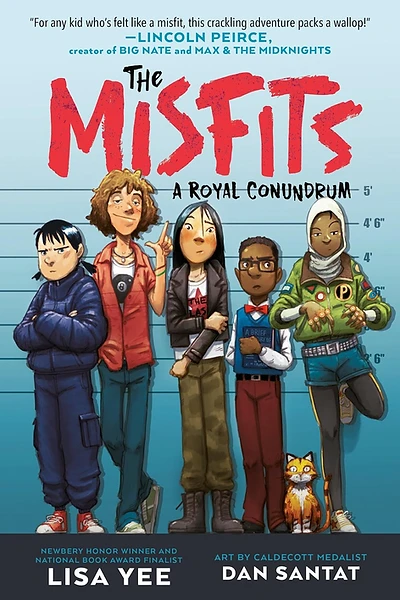
The Misfits: A Royal Conundrum
by Lisa Yee, art by Dan Santat
Pacing MaterialFive misfit kids team up on a heist-style adventure full of humor and heart.
Big Idea
True belonging is found when individuals embrace their unique quirks, proving that what makes us different is exactly what makes us capable of achieving extraordinary things together.
Discussion Questions
- 1.How do the five main characters' individual 'misfit' qualities become assets during their mission?
- 2.Why does the author use humor to balance the high-stakes tension of the heist plot?
- 3.In what ways does the setting of the Gilded Age mansion reflect the internal struggles of the characters?
- 4.How does the dynamic of the team change from the beginning of the book to the end?
- 5.What does this story suggest about the labels society puts on people, and how can we challenge them?
Classroom Activity
The Misfit Blueprint
Students will design their own 'misfit' team, assigning specific skills based on personal quirks and writing a heist plan that utilizes each team member's unique strength.
Lesson Plan
Learning Goals
- Analyze how character traits drive narrative action.
- Practice collaborative storytelling and logical sequencing.
- Explore themes of inclusivity and self-acceptance.
- Understand the structure of a heist-style plot arc.
Activity Steps
- 1.Students brainstorm five unique 'quirks' or talents that could be useful in an unconventional situation.
- 2.Groups are formed where each student presents their character archetype.
- 3.The class defines a collective 'heist' goal (e.g., retrieving a stolen masterpiece or finding a secret room).
- 4.Groups create a blueprint map and write a short summary detailing the specific role each character plays in the plan.
- 5.Each group presents their plan to the class, explaining why their 'misfits' are the only ones capable of succeeding.
Standards Connections
- CCSS.ELA-LITERACY.RL.4.3: Describe in depth a character, setting, or event in a story.
- CCSS.ELA-LITERACY.W.5.3: Write narratives to develop real or imagined experiences.
- SEL: Relationship Skills: Using teamwork to solve problems.
- SEL: Social Awareness: Empathy for diverse perspectives.
Pace-Write-Read Study with Pace-Write It!
Lisa Yee’s 'The Misfits' is a masterclass in kinetic storytelling, demonstrating how to weave complex, character-driven subplots into a fast-paced, high-stakes heist narrative. By utilizing a diverse ensemble cast, Yee teaches students how to balance multiple perspectives without sacrificing the momentum of the central plot. The interplay between Dan Santat’s dynamic illustrations and Yee’s snappy prose creates a reading experience that feels cinematic, offering students a blueprint for how visuals and text can work in tandem to drive reader engagement. Studying this book through a pacing lens allows students to observe how specific narrative structures—such as the 'ticking clock' of a heist—control the flow of information. Yee uses short, punchy chapters and constant character shifts to mirror the chaotic, unpredictable nature of being a teenager, proving that pacing isn't just about speed, but about the strategic placement of reveals, pauses, and action.
| Element | How to notice or teach it in the novel |
|---|---|
| Pace | Observe how Yee speeds up during action sequences and slows down for intimate character reflections. |
| Plot | Notice how the heist structure provides a clear trajectory for the group's journey. |
| Prosody | Encourage students to read character dialogue aloud to match the specific 'voice' of each misfit. |
| Word Pause | Identify where Yee uses short sentences for dramatic effect during high-stakes moments. |
| Concept | Discuss how the overarching theme of 'misfits belonging' anchors the entire plot. |
| Voice & World View | Focus on how each character's unique worldview shapes their reaction to the mission. |
| Setting & Place | Analyze how the opulent school setting contrasts with the characters' feelings of being out of place. |
| Point of View | Discuss how shifting perspectives keeps the reader informed of different character motivations. |
| Original Characters | Examine how Yee gives each character a distinct 'signature' behavior. |
| Dialogue | Notice how dialogue is used to establish conflict and reveal personality traits quickly. |
| Details | Look for specific quirks—like a certain way of dressing—that signal character depth. |
| Descriptions | Observe how Yee uses sensory details to describe the setting of the school. |
| Strong First Lines | Analyze how the opening hook establishes the tone immediately. |
| Immediacy & Engagement | Discuss how the present-tense urgency makes the reader feel like part of the team. |
| Story Scenes & Summaries & Unique Structures | Note the mix of traditional prose and illustrated breaks. |
| Flashback & Flash Forward & Cliffhangers | Identify where the author uses cliffhangers to maintain momentum across chapter breaks. |
| Tension & Suspense & Surprise | Discuss how the threat of being caught creates rising tension. |
| Page Turns and Chapter Breaks | Observe how chapters end on 'beats' that demand a page turn. |
| Performance | Ask students to act out scenes to capture the 'performance' of the characters' personalities. |
| Personality | Focus on how Yee uses action to define personality rather than just exposition. |
| Humor | Analyze how sarcastic humor acts as a coping mechanism for the characters. |
| Pause | Look for moments where the characters stop to reflect on their friendship. |
| Poetry and Poetic Devices | Look for alliteration or clever wordplay used by the narrator. |
| Repetition | Note any recurring themes or phrases that bind the characters together. |
| Rhythm | Discuss how the sentence length changes to match the rhythm of the action. |
| Punctuation | Observe how exclamation points or ellipses are used to show excitement or hesitation. |
| Questions | Track how the characters use questions to challenge authority or each other. |
| Compare-Contrast | Examine how the students compare themselves to their 'perfect' peers. |
| Objects | Focus on key props (like gadgets or maps) that are central to the heist. |
| Threes | Look for instances of three-part lists or events to build narrative logic. |
| Whitespace & Negative Space | Discuss how the layout of the book gives the eyes a break. |
| Art & Graphics | Analyze how Dan Santat’s art clarifies or enhances a scene’s energy. |
| Interactives & Gamification | Discuss how the book feels like a game with levels and objectives. |
Pace-Write It!
Students choose a 2-page spread from the book and rewrite a paragraph by changing the pacing: use shorter, punchier sentences to make it feel like a high-speed chase, or add descriptive 'pauses' to create a moment of intense suspense, then share their revisions to see how pace changes the story's emotional impact.