
 3-7
3-7M MISFITS
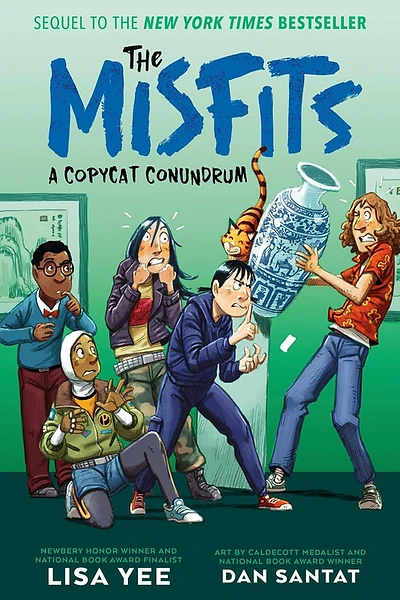
The Misfits: A Copycat Conundrum
by Lisa Yee, art by Dan Santat
Pacing MaterialThe sequel — the Misfits team tackles a museum mystery involving a copycat.
Big Idea
True belonging stems from embracing our unique quirks, and even the most unlikely group of friends can solve complex mysteries by leveraging their individual strengths.
Discussion Questions
- 1.How do the Misfits define themselves as a group, and how does this change when faced with a new challenge?
- 2.What role does the 'copycat' play in the story, and what does it say about the need for originality?
- 3.How do Lisa Yee’s descriptions of the museum atmosphere contribute to the sense of mystery?
- 4.In what ways do the characters' individual personality traits become their greatest assets during the investigation?
- 5.How does the humor in the narrative help balance the suspense of the mystery plot?
Classroom Activity
The Misfit Curator’s Museum Exhibit
Students act as museum curators designing a display that highlights the unique, non-conforming traits of their own 'Misfit' team members.
Lesson Plan
Learning Goals
- Analyze how character traits drive narrative action.
- Practice descriptive writing to build sensory details.
- Collaborate to solve a logic-based mystery puzzle.
- Recognize the importance of diverse perspectives in problem-solving.
Activity Steps
- 1.Divide students into small teams of four, assigning each person a 'specialty' role based on their interests.
- 2.Provide a blank 'exhibit floor plan' for students to map out their display.
- 3.Challenge students to write descriptions for three artifacts that represent their group's unique strengths.
- 4.Have students present their exhibit, explaining why each 'object' was chosen to represent their collective identity.
- 5.Conclude with a reflection on how these diverse traits help them 'solve' a mini-mystery provided by the teacher.
Standards Connections
- ELA: RL.5.3 (Character development)
- ELA: SL.5.1 (Collaborative discussion)
- SEL: Relationship Skills
- Art: Visual Representation
Pace-Write-Read Study with Pace-Write It!
Lisa Yee utilizes a brisk, episodic pacing that mirrors the high-stakes energy of a mystery novel. By alternating between investigation scenes and humorous character banter, she keeps the reader leaning in, waiting to see how the Misfits will react next. In this study, students will examine how Yee balances narrative momentum with character development. By dissecting the 'Copycat Conundrum,' writers can learn how to plant clues, build suspense through chapter structure, and maintain a consistent voice that defines a quirky ensemble cast.
| Element | How to notice or teach it in the novel |
|---|---|
| Pace | Observe how chapters end on 'mini-cliffhangers' to keep the reader flipping pages. |
| Plot | Map the central museum mystery against the subplot of the Misfits' team dynamics. |
| Prosody | Analyze the rhythmic patterns in character-specific dialogue to hear their unique voices. |
| Word Pause | Notice how Yee uses paragraph breaks to signal moments of realization or surprise. |
| Concept | Identify the core concept of the 'Copycat' as a metaphor for the struggle for individuality. |
| Voice & World View | Focus on how the humor frames the way the Misfits view the 'serious' adult world of the museum. |
| Setting & Place | Examine how the museum is treated as a character with its own rules and secrets. |
| Point of View | Evaluate the close third-person perspective and how it allows us to see multiple Misfits' internal reactions. |
| Original Characters | Create character profiles based on the Misfits’ specific niche skills. |
| Dialogue | Highlight how dialogue establishes hierarchy and affection within the team. |
| Details | Look for the specific, weird artifacts mentioned that serve as 'red herrings'. |
| Descriptions | Observe how Yee describes the museum's layout to create a mental map for the reader. |
| Strong First Lines | Critique the opening sentence for its immediate hook into the mystery. |
| Immediacy & Engagement | Study how the action starts within the first page to minimize exposition. |
| Story Scenes & Summaries & Unique Structures | Identify the ratio of 'in-the-moment' action to narrative summary. |
| Flashback & Flash Forward & Cliffhangers | Analyze the use of short, punchy endings to chapters. |
| Tension & Suspense & Surprise | Track the rising tension as the Copycat’s identity gets closer to being revealed. |
| Page Turns and Chapter Breaks | Discuss why specific scenes were chosen for chapter endings. |
| Performance | Notice how the characters 'perform' for one another through banter. |
| Personality | Examine how Yee uses quirks to define personality instantly. |
| Humor | Pinpoint where irony is used to deflate tense situations. |
| Pause | Look for moments of quiet reflection amidst the investigative chaos. |
| Poetry and Poetic Devices | Identify instances of alliteration used for comedic effect. |
| Repetition | Monitor recurring phrases or inside jokes that bind the group together. |
| Rhythm | Study the short sentences used during action sequences. |
| Punctuation | Analyze the use of em-dashes for interrupted thoughts and excitement. |
| Questions | Count the rhetorical questions the Misfits ask themselves to solve the mystery. |
| Compare-Contrast | Evaluate how the Misfits compare their own investigation skills to 'professional' detectives. |
| Objects | Examine how a physical prop acts as the turning point for a clue. |
| Threes | Look for the rule of three in the Misfits' decision-making processes. |
| Whitespace & Negative Space | Notice how whitespace is used to emphasize a surprising discovery on the page. |
| Art & Graphics | Discuss how Dan Santat's illustrations act as a visual narrative layer. |
| Interactives & Gamification | Identify clues hidden in the text that invite the reader to guess the culprit. |
Pace-Write It!
Students spend 10 minutes writing a 'cliffhanger' ending for a scene where they lose a crucial piece of evidence, followed by 10 minutes of swapping and predicting how the partner would solve it.