
 3-7
3-7V V ALEXANDER
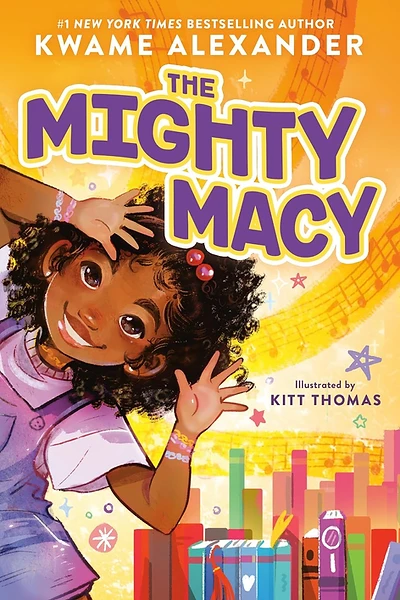
The Mighty Macy
by Kwame Alexander
Pacing MaterialMacy, a basketball-loving girl, finds her inner strength and builds confidence through the challenges of the court and life. This novel-in-verse explores themes of self-discovery and resilience.
Big Idea
Resilience is the muscle we build when we keep trying despite setbacks.
Discussion Questions
- 1.How does writing in verse change the way we read the story?
- 2.What does Macy learn about herself through basketball?
- 3.How do the people around Macy support her growth?
- 4.What are some obstacles you have faced and overcome?
- 5.How does physical activity help us develop mental strength?
Classroom Activity
Resilience Poems
Students write their own free-verse poems describing a time they showed resilience when facing a difficult task.
Lesson Plan
Learning Goals
- Identify elements of free-verse poetry
- Reflect on personal resilience
- Communicate emotions through descriptive language
Activity Steps
- 1.Analyze the poetic style of the book
- 2.Brainstorm a 'tough moment' in your own life
- 3.List sensory details and feelings associated with that moment
- 4.Draft a poem without worrying about rhyme
- 5.Share poems in small peer-review groups
Standards Connections
- CCSS.ELA-LITERACY.W.5.3
- SEL.CASEL.SelfManagement
- National Core Arts Standard TH:Cr1.1
Pace-Write-Read Study with Pace-Write It!
Focus question: How do poems and pictures help us feel Macy's shift from disappointment to speaking up? Macy finishes the first Mighty Zora book and hurries to her school library for the next one—only to find its hours have been cut. With encouragement from classmates, her mom, and poems left by her father, she works toward speaking up for the library. Alexander tells this early chapter book in verse, with illustrations by Kitt Thomas.
| Element | How to notice or teach it in the novel |
|---|---|
| Pace, plot & concept | Follow the steps from wanting a book → finding the library closed → deciding what to do → speaking up. Where does Macy act quickly? Where does she need time to think? Classroom Activity: Draw four story boxes. Label each fast, slow, or pause, and explain one label. |
| Prosody, word pause, performance & rhythm | Read a verse page aloud. Let each line break guide your breath. Compare how a playful page and a thoughtful page sound. Classroom Activity: Mark pauses on four lines of an original poem. Read it twice, changing one pause to hear its effect. |
| Voice, worldview, point of view & personality | Notice which words show Macy's love of books and her way of seeing the library. Compare how she sounds when she is excited and when she is finding the courage to speak. Classroom Activity: Write six lines beginning "At our library…" in the voice of a character who loves one particular thing about it. |
| Setting, place, details & descriptions | Compare the feeling of the library Macy hopes to enter with the closed door she finds. What small detail makes the change clear? Classroom Activity: Describe the same place in two three-line poems: when it is open and when it is closed. |
| Original characters, dialogue & humor | Watch how classmates and family members help Macy. Notice where a funny exchange gives the story a lighter beat. Classroom Activity: Write a four-line conversation in which a friend offers Macy an idea; give each speaker a distinct voice. |
| Strong first lines, immediacy & engagement | Examine the opening of a chapter or poem. Does it begin with an action, feeling, question, or surprising detail? Classroom Activity: Draft two openings for a story about a favorite place: one begins with excitement, the other with an unexpected change. |
| Story scenes, summaries & unique structures | Find a moment the book slows down to show closely. Compare it with lines that move quickly through an activity or part of the day. Notice how a poem from Macy's father adds another voice to the story. Classroom Activity: Summarize a school day in one sentence, then expand its most important moment into five verse lines. |
| Flashback, flash forward & cliffhangers | If Macy recalls an earlier moment, ask why that memory appears there. A hope about what might happen next is a prediction, not a flash forward. Check whether a chapter ends with something unresolved. Classroom Activity: End a short scene just before a character shares an idea. Let the next page reveal it. |
| Tension, suspense & surprise | The question is whether Macy can find a way to help her library. Notice how each attempt changes what she needs to do next. Classroom Activity: Write three gentle obstacles for a character trying to improve a shared space. Give each obstacle a possible solution. |
| Page turns & chapter breaks | Look at what a page or chapter ending makes you expect. How soon does the next page answer that expectation? Classroom Activity: Place a page break before or after a discovery. Ask a partner which placement makes them want to turn the page. |
| Pause, poetry, poetic devices, repetition & punctuation | Look for repeated words or sounds. Notice how a brief line, punctuation mark, or bit of empty space can make one idea stand out. Classroom Activity: Write a five-line poem repeating one important word. Use a line break to make readers pause before its final appearance. |
| Questions, compare–contrast & threes | Compare Macy at the beginning, middle, and end. What does she want, what does she try, and what can she say for herself? Classroom Activity: Make a three-part speaking plan: what matters → what changed → what could help. |
| Objects | Follow the Mighty Zora book, the library sign, or one of Dad's hidden poems. How does each object prompt Macy to think or act? Classroom Activity: Choose one object from a favorite place. Write three lines about why it matters. |
| Whitespace, negative space, art & graphics | Look at the space around the verse and at Thomas's illustrations. How do the picture, the position of words, and the open space tell you where to look or pause? The publisher notes that words sometimes stretch, shrink, or scatter across the page. Classroom Activity: Make two versions of one original line: place it in a block of text, then give it its own space and small drawing. Compare the effect. |
| Interactives & gamification | Turn the class into pacing detectives who find evidence on the page. Classroom Activity: In pairs, place sticky notes labeled GO, SLOW, and STOP on three pages. Point to the words or pictures that support each choice. |
Pace-Write It!
Exit ticket: Choose one illustrated verse page. Complete: "This page makes me read ______ because the words ______ and the picture ______."