
 2-5
2-5R LANG
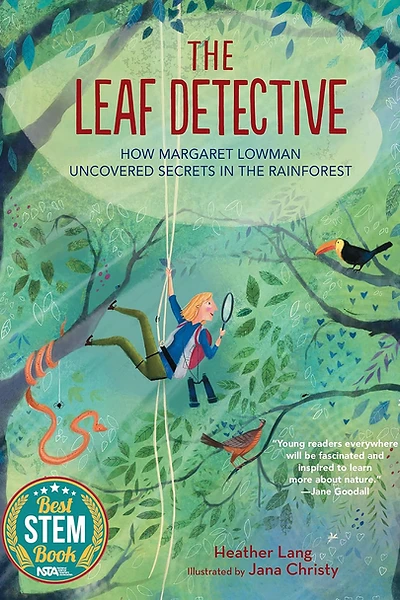
The Leaf Detective
by Heather Lang, Illustrated by Jana Christy
Pacing MaterialBig Idea
Through curiosity, perseverance, and scientific innovation, Meg Lowman proved that the rainforest canopy is a vital, interconnected ecosystem worth protecting.
Discussion Questions
- 1.Why did Meg Lowman feel it was important to study the treetops when most scientists were only looking at the forest floor?
- 2.What were some of the obstacles Meg faced as a woman in science, and how did she overcome them?
- 3.The book calls trees 'soldiers against climate change.' Based on the text, what does this mean?
- 4.How did Meg use her voice and research to advocate for the rainforests beyond just studying them?
- 5.What does it mean to be a 'detective' of nature, and how can you apply that mindset to your own backyard or local park?
Classroom Activity
Canopy Explorer: Mapping the Layers
Students will create a multi-layered diagram of a rainforest to understand the unique biodiversity found in the canopy compared to the forest floor, mirroring Meg Lowman's research.
Lesson Plan
Learning Goals
- Identify the different layers of the rainforest ecosystem.
- Explain the importance of the canopy for biodiversity and climate health.
- Analyze how scientific inquiry leads to environmental advocacy.
- Demonstrate understanding of biographical narrative structure.
Activity Steps
- 1.Read 'The Leaf Detective' aloud, pausing to discuss the challenges Meg faced in reaching the canopy.
- 2.Provide students with large paper to draw a cross-section of a rainforest tree.
- 3.Have students research or recall specific animals and plants that live in the canopy versus the forest floor.
- 4.Students label their diagrams, highlighting the 'secrets' Meg discovered in the treetops.
- 5.Students write a short 'field note' from the perspective of a scientist observing the canopy for the first time.
Standards Connections
- CCSS.ELA-LITERACY.RI.3.3: Describe the relationship between a series of historical events or scientific ideas.
- NGSS 3-LS4-3: Construct an argument with evidence that in a particular habitat some organisms can survive well, some survive less well, and some cannot survive at all.
- SEL Competency: Social Awareness (recognizing the impact of human actions on the environment).
Pace-Write-Read Study with Pace-Write It!
The Pace-Write-Read study of 'The Leaf Detective' invites students to examine how Heather Lang uses narrative momentum to mirror the excitement of scientific discovery. By analyzing the rhythm of the text, students learn how to balance the 'slow' moments of scientific observation with the 'fast' moments of overcoming obstacles and advocacy. This approach encourages students to see the book not just as a biography, but as a blueprint for storytelling. By tracking the pacing, students will identify how the author builds tension through the challenges Meg faces, leading to a satisfying resolution that emphasizes the importance of environmental stewardship.
| Element | How to notice or teach it in the novel |
|---|---|
| Pace | The pace accelerates during Meg's attempts to climb trees and slows down during her detailed observations of leaves. |
| Plot | The plot follows a classic biographical arc: curiosity, struggle, discovery, and advocacy. |
| Prosody | Read with wonder during descriptions of the canopy and with firm resolve during the sections about conservation. |
| Word Pause | Use pauses after the author lists the functions of a tree to allow the weight of the information to sink in. |
| Concept | The central concept is the 'hidden' world of the canopy as a vital life-support system. |
| Voice & World View | The voice is encouraging and persistent, reflecting Meg's own optimistic but serious worldview. |
| Setting & Place | The setting shifts from the ground to the high canopy, emphasizing the verticality of the rainforest. |
| Point of View | The story is told in the third person, allowing for a broad perspective on Meg's life and impact. |
| Original Characters | Meg is the primary focus, but the trees themselves act as characters with their own 'needs' and 'jobs.' |
| Dialogue | Dialogue is used sparingly to highlight key moments of rejection or realization. |
| Details | Focus on the specific, small details of leaves and insects that Meg notices. |
| Descriptions | The descriptions are lush and vibrant, painting the canopy as a 'marvelous, undiscovered world.' |
| Strong First Lines | The opening immediately establishes Meg's fascination with what is above her head. |
| Immediacy & Engagement | The author uses active verbs to make the reader feel like they are climbing the trees with Meg. |
| Story Scenes & Summaries & Unique Structures | The book uses a mix of narrative scenes and summary to cover a lifetime of scientific work. |
| Flashback & Flash Forward & Cliffhangers | The narrative moves chronologically but uses the threat of deforestation as a recurring 'cliffhanger' of urgency. |
| Tension & Suspense & Surprise | Tension is built through the obstacles Meg faces from male-dominated academia and the physical danger of climbing. |
| Page Turns and Chapter Breaks | Page turns are used to reveal the vastness of the canopy after a close-up of a leaf. |
| Performance | Encourage students to read the 'Lorax' comparison with a sense of pride and importance. |
| Personality | Meg's personality is defined by her 'perseverance and creativity.' |
| Humor | Light humor is found in the absurdity of people ignoring the world right above their heads. |
| Pause | Pause before the reveal of how Meg finally solves the problem of reaching the canopy. |
| Poetry and Poetic Devices | The text uses lyrical language to describe the trees as 'soldiers' and 'inventors.' |
| Repetition | The repetition of the idea that 'a tree is not just a tree' reinforces the book's core message. |
| Rhythm | The rhythm mimics the steady, methodical pace of a scientist at work. |
| Punctuation | Em-dashes are used to create dramatic pauses and emphasize key discoveries. |
| Questions | The book poses implicit questions about our relationship with nature. |
| Compare-Contrast | The book contrasts the 'ground-level' view of science with the 'canopy-level' view. |
| Objects | The rope and the canopy walkway are key objects that symbolize Meg's innovation. |
| Threes | The author often lists three benefits of trees to emphasize their complexity. |
| Whitespace & Negative Space | Whitespace is used to let the illustrations of the towering trees breathe. |
| Art & Graphics | The illustrations provide a visual map of the canopy layers, essential for understanding the setting. |
| Interactives & Gamification | The book invites readers to become 'detectives' themselves, gamifying the act of observation. |
Pace-Write It!
In 20 minutes, have students write a 'Discovery Log' entry. They must choose one object in their classroom or home and describe it as if they are a scientist seeing it for the first time, using at least three 'poetic' descriptors (e.g., 'a pencil is a wooden wand of knowledge').