
 3-7
3-7C LAST KIDS
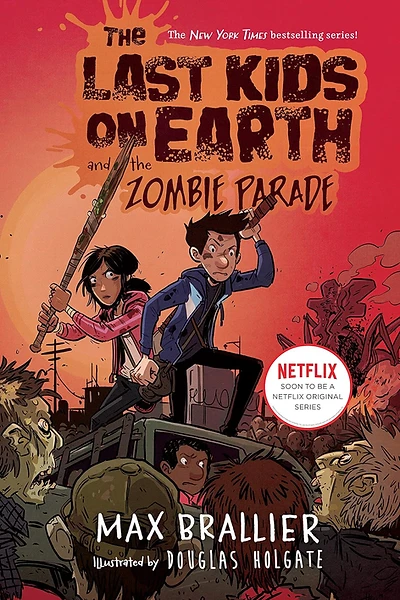
The Last Kids on Earth and the Zombie Parade
by Max Brallier, Illustrated by Douglas Holgate
Pacing MaterialIn this exciting sequel, Jack and his friends discover that the zombies are not just aimless creatures, but are becoming organized and intelligent. As the 'Zombie Parade' threatens their stronghold, the group must investigate the origin of this evolution. They must balance their survival instincts with the need to solve a growing mystery while expanding their community.
Big Idea
Adaptability and critical thinking are essential when facing changing problems that require new solutions.
Discussion Questions
- 1.Why is the sudden organization of the zombies more frightening than them being mindless?
- 2.How does the group's dynamic shift as they encounter new threats and potential allies?
- 3.What does the 'Zombie Parade' symbolize in terms of how the world is changing for the characters?
- 4.How do the characters handle the frustration of failed plans or ineffective weapons?
- 5.How does loyalty to one another change when the stakes of the mystery increase?
Classroom Activity
Zombie Behavior Tracker
Students create a scientific field report analyzing the changing patterns and behaviors of the evolving monsters in the story.
Lesson Plan
Learning Goals
- Identify cause-and-effect relationships in the plot.
- Use evidence from the text to track character and environmental changes.
- Develop skills in observational note-taking and analysis.
Activity Steps
- 1.Create a chart with three columns: Observed Behavior, Potential Cause, and Survival Strategy.
- 2.Identify three key moments where the zombies or monsters change their actions in the book.
- 3.Fill in the chart using specific examples from the text.
- 4.Write a short paragraph summarizing why the creatures are becoming more dangerous.
- 5.Compare your chart with a classmate to see if you identified different patterns.
Standards Connections
- CCSS.ELA-LITERACY.RI.4.1: Refer to details and examples in a text when explaining what the text says explicitly.
- CASEL SEL: Responsible Decision-Making (Evaluating consequences).
- National Core Art Standard: Responding (Interpreting intent and meaning).
Pace-Write-Read Study with Pace-Write It!
Focus question: How does Max Brallier speed up and slow down the action in The Last Kids on Earth and the Zombie Parade to make readers feel both danger and friendship? In The Last Kids on Earth and the Zombie Parade by Max Brallier, Jack tells a fast-moving survival adventure where every new zombie problem seems to raise the stakes. The book uses quick chapters, comic-style illustrations, jokes, cliffhangers, and bursts of action to keep the pacing lively while also pausing for teamwork, mystery, and character reactions.
| Element | How to notice or teach it in the novel |
|---|---|
| Pace | Read: Notice how the story races during zombie attacks and chases, then slows when Jack, Quint, June, and Dirk plan, argue, or investigate why the zombies seem more organized. Classroom Activity: Write a two-part scene in which your characters first sprint from danger in 4-5 short sentences, then stop to make a survival plan in 4-5 longer sentences. |
| Plot | Read: Track how the plot grows from simple survival to a larger mystery as Jack and his friends realize the zombie parade is connected to smarter, more purposeful monsters. Classroom Activity: Create a plot ladder with five steps for an adventure story, ending with a new clue that changes what the heroes thought they knew. |
| Prosody | Read: Listen to how Jack’s narration sounds energetic, dramatic, and playful, especially when he describes monsters, battles, and his friends’ reactions. Classroom Activity: Rewrite a calm sentence like 'We walked outside' so it sounds bold and action-packed in Jack-style narration. |
| Word pause | Read: Notice places where a single word, a short phrase, or a dramatic line break makes readers pause before the next scary or funny moment. Classroom Activity: Write 6-8 lines of action and use one one-word sentence for emphasis, such as 'Boom.' or 'Wait.' |
| Concept | Read: Notice the big idea that survival is not only about fighting monsters, but also about trust, teamwork, and solving the mystery behind the zombie parade. Classroom Activity: Write a paragraph explaining a survival rule your own group follows and how that rule changes when friendship becomes more important than fear. |
| Voice & World View | Read: Notice how Jack’s voice makes the apocalypse feel adventurous, funny, and a little outrageous instead of only dark and hopeless. Classroom Activity: Describe a dangerous setting from the point of view of a narrator who is excited by the challenge instead of scared by it. |
| Setting & Place | Read: Pay attention to how the post-apocalyptic town, stronghold spaces, streets, and monster-filled zones shape what the group can do and how quickly events unfold. Classroom Activity: Draw or list three places in a survival setting, then write one sentence for each showing how that place creates either safety or danger. |
| Point of View | Read: Notice that Jack’s point of view lets readers experience the zombie parade mystery through his ideas, exaggerations, and emotions. Classroom Activity: Rewrite a tense moment from June’s or Quint’s point of view to show how pacing changes when a different character notices different details. |
| Original Characters | Read: Notice how Jack, Quint, June, and Dirk each react differently to danger, which keeps scenes moving through conflict, jokes, and teamwork. Classroom Activity: Invent a new member for the team and write 5-6 sentences showing how that character helps during a zombie emergency. |
| Dialogue | Read: Listen for how dialogue between Jack and his friends speeds scenes up, reveals personality, and shows problem-solving under pressure. Classroom Activity: Write a dialogue-only exchange of 8 lines where a team argues about whether to hide, fight, or investigate. |
| Details | Read: Notice the specific survival details, monster details, and action details that help readers picture the parade and the group’s stronghold. Classroom Activity: List five precise details from an imagined monster attack, then use all five in a short paragraph. |
| Descriptions | Read: Watch how descriptions of zombies, movement, and battle gear are vivid but not so long that they slow the action too much. Classroom Activity: Describe a creature in 3 sentences, making sentence 1 visual, sentence 2 about sound or movement, and sentence 3 about why it is dangerous. |
| Strong First Lines | Read: Notice how chapter openings quickly pull readers into a problem, question, or comic situation so the story never feels slow. Classroom Activity: Write three different opening lines for a chapter book scene about discovering something strange outside a safe base. |
| Immediacy & Engagement | Read: Notice how Jack often makes events feel like they are happening right now, which keeps readers close to the action and the mystery. Classroom Activity: Write a 5-sentence moment using words like 'now,' 'suddenly,' or 'right then' to make the action feel immediate. |
| Story Scenes & Summaries & Unique Structures | Read: Notice how the book balances full action scenes with quicker summaries that move readers from one monster problem to the next. Classroom Activity: Write one detailed scene of 6-8 sentences and then a 2-sentence summary that jumps your characters ahead to the next challenge. |
| Flashback & Flash Forward & Cliffhangers | Read: Notice how reminders of earlier survival experiences and chapter-ending cliffhangers keep readers alert to what may happen next. Classroom Activity: End a paragraph with a cliffhanger about a strange sound, shadow, or signal that makes readers need the next chapter. |
| Tension & Suspense & Surprise | Read: Notice how the friends’ discovery that zombies may be changing creates suspense because the danger is no longer simple or predictable. Classroom Activity: Write a suspense paragraph where your characters think they understand the threat, then add one surprise sentence that changes everything. |
| Page Turns and Chapter Breaks | Read: Notice how short chapters and end-of-chapter reveals encourage readers to keep going, especially when Jack and the team uncover new clues. Classroom Activity: Write a chapter ending of 3-4 sentences that makes a reader want to turn the page immediately. |
| Performance | Read: Notice how the book feels performative, as if Jack is telling the story out loud with dramatic timing, sound effects, and big reactions. Classroom Activity: Turn a short action paragraph into a read-aloud script with stage directions, sound effects, and one dramatic pause. |
| Personality | Read: Notice how each friend’s personality affects pacing: Quint may slow things down to think, while Jack may charge forward, and Dirk may add bold energy. Classroom Activity: Write a scene where two characters with opposite personalities must decide what to do next during an emergency. |
| Humor | Read: Notice how humor appears even during danger, making the story feel fun and keeping the tone from becoming too heavy. Classroom Activity: Write a scary scene that includes one funny observation or line of dialogue without ruining the tension. |
| Pause | Read: Notice the moments when the action pauses so characters can react, rethink, or notice that the zombie parade means something bigger. Classroom Activity: After writing 5 fast action sentences, add 2 pause sentences that show what your main character suddenly realizes. |
| Poetry and Poetic Devices | Read: Notice how sound effects, exaggerated comparisons, and punchy language make action scenes feel vivid and memorable. Classroom Activity: Write 4-5 lines describing a monster using alliteration, simile, or onomatopoeia. |
| Repetition | Read: Notice how repeated ideas about survival, friendship, and strange zombie behavior help build momentum across the book. Classroom Activity: Write a short paragraph that repeats a key phrase such as 'We had one rule' or 'Something was wrong' three times for effect. |
| Rhythm | Read: Notice how short, choppy sentences speed up fights and longer sentences slow down planning or explanation. Classroom Activity: Write one fast paragraph using mostly short sentences and one slower paragraph using longer sentences about the same event. |
| Punctuation | Read: Notice how dashes, exclamation points, ellipses, and question marks help control timing, excitement, and surprise in Jack’s storytelling. Classroom Activity: Write 5-6 sentences of action and use at least three different punctuation marks to create dramatic pacing. |
| Questions | Read: Notice how the mystery grows because readers and characters keep asking why the zombies are acting differently and what is causing the parade. Classroom Activity: Write a paragraph in which your narrator asks three questions while investigating a new threat. |
| Compare-Contrast | Read: Compare the mindless zombies the kids expect with the more organized danger they actually face, and notice how this raises the stakes. Classroom Activity: Write a compare-contrast paragraph about 'the threat we expected' versus 'the threat we found.' |
| Objects | Read: Notice how gear, vehicles, tools, and defensive objects matter in this survival world because they help solve problems and shape scenes. Classroom Activity: Choose one survival object and write 4-5 sentences showing how it becomes important during an attack. |
| Threes | Read: Notice how lists of three actions, three problems, or three character reactions can make scenes feel balanced, funny, and memorable. Classroom Activity: Write a sentence or two that lists three signs that danger is getting closer. |
| Whitespace & Negative Space | Read: Notice how breaks between paragraphs, short bursts of text, and visual spacing help intense moments feel faster and clearer. Classroom Activity: Format a short action scene with at least three paragraph breaks to control pauses and speed. |
| Art & Graphics | Read: Notice how Douglas Holgate’s illustrations add motion, humor, and quick understanding, helping readers feel the pace of battles and monster reveals. Classroom Activity: Sketch a key moment from your scene, then write 3 sentences explaining how the image changes the pacing of the text. |
| Interactives & Gamification | Read: Notice how the survival setup of teams, strongholds, monsters, and missions can feel like levels in a game, pushing the story forward step by step. Classroom Activity: Design a 'mission card' for Jack’s team with an objective, obstacle, reward, and final twist, then write the opening paragraph of that mission. |
Pace-Write It!
20-Minute Classroom Flow\nRead (5 min): Read aloud a short action-centered excerpt in which Jack and his friends react to the zombie parade or to the discovery that the zombies are changing. Ask students to listen for where the story speeds up and where it pauses.\nNotice (5 min): Chart what students notice about pacing: short sentences, cliffhangers, dialogue, humor during danger, and pauses for planning or realizing something important. Prompt: How does Max Brallier make us feel both the danger and the teamwork?\nWrite (7 min): Students write their own survival-mystery scene inspired by Jack, Quint, June, and Dirk’s style. Writing frame: 'At first, we thought ________. Then we noticed ________. Jack-style fast action: ________! ________! ________! But when we stopped, I realized ________. If the zombies were really ________, then our team had to ________ before ________.' Encourage students to include one short sentence for speed, one line of dialogue, and one cliffhanger ending.\nShare (3 min): Partners read their scenes aloud and identify one place where the pacing speeds up and one place where it slows down effectively.\nExit ticket: Write one sentence answering: What is one craft move Max Brallier uses in The Last Kids on Earth and the Zombie Parade to control pacing, and how did you try it in your own writing?