
 K-5
K-5C LAST KIDS
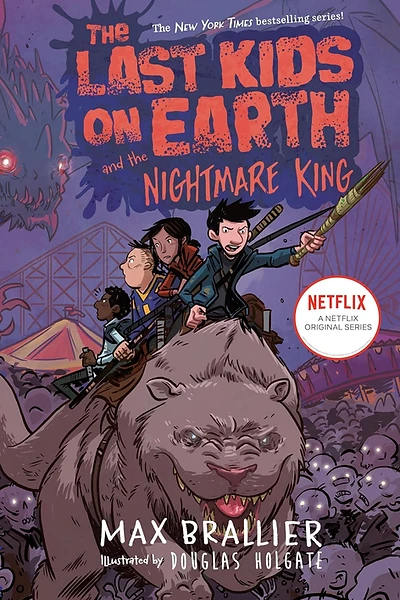
The Last Kids on Earth and the Nightmare King
by Max Brallier, Douglas Holgate
Pacing MaterialThe third book in Max Brallier's middle-grade series. Jack Sullivan and his friends — June, Quint, and Dirk — are living in their post-apocalyptic treehouse when they learn of a powerful new threat: the Nightmare King, an ancient evil that commands monsters and could end what's left of their world. The group embarks on a quest to stop it, blending humor, video-game-style action, and Doug Holgate's cartoon illustrations throughout. Like the rest of the series, it's aimed at roughly ages 8–12 and
Big Idea
In 'The Last Kids on Earth and the Nightmare King,' Jack Sullivan learns that true friendship is defined by supporting others' growth and new discoveries, rather than clinging to a comfortable status quo. The story explores how facing internal fears is just as critical as battling external monsters.
Discussion Questions
- 1.Why is Jack so afraid of the possibility that there are other kids left on Earth?
- 2.How does the 'Nightmare King' serve as a metaphor for the fears Jack has about his life changing?
- 3.In what ways do the illustrations by Douglas Holgate change how you perceive the action compared to reading text alone?
- 4.How do Jack, June, Quint, and Dirk balance their individual strengths to survive as a team?
- 5.If you were in Jack's position, would you prefer to stay in the 'perfect' treehouse or search for other survivors? Why?
Classroom Activity
Design Your Own Apocalypse Survival Base
Students will design and map out their own ultimate survival treehouse or base, incorporating specific defenses, resource storage, and 'fun' zones inspired by Jack’s treehouse in the book.
Lesson Plan
Learning Goals
- Analyze how setting influences character behavior and plot development.
- Practice creative problem-solving by designing a functional space for survival.
- Identify and explain the importance of teamwork and individual roles in a group setting.
- Synthesize visual and textual information to create a cohesive design.
Activity Steps
- 1.Review the descriptions and illustrations of Jack’s treehouse in the book to identify key features like defenses and entertainment.
- 2.Brainstorm a list of 'essential' items for survival versus 'comfort' items that keep morale high.
- 3.Sketch a blueprint of a personal survival base, labeling the different zones (e.g., 'Monster Defense Zone,' 'Supply Storage,' 'Gaming/Relaxation Area').
- 4.Write a short paragraph explaining why each chosen feature is necessary for both survival and happiness.
- 5.Present the designs to the class, explaining how the base would help them survive the Nightmare King’s forces.
Standards Connections
- ELA: RL.4.3 (Describe in depth a character, setting, or event in a story)
- ELA: W.4.2 (Write informative/explanatory texts to examine a topic)
- Art: Visual Literacy (Use visual elements to communicate ideas)
- SEL: Relationship Skills (Collaborative problem solving)
Pace-Write-Read Study with Pace-Write It!
The Last Kids on Earth series is a masterclass in 'hybrid' pacing, where the narrative speed is dictated by the interplay between high-octane prose and graphic-novel-style illustrations. Max Brallier uses short, punchy sentences to mirror the frantic energy of a video game, while Douglas Holgate’s art acts as a visual 'pause' that allows the reader to process the scale of the monster-filled world. This book teaches students that pacing isn't just about word count; it is about the rhythm of information delivery. By studying this book, students learn how to manipulate the reader's experience through structural choices. The book uses cliffhangers and rapid-fire dialogue to keep the reader moving, but balances this with moments of introspection where the pacing slows down to explore Jack’s internal anxieties. This contrast is essential for teaching students how to control the 'speed' of their own writing to keep their audience engaged.
| Element | How to notice or teach it in the novel |
|---|---|
| Pace | Notice how the action scenes use short, fragmented sentences to speed up the reader's heart rate. |
| Plot | The plot is driven by the tension between Jack’s desire for stability and the group’s need for growth. |
| Prosody | Encourage students to read the dialogue with the 'voice' of a teenager—fast, informal, and often humorous. |
| Word Pause | Look for single-word sentences or lines that stand alone to emphasize a sudden realization or shock. |
| Concept | The core concept is 'video-game-logic' applied to real-life survival. |
| Voice & World View | Jack’s voice is consistently that of a kid trying to act brave while feeling insecure. |
| Setting & Place | The treehouse is a character itself; notice how its description changes as the threat level rises. |
| Point of View | The first-person perspective keeps the reader trapped in Jack’s limited, often biased, understanding of the world. |
| Original Characters | Each character has a specific 'class' or role (e.g., Quint as the inventor) that defines their contribution. |
| Dialogue | Dialogue is used to establish the banter and history between the four friends. |
| Details | Focus on the specific brands or items (like Oreos) that ground the fantasy in a recognizable reality. |
| Descriptions | Descriptions are often paired with illustrations; notice how the text describes the 'feel' while the art shows the 'look.' |
| Strong First Lines | The opening lines immediately establish the 'new normal' of the apocalypse. |
| Immediacy & Engagement | The book uses direct address to the reader to make them feel like part of the crew. |
| Story Scenes & Summaries & Unique Structures | The book alternates between traditional prose and comic-style panels to break up the narrative flow. |
| Flashback & Flash Forward & Cliffhangers | Cliffhangers are used at the end of almost every chapter to force the reader to turn the page. |
| Tension & Suspense & Surprise | Tension is built by the looming threat of the Nightmare King, which is always present in the background. |
| Page Turns and Chapter Breaks | Chapter breaks are strategically placed to maximize the impact of a reveal. |
| Performance | The text is written to be read aloud with high energy and dramatic pauses. |
| Personality | Jack’s personality is defined by his humor, which he uses as a defense mechanism. |
| Humor | Humor is used to deflate the tension of scary situations, making the apocalypse feel manageable. |
| Pause | Use the illustrations as a 'visual pause' to let the reader catch their breath after an action sequence. |
| Poetry and Poetic Devices | Look for onomatopoeia in the action scenes (e.g., 'KRAK!', 'BOOM!'). |
| Repetition | Repetition of the 'rules' of the apocalypse helps reinforce the world-building. |
| Rhythm | The rhythm of the prose mimics the fast-paced nature of the video games Jack loves. |
| Punctuation | Frequent use of exclamation points and dashes creates a sense of urgency and excitement. |
| Questions | Jack often asks rhetorical questions to the reader to build intimacy. |
| Compare-Contrast | Compare Jack’s life before the apocalypse to his life now. |
| Objects | Objects like the sword or the treehouse are symbols of the characters' identities. |
| Threes | Look for lists of three items or actions that create a satisfying cadence. |
| Whitespace & Negative Space | The layout uses whitespace to make the text feel less dense and more accessible. |
| Art & Graphics | The art is not just decoration; it is essential for understanding the scale of the monsters. |
| Interactives & Gamification | The book includes 'game-like' elements such as monster stats and level-ups. |
Pace-Write It!
Students will write a 200-word 'Action Sequence' where they must include one 'visual break' (a description of an illustration) and one 'cliffhanger' ending. They will then swap papers to see if their partner feels the urge to keep reading.