 K-5
K-5C LAST KIDS
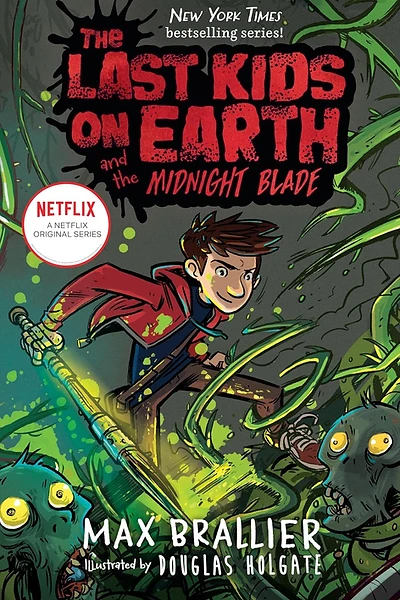
The Last Kids on Earth and the Midnight Blade
by Max Brallier, Douglas Holgate
Pacing MaterialBig Idea
True strength comes from the bonds of friendship and the courage to face the unknown, even when the world as we know it has changed forever.
Discussion Questions
- 1.How does Jack’s relationship with his friends help him cope with the dangers of the Monster Apocalypse?
- 2.Why is it important for Jack to learn to control the power of the Louisville Slicer rather than just relying on it?
- 3.How do the illustrations in the book change the way you understand the action scenes compared to just reading text?
- 4.If you were in Jack’s position, what is one 'tricked-out' feature you would add to your own survival base?
- 5.What does the 'Midnight Blade' represent in terms of Jack’s growth as a hero throughout the story?
Classroom Activity
Design Your Own Monster-Proof Gadget
Students will channel their inner Quint Baker by designing a unique, functional gadget or weapon to help survive the Monster Apocalypse, explaining its purpose and how it works.
Lesson Plan
Learning Goals
- Analyze character traits and their roles in problem-solving.
- Demonstrate understanding of narrative structure by creating a functional invention.
- Practice descriptive writing by explaining the mechanics and utility of an original invention.
- Collaborate with peers to brainstorm creative solutions to fictional challenges.
Activity Steps
- 1.Review the inventions Quint creates in the book to understand how he combines science and survival.
- 2.Brainstorm a specific monster-related problem that needs a creative solution.
- 3.Sketch the invention on paper, labeling key parts and special features.
- 4.Write a short 'User Manual' paragraph describing how the gadget functions and why it is effective.
- 5.Present the invention to the class, explaining how it would help Jack and his friends.
Standards Connections
- ELA: RL.3.3 (Describe characters in a story and explain how their actions contribute to the sequence of events)
- ELA: W.3.2 (Write informative/explanatory texts to examine a topic)
- Art: Visual Literacy (Use visual elements to communicate ideas)
- SEL: Responsible Decision-Making (Identifying problems and generating solutions)
Pace-Write-Read Study with Pace-Write It!
The Last Kids on Earth and the Midnight Blade serves as a masterclass in hybrid storytelling, blending traditional prose with graphic novel elements to maintain a breakneck pace. By studying this book, students learn how to balance internal monologue with external action, using the 'Pace-Write-Read' method to understand how authors manipulate time and tension to keep readers engaged. This book teaches the craft of writing by demonstrating how to use visual breaks to reset the reader's rhythm. Students will observe how Brallier uses short, punchy sentences to mirror the urgency of a monster attack, while Holgate’s illustrations provide the necessary 'breathing room' that allows the reader to process the world-building without slowing the narrative momentum.
| Element | How to notice or teach it in the novel |
|---|---|
| Pace | Notice how the author uses short, fragmented sentences during combat scenes to speed up the reader's heart rate. |
| Plot | The plot is driven by a race against time; identify the 'ticking clock' moments that force Jack to act. |
| Prosody | Encourage students to read dialogue with the exaggerated, energetic tone of a comic book hero. |
| Word Pause | Look for single-word lines on a page that force the reader to stop and emphasize a moment of shock. |
| Concept | The core concept is 'survival meets friendship'; track how this theme anchors the wild monster action. |
| Voice & World View | Jack’s voice is that of an optimistic survivor; notice how he finds humor even in the apocalypse. |
| Setting & Place | The treehouse is a character itself; observe how the setting provides safety in a chaotic world. |
| Point of View | The first-person perspective allows us to feel Jack’s personal fears and triumphs directly. |
| Original Characters | Analyze how each friend brings a unique skill set (science, strength, strategy) to the group dynamic. |
| Dialogue | Dialogue is snappy and informal; notice how it reveals character personality without long descriptions. |
| Details | Focus on the specific, gritty details of the monsters to make the world feel tangible. |
| Descriptions | Descriptions are often visual; compare how the text describes a monster versus how the art shows it. |
| Strong First Lines | The opening lines immediately establish the stakes; discuss why they hook the reader instantly. |
| Immediacy & Engagement | The book uses direct address to the reader to make them feel like part of the crew. |
| Story Scenes & Summaries & Unique Structures | Identify how the book switches between prose chapters and graphic novel-style action sequences. |
| Flashback & Flash Forward & Cliffhangers | Analyze how chapter endings use cliffhangers to ensure the reader turns the page. |
| Tension & Suspense & Surprise | Tension is built through the threat of the unknown; track how the author hides the villain until the right moment. |
| Page Turns and Chapter Breaks | Observe how the layout of the page forces a pause before a big reveal. |
| Performance | The text is written to be read aloud with high energy and dramatic flair. |
| Personality | Jack’s personality is defined by his resilience; look for moments where he doubts himself but keeps going. |
| Humor | Humor acts as a pressure valve; notice how jokes are placed right after intense scenes. |
| Pause | Identify the quiet moments in the treehouse that contrast with the loud monster battles. |
| Poetry and Poetic Devices | Look for onomatopoeia (e.g., 'CRASH', 'BOOM') that acts as a poetic device for sound. |
| Repetition | Repetition of phrases like 'The Last Kids on Earth' reinforces the group's identity. |
| Rhythm | The rhythm of the book mimics a video game; fast, then slow, then fast again. |
| Punctuation | Notice the use of exclamation points and dashes to convey excitement and sudden interruptions. |
| Questions | Jack often asks rhetorical questions to the reader, inviting them to solve problems with him. |
| Compare-Contrast | Compare Jack’s life before the apocalypse to his life now to highlight his growth. |
| Objects | The Louisville Slicer is a symbolic object; track how its importance changes as Jack matures. |
| Threes | Look for the 'rule of three' in action sequences where Jack faces three distinct obstacles. |
| Whitespace & Negative Space | Observe how the white space around the text makes the action panels pop. |
| Art & Graphics | The art is not just decoration; it is essential for understanding the scale of the monsters. |
| Interactives & Gamification | The book feels like a game; discuss how the 'leveling up' of characters mirrors video game mechanics. |
Pace-Write It!
Students will write a 3-sentence 'Action Beat' describing a monster encounter. The first sentence must be long and descriptive, the second must be a short, punchy sound effect, and the third must be a cliffhanger question.