 K-5
K-5C LAST KIDS
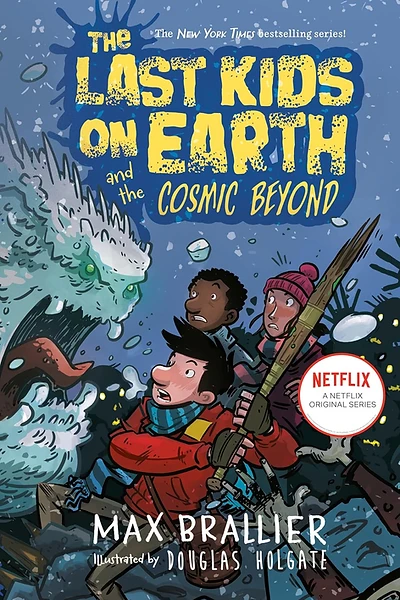
The Last Kids on Earth and the Cosmic Beyond
by Max Brallier, Douglas Holgate
Pacing MaterialBig Idea
Even in the midst of a chaotic monster apocalypse, the true strength of survival lies in friendship, teamwork, and finding joy in the small, everyday moments.
Discussion Questions
- 1.How does the arrival of winter change the way Jack and his friends approach their survival in the monster apocalypse?
- 2.Why is it important for the group to maintain traditions like Christmas, even when the world has changed so drastically?
- 3.How do the characters use their individual strengths—like Quint’s science or Jack’s optimism—to solve problems together?
- 4.In what ways does the 'Cosmic Beyond' represent both a physical challenge and an emotional one for the characters?
- 5.If you were in Jack’s position, what is one 'normal' activity you would fight to keep doing during an apocalypse?
Classroom Activity
Apocalypse Survival Blueprint
Students will design their own 'fortress' or survival base, incorporating creative inventions and defenses inspired by the gadgets and monster-fighting strategies found in the book.
Lesson Plan
Learning Goals
- Analyze how characters adapt to their environment to solve complex problems.
- Demonstrate understanding of narrative setting by creating a detailed, functional space.
- Collaborate with peers to brainstorm creative, imaginative solutions to survival challenges.
- Practice descriptive writing by explaining the purpose and mechanics of their inventions.
Activity Steps
- 1.Review the 'Treehouse Fortress' and Quint’s lab from the book to identify key survival features.
- 2.Brainstorm a list of potential threats (monsters, weather) and necessary resources (food, heat, defense).
- 3.Sketch a blueprint of a survival base, labeling specific areas for sleeping, science, and defense.
- 4.Write a short 'User Manual' for one invention in the base, explaining how it works and why it is useful.
- 5.Present the blueprints to the class, explaining the logic behind their design choices.
Standards Connections
- ELA: RL.3.3 (Describe characters and their motivations)
- ELA: W.3.2 (Write informative/explanatory texts)
- SEL: Relationship Skills (Collaborative problem solving)
- Art: Visual Literacy (Creating diagrams and blueprints)
Pace-Write-Read Study with Pace-Write It!
The Last Kids on Earth series is a masterclass in pacing for reluctant readers, blending high-octane action with the slow, relatable beats of middle-school friendship. By utilizing a hybrid format of text and graphic panels, Brallier teaches students that pacing is not just about word count, but about the visual rhythm of the page. Students learn that writing is a performance. The book uses short, punchy sentences to mimic the adrenaline of a monster chase, while slowing down during moments of reflection or scientific discovery. This study helps students understand how to manipulate time, using white space and illustrations to control how quickly a reader moves through a scene.
| Element | How to notice or teach it in the novel |
|---|---|
| Pace | Notice how action scenes use short, fragmented sentences to speed up the reader's heart rate. |
| Plot | The plot follows a clear 'monster-of-the-week' structure that keeps the stakes rising. |
| Prosody | Read the dialogue aloud to hear the distinct, sarcastic, and optimistic voices of the characters. |
| Word Pause | Look for single-word sentences used for dramatic emphasis during tense moments. |
| Concept | The core concept is 'apocalypse as a playground,' which drives all character decisions. |
| Voice & World View | Jack’s voice is consistently optimistic, framing the apocalypse as an adventure rather than a tragedy. |
| Setting & Place | The setting is a familiar town turned into a monster-filled obstacle course. |
| Point of View | First-person narration allows the reader to feel Jack’s immediate fears and joys. |
| Original Characters | Each character has a specific 'role' (the scientist, the warrior, the leader) that defines their actions. |
| Dialogue | Dialogue is snappy and often humorous, reflecting how friends talk to each other under pressure. |
| Details | Focus on the specific, weird details of the monsters to make them feel real. |
| Descriptions | Descriptions are visual and sensory, often focusing on the 'gross' or 'cool' aspects of the monsters. |
| Strong First Lines | The book starts in the middle of the action, immediately hooking the reader. |
| Immediacy & Engagement | The direct address to the reader makes the story feel like a personal account. |
| Story Scenes & Summaries & Unique Structures | The book alternates between prose and graphic panels to break up the reading experience. |
| Flashback & Flash Forward & Cliffhangers | Chapter endings often leave the characters in immediate danger to force a page turn. |
| Tension & Suspense & Surprise | Tension is built through the threat of the unknown, specifically the 'Cosmic Beyond.' |
| Page Turns and Chapter Breaks | Chapter breaks are strategically placed to maintain momentum. |
| Performance | The text is written to be read with high energy and dramatic flair. |
| Personality | Characters are defined by their quirks, like Quint’s obsession with gadgets. |
| Humor | Humor is used to deflate tension, making the scary monsters feel manageable. |
| Pause | Use the illustrations as a 'pause' button to let the reader process the scene. |
| Poetry and Poetic Devices | Look for alliteration in the names of the monsters. |
| Repetition | Repetition of the 'rules' of the apocalypse helps ground the reader. |
| Rhythm | The rhythm shifts between fast-paced action and slower, character-driven dialogue. |
| Punctuation | Frequent use of exclamation points and dashes creates a sense of urgency. |
| Questions | Jack often asks rhetorical questions to involve the reader in his thought process. |
| Compare-Contrast | Compare the 'before' world to the 'after' world through Jack’s memories. |
| Objects | Objects like the 'Louisville Slicer' are central to the characters' identities. |
| Threes | The group of friends often faces challenges in groups of three or four, balancing their skills. |
| Whitespace & Negative Space | The layout uses whitespace to emphasize the isolation of the characters. |
| Art & Graphics | The art is essential for showing the scale of the monsters compared to the kids. |
| Interactives & Gamification | The book feels like a video game, with 'levels' and 'boss battles' clearly defined. |
Pace-Write It!
Students will write a 200-word 'Action Sequence' where they must include one 'Pause' (a moment of reflection) and one 'Speed-up' (a moment of high action), using short sentences for the latter and descriptive, sensory language for the former.