 3-7
3-7C LAST KIDS
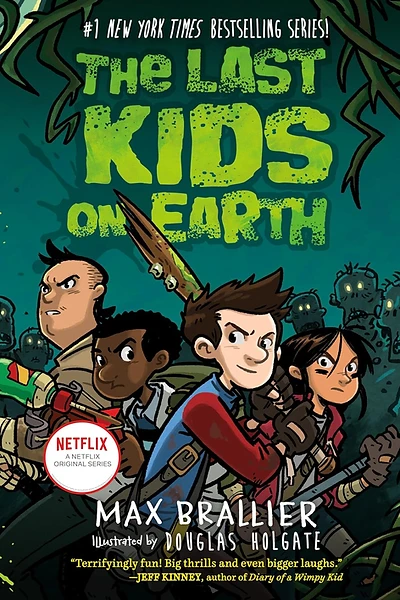
The Last Kids on Earth
by Max Brallier, Illustrated by Douglas Holgate
Pacing MaterialThirteen-year-old orphan Jack Sullivan lives in a treehouse following a monster-filled apocalypse. Along with his friends Quint, Dirk, and June, he navigates the dangers of his hometown while fighting off zombies and giant creatures. Together, they transform their bleak reality into an epic adventure focused on teamwork and finding family in unlikely places.
Big Idea
True survival relies not just on physical skills, but on the strength and emotional support found within a loyal friendship group.
Discussion Questions
- 1.How does Jack's living situation in a treehouse represent his desire for both independence and safety?
- 2.What specific traits does each friend contribute to the group's overall success in surviving?
- 3.Why is it important for the group to maintain a sense of humor during such a dangerous time?
- 4.How does Jack's view of being an 'orphan' change once he finds his friends?
- 5.In what ways does the monster apocalypse force the characters to grow up faster than normal children?
Classroom Activity
Design Your Ultimate Treehouse Fortress
Students will map out and describe the features of a high-tech, monster-proof fortress based on the needs of their own group of friends.
Lesson Plan
Learning Goals
- Analyze setting as a critical component of survival.
- Collaborate to identify necessary resources for a hypothetical environment.
- Practice descriptive writing to explain mechanical or safety features.
Activity Steps
- 1.Brainstorm a list of potential monster threats that might be unique to your local area.
- 2.Draw a detailed floor plan of a secure, multi-level fortress.
- 3.Label each room or section with its specific purpose (e.g., supply storage, lookout point, gaming lounge).
- 4.List three 'essential' items that your group would prioritize keeping in the fortress.
- 5.Present your design to a partner and explain how it keeps occupants safe.
Standards Connections
- CCSS.ELA-LITERACY.RL.3.3: Describe characters, settings, and major events in a story.
- CASEL SEL: Relationship Skills (Cooperation and teamwork).
- National Core Art Standard: Creating (Conceiving and developing new artistic ideas).
Pace-Write-Read Study with Pace-Write It!
Focus question: How does an author speed up and slow down a story to make survival feel exciting, funny, and meaningful? In The Last Kids on Earth by Max Brallier, illustrated by Douglas Holgate, Jack Sullivan tells the story of surviving a monster apocalypse with the energy of a kid turning disaster into adventure. The book uses fast action scenes, comic-style visuals, cliffhangers, and funny pauses to control pacing while building friendship, danger, and excitement.
| Element | How to notice or teach it in the novel |
|---|---|
| Pace | Read: Notice how the story moves quickly during monster attacks and zombie chases, then slows down when Jack reflects on friendship, loneliness, or life in the treehouse. Classroom Activity: Write a short survival scene in which the first 3 sentences are fast and action-packed, and the last 3 sentences slow down to show what your character feels about their team. |
| Plot | Read: Track how Jack’s adventure builds from surviving alone to working with Quint, Dirk, and June against bigger threats in Wakefield. Classroom Activity: Make a 5-part plot ladder for an apocalypse adventure: problem, plan, attack, setback, and team victory. |
| Prosody | Read: Listen to how Jack’s narration sounds playful, dramatic, and energetic, especially when he describes battles or celebrates the team’s wins. Classroom Activity: Rewrite a plain sentence like “We saw a monster” in a bold, dramatic voice that sounds like Jack telling the story out loud. |
| Word pause | Read: Notice how single words, fragments, or short sentences can create a pause before a reveal, joke, or attack. Classroom Activity: Write a 6-sentence suspense paragraph about hearing something outside a treehouse, using one one-word sentence for effect. |
| Concept | Read: Think about the big idea that survival is not just about fighting monsters; it is also about building friendship and finding family after loss. Classroom Activity: Write 2-3 sentences explaining how your own adventure story could show that teamwork matters as much as strength. |
| Voice & World View | Read: Notice that Jack sees the apocalypse as scary but also awesome, like a kid who turns fear into imagination and fun. Classroom Activity: Write a paragraph about a dangerous place from the point of view of a character who is excited instead of terrified. |
| Setting & Place | Read: Pay attention to how Wakefield changes from an ordinary town into a monster-filled adventure zone, and how Jack’s treehouse becomes a safe home base. Classroom Activity: Describe a familiar place in your town after an apocalypse has transformed it into a survival setting. |
| Point of View | Read: Notice how Jack’s first-person point of view lets readers hear his jokes, fears, and heroic version of events. Classroom Activity: Write the same monster encounter twice—once in first person as Jack-like narration and once in third person—and compare the pacing. |
| Original Characters | Read: Study how Jack, Quint, Dirk, and June each bring different strengths, attitudes, and energy to the group, making scenes move in varied ways. Classroom Activity: Create a four-person survival team and give each character one skill and one personality trait that affects action scenes. |
| Dialogue | Read: Notice how the friends’ dialogue shows teamwork, conflict, humor, and problem-solving during dangerous moments. Classroom Activity: Write 8 lines of dialogue between two survivors arguing about a risky plan while a monster gets closer. |
| Details | Read: Look for specific details about weapons, defenses, monsters, zombies, and the treehouse that make the world feel real and fast-moving. Classroom Activity: List 5 survival details for a headquarters, then use them in a descriptive paragraph. |
| Descriptions | Read: Notice how the book describes creatures and action in vivid, exaggerated ways that match its adventurous, comic style. Classroom Activity: Write a monster description using at least 3 strong adjectives and 2 action verbs. |
| Strong First Lines | Read: Notice how the opening quickly introduces Jack’s unusual life and pulls readers into a world already changed by apocalypse. Classroom Activity: Write three possible first lines for an adventure chapter that immediately show danger and personality. |
| Immediacy & Engagement | Read: Notice how Jack’s direct, conversational storytelling makes readers feel as if events are happening right now. Classroom Activity: Write a paragraph beginning with “Here’s the problem” or “You would think” to pull readers straight into the action. |
| Story Scenes & Summaries & Unique Structures | Read: Watch how the book mixes full action scenes with quick summaries, lists, visual breaks, and graphic-style moments to keep the story moving. Classroom Activity: Write one detailed battle scene, then follow it with a 3-sentence summary of what happened over the next week in your story world. |
| Flashback & Flash Forward & Cliffhangers | Read: Notice how Jack refers to what happened before and builds suspense about what might happen next, often ending sections with danger still unresolved. Classroom Activity: End a short chapter with a cliffhanger after adding one sentence that hints at something important from the past. |
| Tension & Suspense & Surprise | Read: Pay attention to how danger grows when the team makes plans, gets interrupted, or realizes a creature is stronger than expected. Classroom Activity: Write a suspense paragraph where characters think they are safe, then reveal a surprise threat in the final sentence. |
| Page Turns and Chapter Breaks | Read: Notice how chapter endings and visual reveals encourage readers to keep turning pages to see what Jack and his friends face next. Classroom Activity: Draft a chapter ending that makes readers need to know whether your characters escape, fight, or fail. |
| Performance | Read: Notice how the book feels ready to be performed aloud, with dramatic reactions, jokes, and action beats. Classroom Activity: Choose 6-8 lines from your own adventure writing and mark where a reader should speed up, slow down, or pause dramatically. |
| Personality | Read: Notice how Jack’s confidence, Quint’s thinking, Dirk’s loyalty, and June’s toughness shape the mood and speed of scenes. Classroom Activity: Write a character introduction in which personality is shown through action during a crisis, not just told. |
| Humor | Read: Look for how humor balances the scary apocalypse, especially in Jack’s narration and in the group’s interactions during danger. Classroom Activity: Write a tense scene that includes one funny comparison or joke without ruining the suspense. |
| Pause | Read: Notice how the story pauses after action to let readers catch a breath, laugh, or understand what friendship means to Jack. Classroom Activity: Add a reflection pause into the middle of an action scene by having your character notice one meaningful detail about a friend. |
| Poetry and Poetic Devices | Read: Notice how exaggeration, sound play, and vivid comparisons make monsters and battles feel larger than life. Classroom Activity: Write 4 lines describing a giant creature using simile, alliteration, or hyperbole. |
| Repetition | Read: Look for repeated ideas about survival, team identity, plans, and monsters that help build rhythm and emphasis. Classroom Activity: Write a paragraph that repeats one key phrase, such as “We stick together,” to build intensity. |
| Rhythm | Read: Notice how sentence lengths change—short in battle scenes, longer in explanations—to control speed and excitement. Classroom Activity: Write 5 sentences about escaping zombies using this pattern: short, short, long, short, long. |
| Punctuation | Read: Notice how exclamation points, dashes, ellipses, and sentence fragments help create urgency, surprise, and comic timing. Classroom Activity: Revise a paragraph of plain action writing by adding punctuation that changes its pace and tone. |
| Questions | Read: Pay attention to when Jack asks questions or sets up mysteries that make readers want answers about monsters, safety, or the future. Classroom Activity: Write 4 rhetorical or dramatic questions a narrator might ask while exploring an abandoned town. |
| Compare-Contrast | Read: Compare the scary outside world with the comfort of the treehouse, and compare Jack’s solo survival with team survival. Classroom Activity: Write a compare-contrast paragraph about a safe base and a dangerous zone in your own adventure world. |
| Objects | Read: Notice how survival gear, homemade weapons, vehicles, and treehouse items help reveal character and move the plot forward. Classroom Activity: Choose one important survival object and write how it helps in action and what it means to your character emotionally. |
| Threes | Read: Look for places where actions, traits, or dangers can be grouped in threes to sound stronger and more memorable, fitting the book’s dramatic style. Classroom Activity: Write a sentence or short paragraph describing a monster using three actions, three sounds, or three features. |
| Whitespace & Negative Space | Read: Notice how breaks in text, short paragraphs, and visual spacing can make a dramatic reveal, joke, or action beat land harder. Classroom Activity: Rewrite a suspenseful paragraph into short lines or chunks to increase tension before the final reveal. |
| Art & Graphics | Read: Study how Douglas Holgate’s illustrations add speed, humor, monster detail, and extra information that support Max Brallier’s pacing. Classroom Activity: Sketch a quick scene map or comic panel for your action paragraph, then revise the writing to match the energy of the image. |
| Interactives & Gamification | Read: Notice how the book feels game-like, with missions, battles, gear, upgrades, and team roles that make the story feel interactive. Classroom Activity: Design a “survival mission card” for Jack, June, Quint, or Dirk, then write a matching mini-scene where that mission goes wrong. |
Pace-Write It!
20-Minute Classroom Flow\n\nRead (5 min): Read aloud a high-action section from The Last Kids on Earth that includes Jack’s narration, a monster threat, and teamwork with Quint, Dirk, or June. Ask students to listen for where the story speeds up and where it pauses.\n\nNotice (5 min): Students identify 3 pacing moves: one short sentence or fragment, one cliffhanger or surprise, and one funny or reflective pause. Chart how Max Brallier balances danger, humor, and friendship.\n\nWrite (7 min): Students write their own apocalypse mini-scene using this frame: “At first, I thought _____. Then _____ appeared. [Character name] shouted, ‘_____!’ We ran/charged/hid because _____. For one second, I noticed _____. But then _____.” Challenge students to use at least one one-word sentence, one line of dialogue, and one reflective pause about friendship or teamwork.\n\nShare (3 min): Partners read their scenes aloud with expression. Listeners name one place where the pacing felt fast and one place where the pause made the scene stronger.\n\nExit ticket: In one sentence, explain one way you changed the speed of your writing and why it helped your scene.