 3-7
3-7GN BROWN
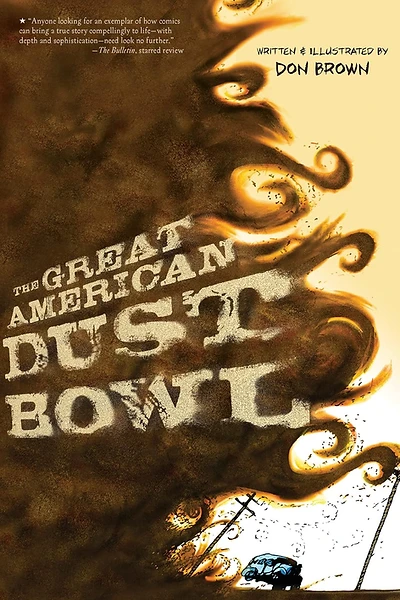
The Great American Dust Bowl
by Don Brown
Pacing MaterialA graphic novel account of the Dust Bowl of the 1930s, when drought and poor farming practices turned the Great Plains into a wasteland of swirling dust storms that displaced millions.
Big Idea
Environmental disasters can be caused by human actions, and understanding the past helps us protect the future.
Discussion Questions
- 1.What farming practices contributed to the Dust Bowl?
- 2.How did the Dust Bowl affect families and communities?
- 3.What lessons can we learn about environmental stewardship?
- 4.How did the government respond to help farmers recover?
Classroom Activity
Dust Bowl Cause and Effect Map
Students create a visual map tracing the causes and effects of the Dust Bowl disaster.
Lesson Plan
Learning Goals
- Understand the environmental and human causes of the Dust Bowl
- Analyze the social and economic impacts on affected communities
- Connect historical environmental disasters to modern challenges
- Examine the role of government in disaster recovery
Activity Steps
- 1.Introduce the geographic and historical context of the Great Plains
- 2.Have students read key excerpts from the graphic novel
- 3.In small groups, students create cause-and-effect maps on chart paper
- 4.Groups present their maps and discuss the chain of events
- 5.Connect to modern environmental challenges and conservation efforts
Standards Connections
- ELA: RL.3.1 — Ask and answer questions about key details
- ELA: RL.3.2 — Retell stories, including key details
- ELA: RL.3.3 — Describe characters, setting, and events
- ELA: RL.7.6 — Acknowledge differences in characters' points of view
- ELA: SL.3.1 — Participate in collaborative conversations about the text
- ELA: W.3.3 — Write narratives recounting events with descriptive details
- SEL: Self-Management
- SEL: Responsible Decision-Making
- Art: VA:Re7 — Perceive and analyze artistic work
Pace-Write-Read Study with Pace-Write It!
Focus question: How does Don Brown use pacing in The Great American Dust Bowl to help readers feel the danger, hardship, and resilience of people living through the Dust Bowl? In The Great American Dust Bowl, Don Brown tells the story of the 1930s environmental disaster through fast-moving graphic-novel scenes, brief narration, and powerful illustrations. The pacing shifts between quick, frightening dust storm moments and slower reflective parts, helping readers understand both the destruction and the recovery efforts people faced.
| Element | How to notice or teach it in the novel |
|---|---|
| Pace | Read: Notice how The Great American Dust Bowl moves quickly during the black blizzards and more slowly when Don Brown explains drought, failed farming practices, and families leaving the Plains. Classroom Activity: Write two short paragraphs about one disaster event—one with fast pacing and one with slow pacing—to show different emotional effects. |
| Plot | Read: Track how the book builds from healthy grasslands to overplowed fields, then to drought, dust storms, sickness, migration, and government recovery efforts. Classroom Activity: Create a plot timeline with 6 key events, then write a short summary of how each event increases the crisis or shows resilience. |
| Prosody | Read: Listen to how the short narration and dramatic words in The Great American Dust Bowl sound when read aloud, especially in storm scenes filled with force and fear. Classroom Activity: Choose one page and rehearse reading it aloud with expression, then write 3 sentences explaining how your voice matched the mood. |
| Word pause | Read: Notice where single words or short phrases in Don Brown’s text make readers stop and feel the weight of dust, silence, hunger, or loss. Classroom Activity: Write a 5-6 sentence scene about a storm and include 3 intentional one-word or two-word pauses for effect. |
| Concept | Read: Think about the big idea that people and land are connected, and that poor choices plus drought helped create the Dust Bowl while communities still fought to recover. Classroom Activity: Write a paragraph explaining how the book teaches both a history lesson and a lesson about resilience. |
| Voice & World View | Read: Notice that Don Brown’s voice is serious, informative, and compassionate, showing concern for farm families, children, and the damaged land. Classroom Activity: Write 4-5 sentences in a narrator’s voice that explains a hard event with both facts and empathy. |
| Setting & Place | Read: Study how the Great Plains setting changes from productive farmland to a wasteland of blowing dirt, buried houses, and dark skies. Classroom Activity: Write a setting description of the Plains before and during the Dust Bowl, using contrast to show the transformation. |
| Point of View | Read: Notice that the book uses an outside narrator to tell the larger history, while still helping readers imagine what farm families experienced. Classroom Activity: Rewrite one event from the point of view of a child living through a dust storm. |
| Original Characters | Read: Even though this is a historical graphic novel, Don Brown helps readers picture real farm families, children, and workers as memorable people facing danger and change. Classroom Activity: Invent an original child character who lives in the Dust Bowl and write a short character sketch including fears, hopes, and daily challenges. |
| Dialogue | Read: Notice how brief lines of dialogue or quoted reactions can make the history feel immediate, especially when people respond to dust, illness, or leaving home. Classroom Activity: Write a short dialogue between a parent and child preparing for a dust storm. |
| Details | Read: Pay attention to specific details such as dust sifting through cracks, crops failing, animals suffering, and families wearing masks or covering faces. Classroom Activity: Make a list of 8 concrete details from the book, then use at least 4 of them in your own historical-fiction paragraph. |
| Descriptions | Read: Notice how Don Brown’s descriptions and illustrations make the storms seem choking, dark, loud, and inescapable. Classroom Activity: Write 6 descriptive sentences about a black blizzard using at least 3 sensory details. |
| Strong First Lines | Read: Look at how the opening quickly introduces the setting, problem, and serious tone of The Great American Dust Bowl. Classroom Activity: Write 3 possible opening lines for a Dust Bowl story that immediately create interest and tension. |
| Immediacy & Engagement | Read: Notice how short text, dramatic page design, and urgent storm scenes make readers feel as if events are happening right now. Classroom Activity: Write a present-tense scene of a family trying to protect their home as dust blows in. |
| Story Scenes & Summaries & Unique Structures | Read: Notice how Don Brown balances short dramatic scenes with summary sections that explain causes, effects, and historical context. Classroom Activity: Write one detailed scene from Dust Bowl life and one 3-sentence summary of the larger event around it. |
| Flashback & Flash Forward & Cliffhangers | Read: Look for places where the book refers back to how the land once was or builds suspense before the next storm or consequence. Classroom Activity: Write a short passage that begins with what the land used to look like, then ends with a cliffhanger as a dust cloud approaches. |
| Tension & Suspense & Surprise | Read: Notice how tension grows when skies darken, dust rolls in, breathing becomes hard, and families do not know if crops or homes will survive. Classroom Activity: Write a suspenseful paragraph ending just as a storm reaches the house. |
| Page Turns and Chapter Breaks | Read: Pay attention to how turning the page in this graphic novel can reveal a huge storm image, a shocking detail, or a new stage of the disaster. Classroom Activity: Plan a 4-panel comic and decide what important moment should be saved for the page turn. |
| Performance | Read: Think about how this book could be performed through dramatic reading, with changes in pace, volume, and pauses during storm scenes. Classroom Activity: Practice a short oral reading from a selected page and mark where to speed up, slow down, or pause. |
| Personality | Read: Notice how the people in the book show determination, fear, exhaustion, and hope as they keep cleaning, planting, protecting children, or moving away. Classroom Activity: Write a diary entry that reveals the personality of a Dust Bowl child who refuses to give up. |
| Humor | Read: Notice that humor is very limited in The Great American Dust Bowl because the subject is serious, which keeps the pacing focused on survival and hardship. Classroom Activity: Write 2-3 sentences explaining why an author might choose not to use humor in a book about this event. |
| Pause | Read: Notice where the book slows readers down with a striking image or a short factual statement that invites reflection on suffering and recovery. Classroom Activity: Write a paragraph about a quiet moment after a storm, using a pause to show exhaustion or sadness. |
| Poetry and Poetic Devices | Read: Listen for vivid figurative language and image-rich wording that makes the dust seem alive, invading homes and covering the world. Classroom Activity: Write 4 lines of free verse about dust using personification or simile. |
| Repetition | Read: Notice how repeated ideas—dust everywhere, storms returning, crops failing—help readers feel the endless nature of the crisis. Classroom Activity: Write a short piece that repeats one phrase 3 times to show how the disaster keeps happening. |
| Rhythm | Read: Pay attention to the rhythm created by short sentences during emergency scenes and longer sentences during explanation. Classroom Activity: Write one paragraph with mixed sentence lengths to create the rhythm of a storm building and then passing. |
| Punctuation | Read: Notice how punctuation in The Great American Dust Bowl can sharpen urgency, especially with short statements and dramatic breaks in storm descriptions. Classroom Activity: Revise a paragraph about a dust storm by adding punctuation that increases tension, such as dashes, commas, and exclamation points. |
| Questions | Read: Ask questions as you read: Why did overfarming make the drought worse? How did families survive? What does resilience look like here? Classroom Activity: Write 3 thoughtful questions about the book, then answer one using evidence from the text and illustrations. |
| Compare-Contrast | Read: Compare the land before the Dust Bowl to the ruined fields during the disaster, and compare destruction with recovery efforts such as soil conservation. Classroom Activity: Write a compare-contrast paragraph about life on the Plains before and during the Dust Bowl. |
| Objects | Read: Notice important objects such as tractors, masks, fences, windows, crops, and household items covered with dust, all of which make the history feel real. Classroom Activity: Choose one object from the book and write from its point of view as it experiences the Dust Bowl. |
| Threes | Read: Look for places where ideas can be grouped in threes, such as drought, wind, and poor farming practices causing disaster, or fear, hunger, and migration affecting families. Classroom Activity: Write a sentence or short paragraph that uses a group of three details to emphasize the crisis. |
| Whitespace & Negative Space | Read: Study how open space, empty land, and dark-to-light contrast in the panels can slow reading and emphasize loss, loneliness, or the vastness of the Plains. Classroom Activity: Sketch a simple page layout for a Dust Bowl scene and label where whitespace would create mood. |
| Art & Graphics | Read: Notice how Don Brown’s illustrations carry much of the pacing by showing towering dust clouds, crowded scenes, and devastated farms with strong visual impact. Classroom Activity: Create a storyboard of 3 panels showing the beginning, middle, and end of a dust storm, then add captions. |
| Interactives & Gamification | Read: Think about how readers could interact with Dust Bowl facts by tracking causes, effects, and survival choices across the book’s events. Classroom Activity: Design a simple choice chart called 'Survive the Dust Bowl' where a reader makes 3 decisions and writes the possible outcomes based on the history in the book. |
Pace-Write It!
20-Minute Classroom Flow\nRead (5 min): Read aloud a short section from The Great American Dust Bowl that shows a dust storm approaching and striking a family’s home. Ask students to notice how Don Brown uses short text and dramatic illustrations to control speed.\nNotice (5 min): Discuss: Where does the pacing feel fast? Where does it slow down? What words, images, and page choices create tension, fear, or reflection? Chart student observations under the headings Fast Pace and Slow Pace.\nWrite (7 min): Students write a short historical-fiction scene from the point of view of a child in the Dust Bowl. Writing frame: 'At first, the day was ________. Then I noticed ________. Suddenly, ________. Dust ________. I tried to ________, but ________. When the storm passed, ________. Even then, I knew ________.' Encourage students to use at least 3 sensory details and 1 intentional short sentence for pacing.\nShare (3 min): Students read one or two sentences aloud to a partner or small group and explain where they tried to speed up or slow down the scene.\nExit ticket: In one sentence, explain one way Don Brown’s pacing in The Great American Dust Bowl helps readers understand resilience and recovery.