 5-9
5-9M EGGERS
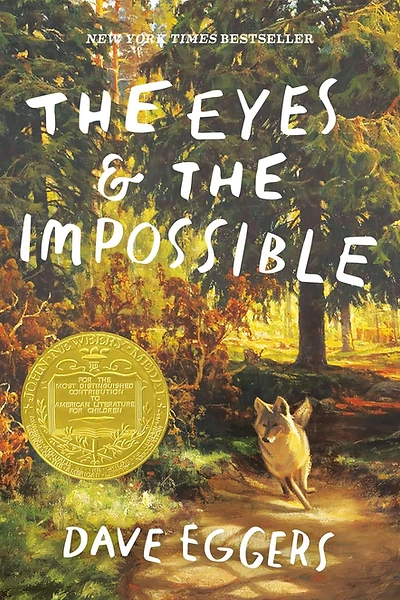
The Eyes & the Impossible
by Dave Eggers, Shawn Harris
Pacing MaterialJohannes is a fast, brave dog who has been chosen as one of the Eyes of a great park—an observer whose job is to run, look, and report everything he sees to three ancient, wise bison who never leave their enclosure. When Johannes discovers a series of extraordinary paintings hidden in a maintenance shed, he becomes entangled in a mystery that threatens the park's future and forces him to question the nature of freedom, duty, and beauty. Told in Johannes's urgent, joyful voice and illustrated with Shawn Harris's bold paintings, the novel follows Johannes as he races between animal communities, uncovers secrets about the humans who built and threaten the park, and ultimately must decide what he owes to the bison, to his fellow creatures, and to his own wild heart.
Big Idea
True freedom is not the absence of responsibility, but the willingness to use your gifts—your eyes, your voice, your speed—in service of something larger than yourself.
Discussion Questions
- 1.Why do you think Johannes takes such pride and seriousness in his role as one of the Eyes, even though no human forces him to?
- 2.The three bison have chosen never to leave their pen. What does their choice suggest about different kinds of freedom and captivity?
- 3.How does Johannes's relationship with art and the murals change the way he sees his park and his purpose?
- 4.In what ways is Johannes both like and unlike a 'real' dog? How does his humanlike reflection change how we understand animal experience?
- 5.What does the ending suggest about the cost and value of freedom? Do you agree with the choices Johannes makes?
- 6.How do Shawn Harris's illustrations change or deepen your understanding of moments in the text?
Classroom Activity
Become the Eyes
Students take on the role of 'Eyes' for their own community—a schoolyard, park, neighborhood block, or even a hallway. For one day, they carry a small notebook and record vivid sensory observations: sounds, smells, movement, color, unusual details, and any 'mysteries' they notice. At the end of the day, students write a short first-person report in Johannes's urgent, observant voice, addressed to an imagined authority figure (their own version of the bison), summarizing what they saw and why it matters. Students then illustrate one key observation in a bold, painterly style inspired by Shawn Harris's artwork, and share their reports aloud in a 'council' circle discussion, comparing what different Eyes noticed about the same shared space.
Lesson Plan
Learning Goals
- Analyze how Johannes’s first-person narration reveals his personality and shapes readers’ understanding of the park.
- Record precise sensory details while distinguishing direct observations from interpretations and unanswered questions.
- Write a first-person report that uses vivid language, energetic pacing, and a clear explanation of why an observation matters to the community.
- Create an illustration that emphasizes a key observation through color, contrast, and composition inspired by Shawn Harris’s artwork.
- Discuss how Johannes’s responsibilities as an Eye connect freedom, personal gifts, and service to others.
Activity Steps
- 1.Introduce the Eyes’ role: Read a selected passage in which Johannes observes the park or reports to the bison. Identify language that conveys his speed, excitement, and confidence. Discuss: How does his freedom help him fulfill a responsibility? Examine an illustration by Shawn Harris and notice how its colors and composition direct attention.
- 2.Prepare observation notebooks: Create headings for sights, sounds, smells, movement, unusual details, and mysteries. Model separating an observation ('Three birds gathered near a dripping fountain') from an interpretation ('They may need water'). Establish approved observation locations and remind students not to record identifying information about people.
- 3.Become the Eyes: Throughout one school day, use two or three brief, supervised observation windows in a shared space such as the schoolyard or hallway. Record at least six specific details and one question. Students may observe from a seated position or use sketches, dictation, or an audio recorder as needed.
- 4.Report to the bison: Write a 250–400-word first-person report addressed to an imagined council of wise community guardians. Borrow Johannes’s energetic pacing and keen attention without copying the novel’s sentences. Include at least three sensory details, identify one mystery without presenting guesses as facts, and explain how one observation suggests a responsibility or helpful action.
- 5.Illustrate an observation: Choose one important detail from the report and depict it using bold color, strong contrast, and deliberate composition inspired by Harris’s illustrations. Add a caption explaining what the image helps the council notice.
- 6.Hold a council circle: Share reports and illustrations in small groups or as a class. Compare different accounts of the same space and discuss how perspective affects what each Eye notices. Finish with an exit ticket connecting Johannes’s use of his gifts to one realistic way students can serve their community. Assess reports for specific evidence, distinctive voice, and a thoughtful observation-to-action connection.
Standards Connections
- ELA: CCSS RL.5.6, RL.6.6, RL.7.6, RL.8.6, RL.9–10.6 — Examine how narration and point of view shape meaning, using grade-appropriate expectations.
- ELA: CCSS W.5.3, W.6.3, W.7.3, W.8.3, W.9–10.3 — Develop narrative writing through descriptive details, purposeful pacing, and a clear first-person perspective.
- ELA: CCSS SL.5.1, SL.6.1, SL.7.1, SL.8.1, SL.9–10.1 — Participate in collaborative discussions, compare perspectives, and build on others’ ideas.
- Visual Arts: Creating and Responding — Use color and composition to communicate meaning and explain connections between an illustration and a written text.
- SEL: Social awareness and responsible decision-making — Consider community needs, distinguish evidence from assumptions, and identify constructive ways to help.
Pace-Write-Read Study with Pace-Write It!
The Eyes & the Impossible is a masterclass in propulsive, sensory storytelling. Eggers's present-tense, first-dog narration gallops alongside Johannes through the park, while Shawn Harris's bold paintings punctuate the text like visual heartbeats. This guide breaks down 33 craft elements readers and writers can study directly from the novel, pairing close observation with hands-on writing and art activities.
| Element | How to notice or teach it in the novel |
|---|---|
| Pace | Read: Notice how Eggers uses short, breathless chapters and rapid present-tense sentences to mirror Johannes's sprinting energy through the park. Classroom Activity: Have students rewrite a calm paragraph from the book in short, urgent sentences to increase pace, then compare the effects aloud. |
| Plot | Read: Notice how the plot builds from Johannes's daily duty of reporting to the bison into a larger mystery about the park's survival and hidden paintings. Classroom Activity: Students create a plot mountain mapping Johannes's routine duties versus the disruption that drives the central conflict. |
| Prosody | Read: Notice the musical, rolling rhythm of Johannes's internal narration, especially during scenes of running or admiring beauty. Classroom Activity: Students read a paragraph aloud marking stressed syllables, then write their own rhythmic paragraph describing motion. |
| Word pause | Read: Notice how Eggers drops in one-word or very short sentences to create dramatic pauses after intense action. Classroom Activity: Students insert one-word sentence pauses into their own action scene to build suspense. |
| Concept | Read: Notice how the novel explores the abstract concept of freedom versus captivity through the bison, who choose never to leave their pen. Classroom Activity: Students write a personal reflection on what freedom means to them, using Johannes's perspective as a model. |
| Voice & World View | Read: Notice how Johannes's voice blends impulsive dog energy with surprising philosophical wisdom about art, duty, and existence. Classroom Activity: Students write a diary entry in the voice of an animal observing the human world with fresh eyes. |
| Setting & Place | Read: Notice how the park is rendered as a vivid, layered ecosystem with specific plants, paths, and structures that feel like their own character. Classroom Activity: Students map a real or imagined local park, labeling sensory details the way Johannes would observe them. |
| Point of View | Read: Notice the book's first-person canine point of view, filtering all human and animal action through Johannes's instincts, loyalty, and occasional misunderstandings. Classroom Activity: Students rewrite a scene from a favorite story from an animal's point of view. |
| Original Characters | Read: Notice how side characters like the three ancient bison, the black-necked stilts, and the raccoons each have distinct personalities and speech patterns. Classroom Activity: Students create a character profile for an invented park animal with a unique voice and worldview. |
| Dialogue | Read: Notice how dialogue between Johannes and other animals is often clipped, formal, or ceremonial, especially in scenes with the bison. Classroom Activity: Students write a dialogue exchange between two animals with contrasting speech styles. |
| Details | Read: Notice the precise sensory details Johannes notices—the smell of eucalyptus, the texture of bark, the exact colors of murals. Classroom Activity: Students take a five-minute 'Eyes' walk and record five sensory details in a notebook. |
| Descriptions | Read: Notice how descriptions of the park's light and art are rendered almost like painted scenes, echoing Shawn Harris's illustrations. Classroom Activity: Students write a descriptive paragraph about a place using color and light like a painter. |
| Strong First Lines | Read: Notice how the opening line establishes Johannes's role and voice immediately with confident, declarative energy. Classroom Activity: Students draft three possible opening lines for their own story and vote on the strongest one. |
| Immediacy & Engagement | Read: Notice how present-tense narration creates a sense that events are happening right now, pulling readers into Johannes's urgency. Classroom Activity: Students convert a past-tense narrative paragraph into present tense and discuss the change in feeling. |
| Story Scenes & Summaries & Unique Structures | Read: Notice how the book mixes fast scene-based chapters with brief summarizing passages that compress time, plus interspersed paintings that function as visual chapters. Classroom Activity: Students storyboard a chapter using both a 'scene' panel and a 'summary' panel. |
| Flashback & Flash Forward & Cliffhangers | Read: Notice how Johannes occasionally flashes back to memories of his past life before the park, adding depth to his present choices. Classroom Activity: Students write a flashback paragraph inserted into a current story that reveals a character's backstory. |
| Tension & Suspense & Surprise | Read: Notice how the mystery of the park's threatened destruction builds suspense as Johannes uncovers clues piece by piece. Classroom Activity: Students write a suspenseful paragraph that reveals a clue at the very end without explaining its meaning. |
| Page Turns and Chapter Breaks | Read: Notice how many chapters end on a sudden image or unanswered question that compels the reader to turn the page immediately. Classroom Activity: Students revise the ending of their own chapter to end with a hook. |
| Performance | Read: Notice how Johannes's narration reads like a spoken performance, full of exclamations and direct address to the reader. Classroom Activity: Students perform a page of the book aloud, then perform their own paragraph with dramatic flair. |
| Personality | Read: Notice how Johannes's personality—brave, curious, devoted, occasionally reckless—comes through in his choices and asides. Classroom Activity: Students list five personality traits for their own character and show, rather than tell, each trait in a sentence. |
| Humor | Read: Notice how humor arises from Johannes's blunt dog logic and his commentary on human behavior he doesn't fully understand. Classroom Activity: Students write a humorous paragraph from an animal's perspective misunderstanding a human object. |
| Pause | Read: Notice how quiet, reflective moments—like Johannes watching sunlight through leaves—slow the story to let emotion breathe. Classroom Activity: Students write a still, quiet paragraph with no action, focusing only on observation. |
| Poetry and Poetic Devices | Read: Notice the use of metaphor and personification when Johannes describes wind, shadows, or light as living forces. Classroom Activity: Students write a short poem personifying a natural element in their own environment. |
| Repetition | Read: Notice how phrases like 'I am the Eyes' repeat throughout the novel to reinforce Johannes's identity and duty. Classroom Activity: Students write a paragraph using a repeated refrain to emphasize a character's core belief. |
| Rhythm | Read: Notice how sentence length varies to create a galloping rhythm during action scenes and a slower rhythm during reflection. Classroom Activity: Students revise a paragraph alternating short and long sentences to create rhythmic variation. |
| Punctuation | Read: Notice Eggers's use of exclamation points, dashes, and italics to convey Johannes's excitement and emphasis. Classroom Activity: Students punctuate a flat paragraph with varied punctuation to add expressive energy. |
| Questions | Read: Notice how Johannes frequently poses rhetorical questions to himself about freedom, duty, and the bison's worldview. Classroom Activity: Students write a reflective passage posing three questions their character cannot yet answer. |
| Compare-Contrast | Read: Notice how the bison's chosen captivity is contrasted with Johannes's freedom to roam, highlighting different types of confinement. Classroom Activity: Students create a compare-contrast chart between two characters with different worldviews in a story they're writing. |
| Objects | Read: Notice how specific objects—the murals, the too-tall fence, scattered feathers—carry symbolic weight throughout the story. Classroom Activity: Students choose one object for their story and describe its significance across three different scenes. |
| Threes | Read: Notice the recurring pattern of three—three ancient bison, sets of three tasks or observations—that structures the story's rhythm. Classroom Activity: Students write a scene structured around three attempts, three characters, or three objects. |
| Whitespace & Negative Space | Read: Notice how Shawn Harris's illustrations use bold color blocks and negative space to convey mood alongside sparse text on some pages. Classroom Activity: Students design a page spread combining minimal text with an image relying on negative space. |
| Art & Graphics | Read: Notice how Shawn Harris's vivid painted illustrations punctuate the text, visually representing Johannes's observations as artwork. Classroom Activity: Students illustrate a scene from their own writing in a bold, painterly style influenced by the book's art. |
| Interactives & Gamification | Read: Notice how the book invites readers to imagine themselves as 'Eyes' of their own community, observing and reporting like Johannes. Classroom Activity: Students become 'Eyes' for a day, keeping an observation log of their neighborhood or schoolyard to report back like Johannes. |
Pace-Write It!
In this workshop, students rotate through three stations built around the novel's craft elements: a 'Pace & Rhythm' station where they revise sentences for speed and flow, a 'Voice & Observation' station where they practice writing from an animal's point of view using sensory detail, and an 'Art & Structure' station where they pair short scenes with painterly illustrations inspired by Shawn Harris. The workshop culminates in students combining their strongest sentence, observation, and image into a single illustrated page modeled on the book's distinctive text-and-art rhythm, which they share in a read-aloud circle.