 5-8
5-8V CROSSOVER
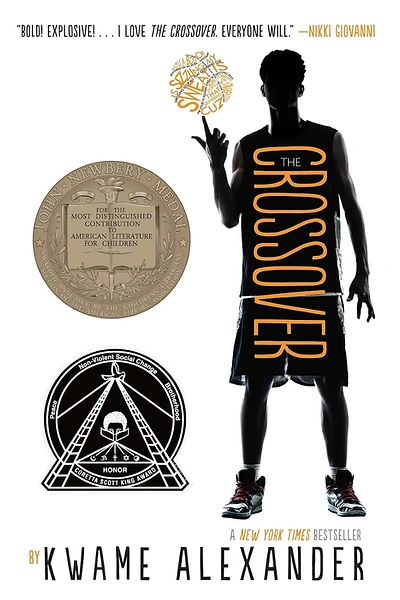
The Crossover
by Kwame Alexander
Pacing MaterialTwin basketball stars Josh and Jordan face tension on and off the court in a novel told entirely in verse.
Big Idea
Family bonds bend under pressure but don't break, and the rhythm of words can carry the heaviest feelings.
Discussion Questions
- 1.How does the verse form change how you read the story?
- 2.What causes the rift between Josh and Jordan?
- 3.How does basketball mirror the family's struggles?
- 4.Which poem hit you hardest, and why?
- 5.How does rhythm carry emotion in the book?
Classroom Activity
Verse Portrait
Write a short poem in verse about a family moment, using rhythm and a repeated word, the way Kwame Alexander does.
Lesson Plan
Learning Goals
- Explain how tension between Josh and Jordan reveals the challenges and strengths of family relationships in The Crossover.
- Identify how rhythm, repetition, and line breaks convey Josh’s voice and feelings in the novel’s verse.
- Write a short verse portrait of a family moment using sensory details, purposeful line breaks, and a repeated word.
- Revise a poem to strengthen its rhythm and emotional meaning, using feedback and reading aloud.
Activity Steps
- 1.Introduce the Verse Portrait activity: students will capture one family moment in a short poem. Discuss how basketball, sibling rivalry, and changes in Josh and Jordan’s relationship put their family bonds under pressure. Ask: What helps family members stay connected when feelings change?
- 2.Read aloud a teacher-selected passage from The Crossover that highlights Josh’s feelings about Jordan or their family. Reread while students tap the rhythm softly. Identify repetition, short or long lines, and pauses; discuss how these choices shape the emotional effect.
- 3.Model a brief original verse portrait of a family moment. Show how a repeated word such as “together,” “wait,” or “home” can gain meaning as the poem develops. Students brainstorm a real, imagined, or book-based family moment and list its sounds, actions, and feelings; personal disclosure is optional.
- 4.Have students draft an 8–16-line poem focused on that single moment. Require at least two sensory details, deliberate line breaks, and one word repeated at least three times. Encourage rhythms that reflect the scene, such as quick lines for an argument or slower lines for reconciliation.
- 5.In pairs, students read their poems aloud or have a partner read them. Partners identify one place where rhythm or repetition communicates emotion and suggest one revision. Students adjust wording, repeated words, or line breaks.
- 6.Invite optional sharing. Finish with a short reflection: How did your verse choices carry a feeling, and how does your family moment connect to the pressures or bonds in Josh and Jordan’s story?
Standards Connections
- ELA: CCSS RL.5.2 / RL.6.2 / RL.7.2 / RL.8.2 — Determine a theme and explain its development through details about family relationships.
- ELA: CCSS RL.5.4 / RL.6.4 / RL.7.4 / RL.8.4 — Analyze how word choice and poetic language contribute to meaning, tone, and emotional impact.
- ELA: CCSS W.5.5 / W.6.5 / W.7.5 / W.8.5 — Strengthen writing through planning, revising, and peer feedback.
- ELA: CCSS SL.5.1 / SL.6.1 / SL.7.1 / SL.8.1 — Participate in collaborative discussions, building on others’ ideas and expressing interpretations clearly.
- SEL: Self-awareness and relationship skills — Name emotions, consider different family perspectives, and give respectful feedback.
Pace-Write-Read Study with Pace-Write It!
The Crossover tells Josh Bell's story through poems that can move like a basketball play or slow to hold one feeling. Alexander has explained that he chose poetic forms to match each poem's subject, making the shape, sound, and space on the page part of the pacing.
| Element | How to notice or teach it in the novel |
|---|---|
| Pace & plot | Quick game action alternates with slower changes in Josh's relationships with his twin brother, JB, and their family. |
| Prosody, rhythm & performance | Beats, rhyme, and changing line lengths invite readers to vary their speed and emphasis aloud. |
| Word pause, pause & punctuation | A short line, a line break, or a mark of punctuation can make readers stop on a word before the next thought arrives. |
| Concept | A crossover is a basketball move and a way to think about change in Josh's life. The double meaning ties the action to the larger story. |
| Voice, worldview & point of view | Josh's first-person voice is confident and playful at times, then more uncertain as he tries to understand changes around him. Readers experience events through his perspective. |
| Setting & place | The basketball court gives fast scenes a clear location; home and school make room for different pressures and moods. |
| Original characters, personality & humor | Josh's love of words and basketball helps distinguish his voice. The family's teasing and affection can briefly lighten the pace. |
| Dialogue | Conversations reveal shifts between Josh, JB, and their parents without requiring long explanations. |
| Details & descriptions | A well-chosen image or basketball detail can make a play vivid while keeping the poem moving. |
| Strong first lines & immediacy | Study the opening poem: its energy places readers close to Josh's movements and voice right away. |
| Story scenes, summaries & unique structures | Individual poems may hold a single moment or carry readers across more time. Vocabulary poems and basketball rules add distinct ways to tell the story. |
| Flashback, flash forward & cliffhangers | References to family history add context to present events. For flash forward, have students verify an actual jump to a future event before applying the term. A poem can also end before a question or conflict is resolved. |
| Tension, suspense & surprise | Competition on the court creates immediate uncertainty; changes in the family create longer questions that carry across poems. |
| Page turns & chapter breaks | A poem's ending can act like a small chapter break. Turning the page may reveal a new play, mood, or piece of information. |
| Poetry & poetic devices | Metaphor, rhyme, sound, and line breaks shape how long readers spend with an action or feeling. |
| Repetition | Returning to basketball language and family sayings builds a familiar beat; their meanings can shift as Josh changes. |
| Questions | Josh's spoken and unspoken questions encourage readers to keep going for an answer. |
| Compare–contrast | Compare the pace of a game poem with a quiet family poem, or Josh's view of JB early and later in the book. |
| Objects | The basketball can represent play, skill, connection, and competition, depending on the scene. |
| Threes | Josh, JB, and their father offer a useful three-person comparison of basketball and family expectations. Check the text before claiming a repeated three-part poetic pattern. |
| Whitespace & negative space | Space between and around lines gives the eye a rest and can make a brief line feel especially important. |
| Art & graphics | In the original verse novel, typography and the placement of words do visual work. If using the graphic novel adaptation, examine its illustrations and panels separately; those are features of a different edition. |
| Interactives & gamification | These are teaching extensions: students might mark a poem's "fast" and "slow" lines, perform it aloud, or arrange pacing cards in the order a basketball play unfolds. |
Pace-Write It!
Choose one poem that feels fast and one that feels slow. What do the line breaks, word choices, sounds, and empty space make you do as a reader? How does that speed fit what Josh is experiencing?
Pace-Write-Read Connection
Teach this book using the Pace-Write-Read method — Tool 27: Rhythm.
Open the Mastery Manual