
 3-7
3-7GN MCCLOUD
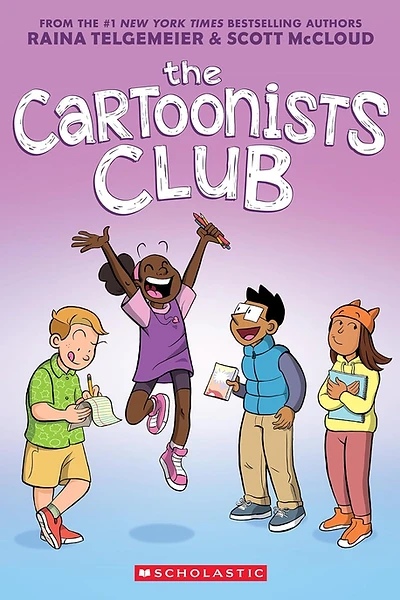
The Cartoonists Club
by Raina Telgemeier & Scott McCloud
Pacing MaterialA group of students who love drawing comics form a club, discovering friendship, collaboration, and the power of telling their own stories through art.
Big Idea
Creating art together builds not just better comics, but stronger friendships and more confident voices.
Discussion Questions
- 1.How does making comics help the characters express themselves?
- 2.What challenges do the club members face when working together?
- 3.How does collaboration change the way we create?
- 4.What story would you tell in a comic of your own?
Classroom Activity
Create a Mini-Comic
Students create a 4-panel mini-comic about a real experience, then share and discuss how their stories connect.
Lesson Plan
Learning Goals
- Understand the basics of comic storytelling: panels, sequencing, and visual narrative
- Explore how art and text work together to tell a story
- Develop personal narrative skills through comics
- Practice giving and receiving creative feedback
Activity Steps
- 1.Discuss what makes a comic different from other kinds of stories
- 2.Have students brainstorm a personal experience to adapt into a comic
- 3.Students draw a 4-panel comic with pencil, then ink and color
- 4.Share comics in small groups and give positive feedback
- 5.Discuss how collaboration could improve each comic
Standards Connections
- ELA: RL.3.1 — Ask and answer questions about key details
- ELA: RL.3.2 — Retell stories, including key details
- ELA: RL.3.3 — Describe characters, setting, and events
- ELA: RL.7.6 — Acknowledge differences in characters' points of view
- ELA: SL.3.1 — Participate in collaborative conversations about the text
- ELA: W.3.3 — Write narratives recounting events with descriptive details
- SEL: Social Awareness
- SEL: Relationship Skills
- Art: VA:Re7 — Perceive and analyze artistic work
Pace-Write-Read Study with Pace-Write It!
Focus question: How do writers and artists control pacing so a story about making comics feels lively, clear, and exciting? In The Cartoonists Club by Raina Telgemeier and Scott McCloud, a group of kids comes together to draw comics, solve problems, and learn how stories work. The book uses pacing through graphic panels, dialogue, page turns, and shifts between explanation and action so readers can feel both the energy of friendship and the step-by-step process of creating.
| Element | How to notice or teach it in the novel |
|---|---|
| Pace | Read: Notice how The Cartoonists Club moves between fast comic-club moments and slower teaching moments as the students draw, talk, and figure out ideas together. Classroom Activity: Write a 6-panel comic plan that includes 3 quick panels of club excitement and 3 slower panels showing a character thinking through a story problem. |
| Plot | Read: Notice how the plot grows from kids forming a club into moments of collaboration, challenge, and discovery about storytelling. Classroom Activity: Make a beginning-middle-end plot map for a new Cartoonists Club meeting where the members face a creative problem and solve it together. |
| Prosody | Read: Listen to how the dialogue and narration in The Cartoonists Club sound smooth, playful, and instructional, matching the energy of kids who love comics. Classroom Activity: Write 5 lines of dialogue for two club members that sound excited, natural, and expressive when read aloud. |
| Word pause | Read: Notice where single words, sound effects, or short speech bubbles slow you down or make you pause to notice an idea or feeling. Classroom Activity: Write a short comic exchange using 3 one-word bubbles to create pauses while a character reveals a new comic idea. |
| Concept | Read: Notice that the big concept is not only making comics, but discovering that creativity grows through practice, friendship, and trying new ideas. Classroom Activity: Write 3-4 sentences explaining a big idea your own comic club would teach about creativity. |
| Voice & World View | Read: Notice how the book presents a welcoming world view that says kids' stories matter and everyone can become more confident through creating. Classroom Activity: Write a short narration box in the voice of a club member explaining why comics help kids share their point of view. |
| Setting & Place | Read: Notice how the club setting feels like a creative space where drawing materials, conversation, and shared projects shape the story. Classroom Activity: Describe a meeting place for your own cartoonists club and explain how that place helps characters invent stories. |
| Point of View | Read: Notice how the book lets readers experience the club through the perspectives of kids learning together, making the lessons feel personal and immediate. Classroom Activity: Rewrite one club moment from the point of view of a nervous new member joining for the first time. |
| Original Characters | Read: Notice how each student in The Cartoonists Club brings a different personality, interest, and creative strength to the group. Classroom Activity: Invent an original club member with a name, favorite drawing style, and one challenge they have as a storyteller. |
| Dialogue | Read: Notice how the characters' dialogue teaches comic-making while also building friendship and showing their different reactions. Classroom Activity: Write a dialogue scene in which two club members disagree about a comic idea but end by combining their ideas. |
| Details | Read: Notice the small visual and spoken details that show tools, expressions, and the process of drawing and revising comics. Classroom Activity: List 5 specific details a reader would see on a comic artist's desk, then use them in a paragraph or panel plan. |
| Descriptions | Read: Notice that descriptions in this graphic novel come through both words and pictures, so readers build meaning from facial expressions, posture, and setting clues. Classroom Activity: Write 4 descriptive sentences about a character sketching a comic page without saying 'happy' or 'excited' directly. |
| Strong First Lines | Read: Notice how opening lines and opening panels invite readers into a world of making, imagining, and sharing stories. Classroom Activity: Write 3 possible first lines or first narration boxes for a comic about the first day of a new art club. |
| Immediacy & Engagement | Read: Notice how the graphic format makes readers feel present in the room with the students as they react, laugh, and create. Classroom Activity: Write a scene opener that drops readers right into a busy Cartoonists Club meeting with no long explanation first. |
| Story Scenes & Summaries & Unique Structures | Read: Notice how the book balances full scenes of kids talking and drawing with summary-style explanations about how comics work. Classroom Activity: Write one full scene of a club conversation and then a 2-sentence summary that explains what the group learned from it. |
| Flashback & Flash Forward & Cliffhangers | Read: Notice whether characters refer to earlier experiences with drawing or hint at what they hope to create next, and how these shifts build interest. Classroom Activity: Write a brief flashback about a club member's first comic failure and end with a cliffhanger about their new idea. |
| Tension & Suspense & Surprise | Read: Notice that the tension often comes from creative struggles, mistakes, and uncertainty about whether an idea will work. Classroom Activity: Write a short comic script where a student is about to share a comic page and worries how the club will react, then add one surprising response. |
| Page Turns and Chapter Breaks | Read: Notice how page turns in The Cartoonists Club can reveal a joke, a visual example, or a new storytelling lesson at just the right moment. Classroom Activity: Plan a 2-page comic and mark what surprise or key idea should be saved for the page turn. |
| Performance | Read: Notice how characters perform emotion through gesture, expression, and the way they present their comic ideas to others. Classroom Activity: Write stage-direction-style notes for 3 panels showing how a character acts while proudly presenting a comic to the club. |
| Personality | Read: Notice how each club member's personality affects the kind of stories they want to tell and how they work with others. Classroom Activity: Write a character profile showing how one student's personality shapes their comic topic, art style, and response to feedback. |
| Humor | Read: Notice the playful humor in reactions, misunderstandings, and comic-making moments that keep the book lively and inviting. Classroom Activity: Create a 4-panel humorous scene in which a small drawing mistake turns into a funny new story idea. |
| Pause | Read: Notice how pauses happen between panels, in silent reactions, or when a character stops to think before speaking. Classroom Activity: Write a 3-panel silent moment where a character stares at a blank page, thinks, and then suddenly gets an idea. |
| Poetry and Poetic Devices | Read: Notice that even in a realistic graphic novel, repeated sounds, imagery, and careful word choice can make lines memorable. Classroom Activity: Write a short comic caption or poem about drawing that uses alliteration or imagery inspired by the club's creative energy. |
| Repetition | Read: Notice how repeated reminders about story, art, practice, or collaboration help the lessons in The Cartoonists Club stick with readers. Classroom Activity: Write a short passage or comic script that repeats a key phrase such as 'keep creating' or 'tell your story' for emphasis. |
| Rhythm | Read: Notice the rhythm created by alternating speech bubbles, panel sizes, and moments of action and explanation. Classroom Activity: Draft a 6-line scene that uses short-long-short-long sentences to create a clear rhythm for a comic conversation. |
| Punctuation | Read: Notice how punctuation in speech bubbles—like exclamation points, ellipses, and question marks—changes the mood and speed of dialogue. Classroom Activity: Write the same line of dialogue 3 ways using different punctuation to show excitement, hesitation, and confusion. |
| Questions | Read: Notice how characters ask questions to learn, solve problems, and push their comic ideas further. Classroom Activity: Write 5 questions a new club member might ask about how to turn an idea into a comic story. |
| Compare-Contrast | Read: Notice how different students may approach storytelling in different ways, letting readers compare artistic styles, personalities, and problem-solving methods. Classroom Activity: Compare and contrast two imaginary club members by writing how each would create the same comic topic differently. |
| Objects | Read: Notice how pencils, sketchbooks, comic pages, and art supplies are meaningful objects because they support identity and creativity in the club. Classroom Activity: Choose one object from a cartoonist's workspace and write about how it reveals something important about its owner. |
| Threes | Read: Notice places where ideas, examples, or steps can be grouped in threes to help readers remember comic-making advice. Classroom Activity: Write 3 rules for your own cartoonists club and show how each rule helps creativity grow. |
| Whitespace & Negative Space | Read: Notice how blank space on the page, between panels, or around a figure can slow pacing and focus attention on a feeling or idea. Classroom Activity: Design a comic page plan that uses one large area of whitespace to show a character stuck before inspiration arrives. |
| Art & Graphics | Read: Notice how the art in The Cartoonists Club is not just decoration; it teaches story structure, shows emotion, and helps readers understand how comics are made. Classroom Activity: Sketch or describe 4 panel ideas that use facial expressions and layout to show a character moving from frustration to confidence. |
| Interactives & Gamification | Read: Notice how the book's teaching style invites readers to try comic-making strategies themselves, almost like joining the club. Classroom Activity: Create a mini 'comic challenge' card for classmates with 3 steps: invent a character, add a problem, and draw the ending. |
Pace-Write It!
20-Minute Classroom Flow\nRead (5 min): Read a short section of The Cartoonists Club where the students are talking, drawing, and learning together. Ask students to watch how the panels, speech bubbles, and pauses affect the speed of the scene.\nNotice (5 min): Discuss: Where does the story move quickly? Where does it slow down? How do Raina Telgemeier and Scott McCloud use dialogue, expressions, and page layout to show creativity, problem-solving, and friendship? Chart student noticings under 'Fast Pace' and 'Slow Pace.'\nWrite (7 min): Students write a short comic scene or paragraph about a kid joining a cartoon club and getting a new idea. Writing frame: 'At first, ___ felt ___. In the club, ___ said, "___." The moment slowed when ___. Then everything sped up when ___. By the end, ___ learned ___. ' Encourage students to include at least one pause, one line of dialogue, and one detail about drawing or art supplies.\nShare (3 min): Partners read their scenes aloud and point out one place where they intentionally slowed the pacing and one place where they sped it up.\nExit ticket: Write one sentence answering: How can a writer or cartoonist change pacing to make a creative moment more interesting for the reader?