 1-4
1-4P GHOLZ
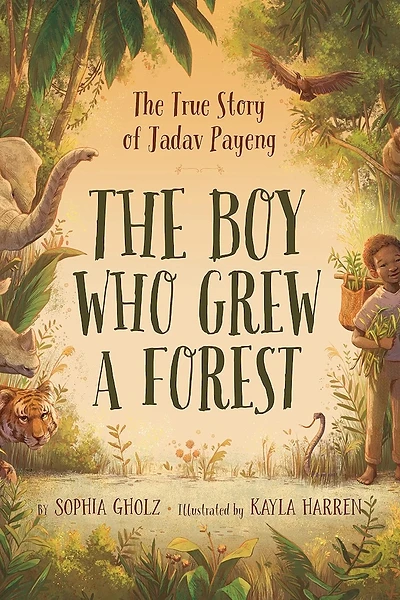
The Boy Who Grew A Forest
by Sophia Gholz
Pacing MaterialThe true story of Jadav Payeng, who planted trees every day until he grew a forest larger than Central Park.
Big Idea
One person's steady, patient action can restore an ecosystem and inspire a whole community to care for the earth.
Discussion Questions
- 1.What problem did Jadav notice in his village?
- 2.How did one person make such a big difference?
- 3.Why is patience important when growing a forest?
- 4.How did the animals benefit from the forest?
- 5.What is one thing you could plant or protect where you live?
Classroom Activity
Seed of Change
Choose an environmental problem near you and design a small action plan: the problem, your idea, who would help, and the first step.
Lesson Plan
Learning Goals
- Explain how one person's steady action can restore an ecosystem
- Design a small environmental action plan for their community
Activity Steps
- 1.Read the story, tracking each step Jadav took.
- 2.Discuss: 'What problem did Jadav notice? How did he solve it?'
- 3.In pairs, identify an environmental problem near school.
- 4.Design a one-step action plan to address it.
- 5.Share plans and display as a 'Seed of Change' gallery.
Standards Connections
- ELA: RL.1.1 — Ask and answer questions about key details
- ELA: RL.1.2 — Retell stories, including key details
- ELA: RL.1.3 — Describe characters, setting, and events
- ELA: RL.4.6 — Acknowledge differences in characters' points of view
- ELA: SL.1.1 — Participate in collaborative conversations about the text
- ELA: W.1.3 — Write narratives recounting events with descriptive details
- SEL: Social Awareness
- SEL: Relationship Skills
- Art: VA:Re7 — Perceive and analyze artistic work
Pace-Write-Read Study with Pace-Write It!
Focus question: How does an author slow down and speed up parts of a story to show how one small action can grow into a big change? In The Boy Who Grew A Forest by Sophia Gholz, readers follow Jadav Payeng as he notices a problem and keeps planting trees day after day. The pacing helps us feel both the small, steady work of one boy and the huge change that happens over time as a forest grows.
| Element | How to notice or teach it in the novel |
|---|---|
| Pace | Read: Notice how the story moves slowly when Jadav Payeng begins planting and then stretches across many days and years to show patient change. Classroom Activity: Write 3-4 sentences that begin with one small action and then speed up time to show a big result. |
| Plot | Read: Notice the clear plot: Jadav sees the land and animals need help, he starts planting trees, and over time his work grows into a forest larger than Central Park. Classroom Activity: Make a beginning-middle-end plot map for Jadav’s story, then write a new short story about a child solving a problem in the same structure. |
| Prosody | Read: Listen to how the sentences can be read smoothly and gently, matching the steady rhythm of planting, growing, and waiting. Classroom Activity: Read one page aloud with expression, then write 2 sentences that sound calm and hopeful like Jadav’s work. |
| Word pause | Read: Notice places where you naturally pause to think about the hot, bare land, the animals, and each planted tree. Classroom Activity: Write a sentence about Jadav planting a tree and add slash marks / where a reader should pause for effect. |
| Concept | Read: The big idea is that one person can make a difference through small, repeated actions. Classroom Activity: Write a response explaining how Jadav’s daily planting teaches the concept of making a difference. |
| Voice & World View | Read: Notice the respectful, admiring voice that presents Jadav as thoughtful, caring, and connected to nature. Classroom Activity: Write 3 sentences in a warm, hopeful voice about a person who helps their community. |
| Setting & Place | Read: Notice how the setting on Majuli Island in India matters because the hot sandbars and river area make Jadav’s work necessary and meaningful. Classroom Activity: Write a setting description of a place that needs help, using details like land, weather, plants, or animals. |
| Point of View | Read: Notice that the story is told in third person, which lets readers watch Jadav’s actions over time. Classroom Activity: Rewrite one moment from the book as if Jadav is saying, “I saw… I planted… I hoped…”. |
| Original Characters | Read: Notice that Jadav Payeng is a real person, but he stands out as a memorable character because of his patience, care, and determination. Classroom Activity: Create an original character who helps nature in a surprising way, and write 4 sentences introducing that character. |
| Dialogue | Read: Notice whether dialogue is used sparingly and how the story mostly depends on actions and narration rather than long conversations. Classroom Activity: Write a short dialogue between Jadav and a curious child who asks why he keeps planting trees. |
| Details | Read: Notice specific details about trees, animals, heat, land, and time that help readers picture Jadav’s work. Classroom Activity: Make a list of 5 details from the story, then use at least 3 of them in your own nature-helping paragraph. |
| Descriptions | Read: Notice how the descriptions help readers see the dry land at first and the rich forest later. Classroom Activity: Write two contrasting descriptions: one of the land before Jadav plants and one after the forest grows. |
| Strong First Lines | Read: Notice how the opening pulls readers quickly into Jadav’s world and the problem he will face. Classroom Activity: Write a strong first line for a story about one child changing a place over time. |
| Immediacy & Engagement | Read: Notice how the book makes readers care right away about the land, the animals, and what Jadav will do next. Classroom Activity: Write 2-3 sentences that make a reader immediately care about a problem in nature. |
| Story Scenes & Summaries & Unique Structures | Read: Notice how some parts feel like close-up scenes, while other parts summarize many days, months, or years of planting. Classroom Activity: Write one close-up scene of Jadav planting one tree and one summary sentence that covers many years of growth. |
| Flashback & Flash Forward & Cliffhangers | Read: Notice that this story mostly moves forward in time, but readers can think about how a writer could look back at the bare land or forward to the future forest. Classroom Activity: Write a flash forward sentence showing what Jadav’s work will become many years later. |
| Tension & Suspense & Surprise | Read: Notice the tension in wondering whether one boy’s small actions can really change such a large place, and the surprise of how huge the forest becomes. Classroom Activity: Write 3 sentences that build suspense before revealing a big change in a setting. |
| Page Turns and Chapter Breaks | Read: Notice how page turns in a picture book can make readers pause, wonder, and then discover the next step in Jadav’s journey. Classroom Activity: Plan a two-page spread by writing what a reader learns before the page turn and what surprising image or idea comes after it. |
| Performance | Read: Notice that this book can be performed with a calm, growing energy, using voice to show hope and amazement. Classroom Activity: Practice reading a favorite section aloud and mark 3 words to stress when performing it. |
| Personality | Read: Notice Jadav’s personality traits: patient, observant, caring, and persistent. Classroom Activity: Write a character paragraph showing personality through actions instead of just naming traits. |
| Humor | Read: Notice that the story is mostly serious and inspiring, not silly, because it focuses on real work and real change. Classroom Activity: Write one light, gentle line that could fit the story without taking away from its respectful tone. |
| Pause | Read: Notice moments when the reader may stop and think about how long it takes for trees to grow and for change to happen. Classroom Activity: Add an ellipsis or line break to create a thoughtful pause in a sentence about waiting for something to grow. |
| Poetry and Poetic Devices | Read: Notice any poetic language that makes the forest feel alive, such as imagery or repeated sounds. Classroom Activity: Write 2 lines of poetic description about young trees growing where the land was once bare. |
| Repetition | Read: Notice how repeated actions—planting trees again and again—create meaning and pacing in Jadav’s story. Classroom Activity: Write a short paragraph that repeats a key phrase like “He planted” to show steady effort. |
| Rhythm | Read: Notice the rhythm of action and time: plant, wait, grow; plant, wait, grow. Classroom Activity: Write a 3-line piece with a repeating rhythm that matches the cycle of helping nature. |
| Punctuation | Read: Notice how punctuation helps control pacing, slowing readers down for reflection or moving them quickly through change. Classroom Activity: Rewrite one sentence about Jadav’s work in two ways—one with commas to slow it down and one with shorter sentences to speed it up. |
| Questions | Read: Notice the questions readers may ask: Why did Jadav begin? Would he keep going? Could one person really grow a forest? Classroom Activity: Write 3 thoughtful questions about the story, then answer one using evidence from the book. |
| Compare-Contrast | Read: Notice the contrast between the empty land at the beginning and the thriving forest at the end. Classroom Activity: Use a compare-contrast organizer, then write 4 sentences comparing the place before and after Jadav’s work. |
| Objects | Read: Notice meaningful objects in the story, such as seeds, saplings, trees, and the land itself. Classroom Activity: Choose one object from the story and write from its point of view, explaining how it connects to Jadav’s mission. |
| Threes | Read: Notice how ideas can be grouped in threes, such as what Jadav notices, what he does, and what changes. Classroom Activity: Write a sentence with three actions Jadav takes or three changes the forest brings. |
| Whitespace & Negative Space | Read: Notice how open space on a page can make the early bare landscape feel empty and later pages feel fuller as the forest grows. Classroom Activity: Create a mini picture-book page plan showing where you would leave empty space and where you would fill the page with words or art. |
| Art & Graphics | Read: Notice how the illustrations likely help show the passing of time, the growth of trees, and the changing mood from barren to full of life. Classroom Activity: Draw or sketch a before-and-after scene, then add 2 caption sentences that match the pacing of the change. |
| Interactives & Gamification | Read: Notice how readers could track Jadav’s repeated actions like steps in a challenge: one tree, then another, then another. Classroom Activity: Create a class ‘Grow a Forest’ chart where each student writes one sentence about a small action that can make a big difference. |
Pace-Write It!
20-Minute Classroom Flow\nRead (5 min): Read aloud a section of The Boy Who Grew A Forest by Sophia Gholz that shows Jadav Payeng beginning his work and another section that shows the forest after many years. Ask students to listen for where the story slows down and where it speeds up.\nNotice (5 min): Discuss: What small action does Jadav repeat? How does the author help us feel the passing of time? What details show the difference between the bare land and the grown forest? Chart student noticings under two headings: Slow Moment and Fast Time.\nWrite (7 min): Students write their own short piece about one small action leading to a big change. Writing frame: “At first, _____ was _____. So _____ decided to _____. Day after day, _____ _____. Over time, _____. In the end, _____ changed because _____.” Encourage students to include one repeated phrase and one before-and-after description.\nShare (3 min): Partners read their writing aloud and point out one place where they slowed the story down and one place where they sped time up. Invite 1-2 students to share with the class.\nExit ticket: Write one sentence answering this question: How did Sophia Gholz use pacing in The Boy Who Grew A Forest to show that Jadav Payeng made a difference?
Pace-Write-Read Connection
Teach this book using the Pace-Write-Read method — Tool 19: Pace & Creativity.
Open the Mastery Manual