 K-3
K-3R STREET
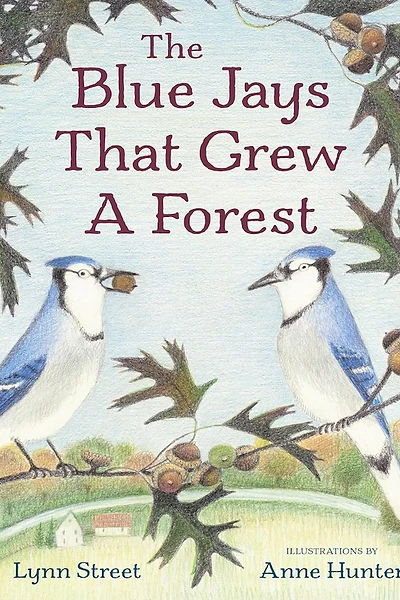
The Blue Jays That Grew a Forest
by Lynn Street
Pacing MaterialThe true story of how blue jays, carrying acorns one beakful at a time, helped replant forests after the last ice age — and still do today.
Big Idea
Small actions, repeated over time, can grow entire forests — and animals are nature's gardeners.
Discussion Questions
- 1.How do blue jays plant trees?
- 2.Why were blue jays important after the ice age?
- 3.How can one small action lead to something big?
- 4.What is seed dispersal?
- 5.How do animals help forests grow?
Classroom Activity
Seed Dispersal Map
Draw a blue jay carrying an acorn. Map the journey and show where a new tree might grow.
Lesson Plan
Learning Goals
- Explain how blue jays carry and bury acorns, helping oak trees spread to new places.
- Sequence an acorn’s journey from an oak tree to a hiding place where it might sprout.
- Create a labeled map showing how a blue jay’s actions can help a forest grow.
- Use details from the book to explain how small actions repeated over time can create big changes.
Activity Steps
- 1.Read The Blue Jays That Grew a Forest aloud. Discuss how blue jays helped forests return after the last ice age and continue spreading acorns today.
- 2.Review the journey: an oak tree produces an acorn, a blue jay carries and hides it, and an acorn that is not eaten may sprout if conditions are suitable. Ask: “Does every hidden acorn become a tree?”
- 3.Have students draw a simple map with an oak tree, an open area, and a place where a blue jay could bury an acorn. Add a blue jay carrying an acorn in its beak.
- 4.Draw arrows tracing the acorn’s journey. Number and label three stops: “Oak tree,” “Blue jay carries acorn,” and “Acorn buried.” Younger students may dictate labels.
- 5.At the burial spot, draw a possible oak seedling and add sunlight, rain, and soil. Include a caption such as “This forgotten acorn might grow into an oak tree.”
- 6.Invite students to share their maps with a partner. Discuss how many blue jays hiding many acorns over many years could help grow a forest.
Standards Connections
- ELA: RI.1.3 — Describe connections between events and ideas in an informational text, such as blue jays hiding acorns and new oak trees growing.
- ELA: SL.1.5 — Add drawings or other visual displays to descriptions to clarify ideas.
- Science: NGSS 2-LS2-2 — Develop a simple model that mimics an animal’s role in dispersing seeds.
- Science: NGSS 1-LS1-2 — Read texts to identify patterns in animal behavior that help animals survive, including storing food.
Pace-Write-Read Study with Pace-Write It!
Focus question: How does an author slow down and speed up a true story so readers can understand how small actions change a whole ecosystem? In The Blue Jays That Grew a Forest by Lynn Street, readers follow the real work of blue jays carrying and hiding acorns across the land after the last ice age. The book uses pacing by moving between small, repeated bird actions and big changes over long periods of time, helping readers feel both the moment and the long-term impact.
| Element | How to notice or teach it in the novel |
|---|---|
| Pace | Read: Notice how Lynn Street paces the book by showing one blue jay carrying one acorn at a time, then widening out to show forests growing over many years after the last ice age. The steady pace of repeated actions helps readers understand that ecosystems change slowly but powerfully. Classroom Activity: Write 3-4 sentences that begin with one small animal action and end with a big change in nature, using time words like first, then, later, and over time. |
| Plot | Read: Notice the plot moves from a world changed by ice, to blue jays gathering and hiding acorns, to oak forests returning because many seeds are forgotten and begin to grow. This real story has a clear sequence of problem, action, and result. Classroom Activity: Make a beginning-middle-end organizer showing how blue jays helped forests regrow, then turn your organizer into a short paragraph. |
| Prosody | Read: Listen to how the sentences can be read smoothly and meaningfully, especially when the text describes blue jays flying, carrying, and planting acorns through repeated natural actions. The flow of the language supports the calm, true-story tone. Classroom Activity: Echo-read a page aloud, then write one sentence you could read slowly and one sentence you could read quickly about an animal helping nature. |
| Word pause | Read: Notice where you naturally pause at commas and line breaks in sentences that list actions such as finding, carrying, hiding, and forgetting acorns. These pauses help readers take in each step of seed dispersal. Classroom Activity: Write one long sentence about a blue jay’s work and add commas to show where a reader should pause. |
| Concept | Read: The big concept is seed dispersal in an ecosystem: blue jays do not just eat acorns, they also spread them, which helps oak forests grow. Lynn Street turns a science idea into a story children can picture. Classroom Activity: Write a teaching sentence that explains how one animal helps one plant, using the frame: ___ helps ___ by ___. |
| Voice & World View | Read: Notice the author’s voice is curious, respectful, and full of wonder about the natural world. The world view of the book shows that even small creatures like blue jays matter in rebuilding habitats. Classroom Activity: Write 2-3 sentences in a wonder-filled voice about a small animal doing important work in nature. |
| Setting & Place | Read: Notice the setting shifts across outdoor places shaped by the last ice age and later covered by growing oak forests. Place matters because the land changes from icy and open to wooded and full of life. Classroom Activity: Draw and label two settings from the book—after the ice age and after the forest grows—then write one sentence comparing them. |
| Point of View | Read: The book is told from an outside narrator who explains true events about blue jays and forests. This point of view lets readers see both the birds’ actions and the larger ecosystem changes they cause. Classroom Activity: Rewrite one event from the book as if a blue jay were telling it using I, me, and my. |
| Original Characters | Read: Even though this is a real story, the blue jays stand out as memorable central figures because their repeated habits drive the action. The ‘characters’ are not made-up heroes, but real birds whose behavior changes the land. Classroom Activity: Write a character card for a blue jay that includes actions, traits, and its important job in the ecosystem. |
| Dialogue | Read: This true science story likely relies more on explanation than spoken dialogue, which keeps the focus on facts and natural action. Readers can imagine what a blue jay might ‘say,’ but the author lets behavior tell the story. Classroom Activity: Add 2 lines of imagined dialogue between two blue jays planning where to hide acorns, while keeping the science accurate. |
| Details | Read: Notice the specific details about acorns, blue jay behavior, and forest regrowth that make the real story believable and informative. These details help readers learn exactly how seed dispersal works. Classroom Activity: Write three factual details you learned about blue jays or acorns, then use them in a short explanatory paragraph. |
| Descriptions | Read: Pay attention to how the book describes natural actions and changes in the land so readers can picture acorns tucked away and forests slowly returning. Description helps connect science information to clear mental images. Classroom Activity: Write a description of a blue jay carrying an acorn using color, motion, and place words. |
| Strong First Lines | Read: Notice how the opening likely introduces a big idea or striking natural situation to pull readers into this true story of birds and forests. A strong first line helps readers care right away about blue jays and the land. Classroom Activity: Write your own first line for a nonfiction picture book about an animal changing its habitat. |
| Immediacy & Engagement | Read: Lynn Street creates engagement by focusing on concrete actions—blue jays picking up, flying with, and hiding acorns—so readers can follow the process step by step. Immediate action makes a long ecological timeline feel active. Classroom Activity: Write 3 action sentences about a blue jay using strong verbs such as grabbed, flew, tucked, or buried. |
| Story Scenes & Summaries & Unique Structures | Read: Notice how the book likely combines scene-like moments of a jay handling acorns with summary sections that explain years of forest growth. This mix helps pace a true story that happens across both moments and centuries. Classroom Activity: Write one scene sentence about a single blue jay hiding an acorn and one summary sentence about what happened over many years. |
| Flashback & Flash Forward & Cliffhangers | Read: The book reaches back to the time after the last ice age and then forward to forests growing, which works like a nonfiction flashback and flash forward. This structure helps readers connect past actions to future ecosystems. Classroom Activity: Write two sentences—one starting with Long ago... and one starting with Years later...—to show cause and effect in nature. |
| Tension & Suspense & Surprise | Read: The tension comes from wondering how forests could return after ice changed the land, and the surprise is that blue jays helped solve this problem by spreading acorns. The science fact itself creates wonder and suspense. Classroom Activity: Write a question-and-answer pair that builds surprise, such as Who helped grow the forest? The blue jays did. |
| Page Turns and Chapter Breaks | Read: In a picture book like this, page turns help reveal the next step in the blue jays’ work or the next stage in the forest’s growth. The turn can slow readers down or create anticipation about what changed next. Classroom Activity: Fold a paper into 4 mini-pages and plan a page turn book showing acorn, jay, hidden seed, and new oak tree. |
| Performance | Read: This book invites expressive reading with gestures for flying, pecking, hiding, and growing. Performing the actions helps students feel the rhythm of repeated natural work. Classroom Activity: Act out the sequence of a blue jay finding and hiding an acorn, then write one sentence for each movement. |
| Personality | Read: The blue jays can seem busy, clever, and determined because of the way their actions are presented, even in a factual text. Their repeated habits give them personality without turning the story into fantasy. Classroom Activity: Write 2 sentences describing a blue jay’s personality based on what it does in the book. |
| Humor | Read: There may be gentle humor in the idea that blue jays hide acorns and then forget some of them, accidentally helping forests grow. That small mismatch between what the bird plans and what happens can make readers smile. Classroom Activity: Write a lighthearted sentence about a bird forgetting a seed in a way that still teaches a true fact. |
| Pause | Read: Notice where readers may pause to think—especially after learning that one small bird action can lead to many new trees. These thinking pauses help the science message sink in. Classroom Activity: After reading, pause and complete this sentence in writing: I used to think ___, but now I think ___ about blue jays or forests. |
| Poetry and Poetic Devices | Read: Even in nonfiction, the book may use vivid language, sound patterns, or image-rich phrasing to make blue jays and acorns memorable. Poetic touches can slow pacing and deepen wonder about ecosystems. Classroom Activity: Write a 3-line poem about an acorn’s journey from beak to forest using one comparison, such as like or as. |
| Repetition | Read: Notice how repeated actions—carry, hide, forget, grow—show the ongoing work of blue jays and reinforce the idea of seed dispersal. Repetition also creates a steady reading pace. Classroom Activity: Write a patterned piece that repeats the starter The blue jay... in three sentences to show how repetition builds meaning. |
| Rhythm | Read: The rhythm of the book may come from the cycle of bird movement and plant growth: quick action by the jay, slow change in the forest. That contrast in rhythm supports the book’s pacing. Classroom Activity: Write one short sentence and one longer sentence about the same event to show fast and slow rhythm. |
| Punctuation | Read: Notice how periods, commas, and maybe dashes or exclamations shape how the information is read and understood. Punctuation helps separate each step in the blue jay-acorn-forest process. Classroom Activity: Write a sentence about seed dispersal, then revise it by adding punctuation that makes the meaning clearer. |
| Questions | Read: The book naturally raises questions such as How did forests come back? and What do blue jays do with acorns? Questions keep readers thinking through the science. Classroom Activity: Write two inquiry questions about ecosystems that this book helps answer, then answer one in a complete sentence. |
| Compare-Contrast | Read: Compare the icy land after the last ice age with the later oak forest, or compare an acorn that gets eaten with one that gets hidden and grows. These comparisons help explain how outcomes can be different. Classroom Activity: Use the frame One acorn ___, but another acorn ___ to compare two possible seed outcomes. |
| Objects | Read: The acorn is the key object in the book because it connects the blue jays to the oak forest and to the whole ecosystem story. One small object carries the big idea. Classroom Activity: Write an object-centered paragraph about an acorn and explain why it matters so much in this book. |
| Threes | Read: Notice if ideas are grouped in threes, such as three steps in what the blue jay does or three changes in the land. Groups of three can make information easy to remember. Classroom Activity: Write three sentences that tell the blue jay’s job in three steps: finds, carries, hides. |
| Whitespace & Negative Space | Read: In a picture book, open space on the page can slow readers down and give them room to think about the long stretch of time between one hidden acorn and a grown forest. The space can match the quiet patience of nature. Classroom Activity: Create a page with one sentence in the middle—A forest can begin with one acorn.—and add a small sketch that uses lots of open space. |
| Art & Graphics | Read: Notice how the illustrations and any diagrams help show blue jays moving acorns and forests changing over time. The art supports understanding of both action and ecosystem growth. Classroom Activity: Make a labeled diagram showing blue jay, acorn, hiding place, sprout, and oak tree, then write captions for each part. |
| Interactives & Gamification | Read: The book lends itself to interactive learning because students can track where acorns go and predict which ones might grow into trees. This kind of participation helps students grasp seed dispersal. Classroom Activity: Play a simple seed-dispersal game by moving paper acorns to different spots on a map, then write 2 sentences explaining which acorns had the best chance to become trees and why. |
Pace-Write It!
20-Minute Classroom Flow\nRead (5 min): Read aloud a key section from The Blue Jays That Grew a Forest by Lynn Street that shows blue jays carrying and hiding acorns, then connect it to forests growing after the last ice age. Ask students to listen for places where the story feels slow and careful and places where time moves fast.\nNotice (5 min): Discuss: What small action keeps repeating? How does the author move from one acorn to a whole forest? Chart student ideas under Small action and Big result.\nWrite (7 min): Students write a short cause-and-effect piece about the book’s pacing. Writing frame: First, the blue jay ____. Then, it ____. Later, ____. Over time, ____. This shows ____. Encourage students to use one specific detail about acorns, seed dispersal, or oak trees.\nShare (3 min): Partners read their pieces aloud and listen for time words and the big result at the end. Invite 2-3 students to share how they showed a small action leading to a big ecosystem change.\nExit ticket: Complete this sentence: The author paced the story by showing ___ first and ___ over time.
Pace-Write-Read Connection
Teach this book using the Pace-Write-Read method — Tool 11: Details.
Open the Mastery Manual