 5-8
5-8M SEPETYS
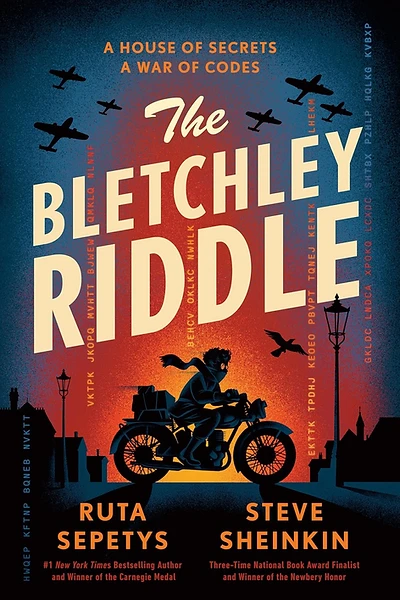
The Bletchley Riddle
by Ruta Sepetys and Steve Sheinkin
Pacing MaterialSet against the tense backdrop of World War II, this novel follows siblings Jakob and Lizzie as they arrive at Bletchley Park, the secretive British estate where codebreakers race to crack Nazi Germany's Enigma cipher. When their mother disappears under mysterious circumstances, the siblings begin unraveling clues that intertwine with the real codebreaking work happening around them. As they navigate wartime rationing, secrecy oaths, and encrypted messages, Jakob and Lizzie discover that puzzles come in many forms—some etched in code, others hidden within their own family's past. Blending real history with a page-turning mystery, the novel explores courage, trust, and the power of intellect during humanity's darkest hour.
Big Idea
Even in times of great danger and uncertainty, ordinary people—including young people—can use intelligence, courage, and persistence to make a meaningful difference.
Discussion Questions
- 1.Why do you think the authors chose to tell this story through the eyes of two siblings rather than adult codebreakers?
- 2.How does the secrecy required at Bletchley Park create tension for characters who want to protect their loved ones?
- 3.What does the novel suggest about the relationship between truth and safety during wartime?
- 4.How do Jakob and Lizzie's personalities complement each other as they solve puzzles together?
- 5.In what ways does historical fiction help us understand real events differently than a textbook might?
- 6.What sacrifices do the adult codebreakers make, and how do these compare to the sacrifices made by the children?
- 7.How does the setting of Bletchley Park itself function almost like a character in the story?
- 8.What role does trust play when everyone around you might be keeping secrets?
Classroom Activity
Crack the Code: Design Your Own Cipher
Students work in pairs to design an original substitution or transposition cipher, inspired by the codebreaking techniques described in the novel. Each pair creates an encoded message related to a scene or theme from the book, then swaps their cipher key and message with another pair to decode. Afterward, students write a short reflective paragraph describing the process of encoding/decoding and connecting it to how characters in the novel might have felt while breaking or protecting a code—balancing logic, patience, and the weight of secrecy.
Lesson Plan
Learning Goals
- Design and accurately apply an original substitution or transposition cipher to encode a message connected to a scene or theme in The Bletchley Riddle.
- Use logical reasoning, collaboration, and persistence to decode another pair’s message and identify unclear cipher instructions.
- Explain how secrecy and codebreaking shape Jakob and Lizzie’s experiences at Bletchley Park, using specific evidence from the novel.
- Write a reflective paragraph connecting the challenges of encoding and decoding to the characters’ courage, patience, and responsibility during World War II.
Activity Steps
- 1.Introduce the challenge (8 minutes): Discuss a previously read scene involving Jakob and Lizzie, an encrypted message, or wartime secrecy. Ask: How can intelligence and persistence help ordinary people make a difference? Explain that students will use simplified classroom ciphers, not reproduce the much more complex Enigma system.
- 2.Model two cipher types (7 minutes): Demonstrate a substitution cipher by shifting each letter three places, so TRUST becomes WUXVW. Demonstrate a transposition cipher by reversing the letters in each word, so TRUST becomes TSURT. Show how a key explains the rule, including treatment of spaces and punctuation.
- 3.Design and test in pairs (12 minutes): Students create an original substitution mapping or reversible letter-reordering rule. Each pair writes a clear key and a 10–20-word message about a scene or theme in the novel, such as the search for the siblings’ mother, trust, or protecting secrets. Partners test their cipher and retain a plaintext answer copy.
- 4.Swap and decode (10 minutes): Pairs exchange encoded messages and keys, keeping their plaintext copies hidden. Students use the provided rules to decode, record one difficulty and the strategy used to address it, and compare their result with the creators’ answer. Clarify that decoding with a supplied key differs from the wartime challenge of discovering an unknown key.
- 5.Reflect and share (13 minutes): Students individually write a 5–7-sentence paragraph explaining their process, a challenge, and a connection to how Jakob or Lizzie might feel when breaking or protecting a code. Require one specific detail from the novel and a statement about how intelligence, courage, or persistence can make a meaningful difference. Invite several students to share.
Standards Connections
- ELA: CCSS RL.5.1 / RL.6.1 / RL.7.1 / RL.8.1 — Use textual evidence to support analysis of characters’ experiences with secrecy and codebreaking.
- ELA: CCSS RL.5.2 / RL.6.2 / RL.7.2 / RL.8.2 — Determine a theme and explain how the novel develops ideas about courage, trust, and persistence.
- ELA: CCSS W.5.9 / W.6.9 / W.7.9 / W.8.9 — Draw evidence from literature to support written reflection.
- ELA: CCSS SL.5.1 / SL.6.1 / SL.7.1 / SL.8.1 — Collaborate effectively, explain cipher rules, and build on partners’ ideas.
- SEL: Self-management and relationship skills — Practice persistence, manage frustration, and communicate clearly during collaborative problem-solving.
Pace-Write-Read Study with Pace-Write It!
The Bletchley Riddle uses a tightly woven dual mystery—codebreaking history and family secrets—to control pacing across short chapters, timed historical events, and rising personal stakes. The following elements highlight how Sepetys and Sheinkin balance historical detail with narrative propulsion, offering rich opportunities for close reading and craft-focused writing instruction.
| Element | How to notice or teach it in the novel |
|---|---|
| Pace | Read: Notice how short, alternating chapters between Jakob's and Lizzie's perspectives keep the story moving quickly even during dense historical explanation. Classroom Activity: Have students rewrite a slow-moving paragraph from a school report to make it as tense and fast-paced as a Bletchley Park chapter opening. |
| Plot | Read: Notice how the mystery of the siblings' mother's disappearance runs parallel to the historical codebreaking plot, converging at key moments. Classroom Activity: Have students map two intertwining plotlines from the novel on a chart, showing where they intersect and why those intersections matter. |
| Prosody | Read: Notice the clipped, urgent sentence rhythms used during code-cracking scenes versus longer, reflective sentences during quiet family moments. Classroom Activity: Have students rewrite a calm paragraph using short clipped sentences to build urgency, then compare the emotional effect. |
| Word pause | Read: Notice how the authors use single-word paragraphs or sentence fragments to emphasize revelations, such as when a code is finally cracked. Classroom Activity: Have students identify a moment of discovery in their own writing and isolate one key word into its own line for dramatic effect. |
| Concept | Read: Notice how the novel introduces complex concepts like cryptography and cipher wheels through character curiosity rather than lecture. Classroom Activity: Have students explain a complex concept (like a math rule or scientific process) through a character's discovery rather than direct exposition. |
| Voice & World View | Read: Notice how Jakob's analytical, skeptical voice differs from Lizzie's intuitive, emotionally driven voice. Classroom Activity: Have students write the same short scene twice, once from an analytical character's voice and once from an emotional character's voice. |
| Setting & Place | Read: Notice how the fog, guarded gates, and hushed huts of Bletchley Park create a sense of secrecy and confinement. Classroom Activity: Have students write a setting description of a real place they know, using sensory details to convey a feeling of hidden secrets. |
| Point of View | Read: Notice how alternating first-person or close third-person perspectives between siblings reveal different pieces of the mystery. Classroom Activity: Have students write a two-paragraph scene from two different characters' points of view describing the same event. |
| Original Characters | Read: Notice how supporting codebreakers are given quirky, memorable habits (a nervous habit, a favorite phrase) that make them feel real despite limited page time. Classroom Activity: Have students create a minor character profile including one quirky habit that reveals their personality in a single scene. |
| Dialogue | Read: Notice how clipped, code-like dialogue between codebreakers reflects the secrecy of their work, often implying more than it states. Classroom Activity: Have students write a dialogue exchange where characters cannot say something directly and must imply meaning through subtext. |
| Details | Read: Notice how specific historical details—ration cards, teleprinters, blackout curtains—ground the fictional story in authentic history. Classroom Activity: Have students research three authentic details from a historical period and incorporate them into a short descriptive paragraph. |
| Descriptions | Read: Notice how the authors describe the physical sensation of code-breaking work—ink-stained fingers, aching eyes—to make intellectual work feel physical and immediate. Classroom Activity: Have students describe a mental or intellectual task (like studying) using physical, sensory details. |
| Strong First Lines | Read: Notice how early chapters often open with an intriguing question or unsettling detail that immediately raises stakes. Classroom Activity: Have students write three alternative first lines for a personal narrative, each designed to hook a reader immediately. |
| Immediacy & Engagement | Read: Notice how present-tense urgency is created even in past-tense narration through active verbs and time pressure (deadlines, approaching footsteps). Classroom Activity: Have students revise a passive paragraph to add urgency using stronger verbs and implied time pressure. |
| Story Scenes & Summaries & Unique Structures | Read: Notice how the novel occasionally shifts from full immersive scenes to brief historical summaries that provide necessary context without slowing momentum. Classroom Activity: Have students write one immersive scene and one brief summary paragraph covering the same historical event, then compare pacing effects. |
| Flashback & Flash Forward & Cliffhangers | Read: Notice how chapters often end on a cliffhanger just as a code is nearly solved or a secret is about to be revealed. Classroom Activity: Have students rewrite the ending of a chapter they've written to end on a cliffhanger that withholds a key piece of information. |
| Tension & Suspense & Surprise | Read: Notice how withheld information about the mother's whereabouts builds sustained suspense across multiple chapters. Classroom Activity: Have students identify a secret in their own story draft and plan three moments where they can hint at it without revealing it fully. |
| Page Turns and Chapter Breaks | Read: Notice how chapter breaks often occur right after a character makes a discovery, forcing readers to turn the page for resolution. Classroom Activity: Have students revise their own chapter ending to stop right before a discovery is explained. |
| Performance | Read: Notice how dramatic tension in dialogue-heavy scenes lends itself to being read aloud with distinct character voices. Classroom Activity: Have students perform a short dialogue scene aloud in pairs, using tone and pacing to convey secrecy or urgency. |
| Personality | Read: Notice how Lizzie's boldness and Jakob's caution create natural narrative friction and complement each other's problem-solving styles. Classroom Activity: Have students write a scene where two characters with opposite personalities must solve a problem together. |
| Humor | Read: Notice how brief moments of sibling banter provide comic relief amid tense wartime scenes. Classroom Activity: Have students insert one light, humorous exchange into a serious scene without undercutting the stakes. |
| Pause | Read: Notice how the authors insert quiet reflective moments after intense scenes, allowing readers to process what just happened. Classroom Activity: Have students add a brief, quiet paragraph immediately after an action scene in their own writing to let tension settle. |
| Poetry and Poetic Devices | Read: Notice how metaphors comparing codes to puzzles or locks appear throughout, reinforcing the novel's central themes. Classroom Activity: Have students write three original metaphors comparing an abstract concept (like secrecy or trust) to a concrete object. |
| Repetition | Read: Notice how phrases about secrecy ("Careless talk costs lives") repeat throughout to reinforce the wartime setting and its central tension. Classroom Activity: Have students choose a repeating phrase or motto for their own story and use it in at least three different contexts. |
| Rhythm | Read: Notice how sentence length varies to mimic the rhythm of decoding—short bursts during frantic work, longer sentences during calm explanation. Classroom Activity: Have students write a paragraph that alternates between short and long sentences to create a rhythmic build in tension. |
| Punctuation | Read: Notice how dashes and ellipses are used in dialogue to show interrupted or hesitant speech during tense exchanges. Classroom Activity: Have students revise a dialogue exchange to include dashes or ellipses that convey hesitation or interruption. |
| Questions | Read: Notice how characters frequently pose direct questions to themselves or each other to drive the mystery forward. Classroom Activity: Have students write a paragraph in which a character asks themselves three unanswered questions that propel the plot. |
| Compare-Contrast | Read: Notice how the novel contrasts the siblings' sheltered pre-war life with the harsh realities of wartime secrecy. Classroom Activity: Have students write a paragraph comparing a character's life before and after a major event. |
| Objects | Read: Notice how a specific object, like a coded letter or a family photograph, serves as a recurring symbol tying together the mystery. Classroom Activity: Have students choose one meaningful object in their own writing and describe how it changes meaning across three different scenes. |
| Threes | Read: Notice how important clues or details are often grouped in threes to help readers track the mystery without overwhelming them. Classroom Activity: Have students organize three key clues in their own mystery story and decide the order that best builds suspense. |
| Whitespace & Negative Space | Read: Notice how short paragraphs and frequent line breaks during tense scenes create visual pacing that mirrors the urgency of the plot. Classroom Activity: Have students revise a dense paragraph by breaking it into shorter paragraphs to control pacing and emphasis. |
| Art & Graphics | Read: Notice how historical photographs and diagrams (if included in back matter) enhance understanding of real codebreaking machines like the Enigma. Classroom Activity: Have students create a simple diagram or illustration explaining a historical object or process from the book. |
| Interactives & Gamification | Read: Notice how the novel's embedded codes and ciphers invite readers to attempt decoding alongside the characters. Classroom Activity: Have students design a simple cipher puzzle for classmates to solve, connecting it to a moment in the story. |
Pace-Write It!
In this workshop, students will explore how The Bletchley Riddle balances historical exposition with mystery-driven pacing. Begin by having students select two chapters—one focused on historical context and one focused on the sibling's personal mystery—and annotate how sentence length, dialogue, and chapter breaks shift the pacing between them. Then, in small groups, have students chart the novel's pacing arc across five key moments, identifying where tension rises, pauses, or accelerates. Conclude with a writing exercise where students draft a short scene of their own that intentionally alternates between fast-paced action and slower reflective moments, using techniques identified in the pacing_elements list above. This workshop encourages students to see pacing not as accidental, but as a deliberate craft choice authors use to control reader engagement and emotional impact.