
 PreK-2
P WILLEMS
That Is NOT a Good Idea!
by Mo Willems
Pacing MaterialA hungry fox invites a plump duck for a stroll, with each page building suspense. The baby chicks try to warn the duck — but this story has a surprising twist.
Big Idea
Things aren't always what they seem — and sometimes the one who seems most helpless is the cleverest of all.
Discussion Questions
- 1.Why do the chicks keep saying 'That is NOT a good idea!'?
- 2.What do you think will happen to the duck?
- 3.Were you surprised by the ending? Why?
- 4.Have you ever judged a situation too quickly?
Classroom Activity
Predict the Twist
Stop before the ending and have students predict what will happen. Then compare their predictions to the actual twist.
Lesson Plan
Learning Goals
- Make a prediction about the fox and duck’s encounter using clues from the words and illustrations.
- Describe how the baby chicks’ repeated warnings build suspense.
- Compare an initial prediction with the actual ending and identify clues that support the twist.
- Explain how the ending changes our understanding of which character is clever and which is in danger.
Activity Steps
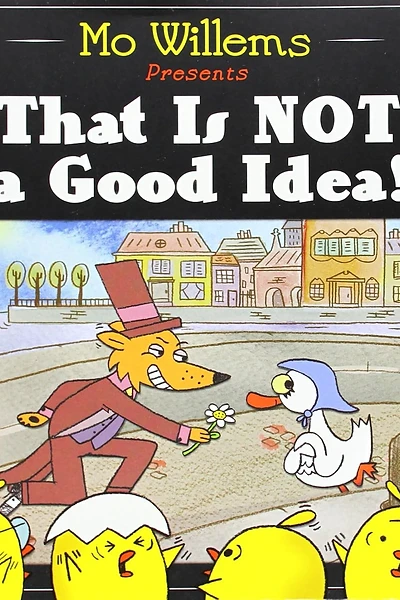
- 1.Introduce the title and cover of That Is NOT a Good Idea! Ask: “Who might be giving this warning? What might be a bad idea?” Record students’ ideas without confirming them.
- 2.Read aloud, inviting students to join in the baby chicks’ warnings. Pause briefly to examine the fox’s invitations and the duck’s responses. Ask: “What do these words and pictures make you think will happen?”
- 3.Stop just before the ending reveals the twist. Have students draw, dictate, or write their prediction about what will happen to the fox and duck. Encourage them to include one clue from the story.
- 4.Invite students to share predictions with a partner, then hear several different possibilities. Emphasize that predictions can differ when readers interpret clues differently.
- 5.Finish reading. Ask: “Who were the chicks warning? How did the ending surprise you?” Revisit earlier illustrations and dialogue to look for clues students now understand differently.
- 6.Have students add the actual ending beside their prediction. Discuss what matched, what changed, and how the duck challenges the idea that a character who appears helpless cannot be clever.
Standards Connections
- ELA: RL.K.1 — With prompting and support, ask and answer questions about key details in the story.
- ELA: RL.1.3 — Describe the fox, duck, and major events using key details.
- ELA: RL.1.7 — Use illustrations and story details to describe characters and events and support predictions.
- ELA: RL.2.3 — Describe how the characters respond as the encounter develops and the ending reveals a twist.
- ELA: SL.1.1 — Participate in collaborative conversations, listen to others’ predictions, and build on their ideas.
Pace-Write-Read Study with Pace-Write It!
Focus question: How does an author slow us down, speed us up, and build suspense before a surprise ending? In That Is NOT a Good Idea! by Mo Willems, a fox politely invites a duck to take a walk, while baby chicks keep warning that something seems wrong. Willems uses page turns, repeated warnings, dramatic dialogue, and a twist ending to control the pacing and keep readers thinking about who is really in charge.
| Element | How to notice or teach it in the novel |
|---|---|
| Pace | Read: Notice how That Is NOT a Good Idea! moves at a careful, creepy pace at first as the fox and duck walk together, then speeds up near the stove and the surprise ending. Classroom Activity: Write 3 short story beats for a new suspicious walk, making the first slow, the second slower, and the third fast and surprising. |
| Plot | Read: Follow the simple plot: the fox meets the duck, invites her along, takes her home, and the story seems to head toward danger until the ending flips what readers expect. Classroom Activity: Draw and label a beginning, middle, and end for a trick story with a surprise. |
| Prosody | Read: Listen to how the baby chicks’ warning—'That is NOT a good idea!'—sounds louder and more urgent each time when read aloud. Classroom Activity: Practice reading one warning line in 3 ways—worried, loud, and dramatic—then write your own warning sentence for a character. |
| Word pause | Read: Notice where a reader naturally pauses after the fox asks polite questions and after the chicks interrupt, giving the suspense time to grow. Classroom Activity: Write 2 lines of dialogue and add a slash mark / where a reader should pause for suspense. |
| Concept | Read: Think about the big idea that readers should question what seems polite or obvious, because first impressions can be wrong. Classroom Activity: Complete the frame: 'At first I thought ___, but then I learned ___.' |
| Voice & World View | Read: Notice the formal, old-fashioned storyteller voice and how the baby chicks’ world view is full of alarm, while the duck seems calm and cheerful. Classroom Activity: Write 2 sentences about the same event—one in a worried voice like the chicks and one in a calm voice like the duck. |
| Setting & Place | Read: Pay attention to how the walk from outdoors to the fox’s home and then to the kitchen/stove makes the setting feel more dangerous page by page. Classroom Activity: Make a 3-box setting map showing where a character goes from safe place to risky place. |
| Point of View | Read: Notice that readers can see the fox, duck, and warning chicks from the outside, which helps us guess and wonder without knowing everything. Classroom Activity: Rewrite one moment from the duck’s point of view using 'I' statements. |
| Original Characters | Read: Study how Mo Willems makes the fox seem smooth and polite, the duck seem pleasant and plump, and the baby chicks seem tiny but important. Classroom Activity: Invent 2 animal characters who seem opposite from each other and write one trait for each. |
| Dialogue | Read: Notice how the polite back-and-forth between the fox and duck sounds simple, but it hides the real danger underneath. Classroom Activity: Write 4 lines of dialogue between a tricky character and a trusting character. |
| Details | Read: Look closely at the small details—like the fox’s invitation, the walk, the kitchen, and the chicks’ interruptions—that help readers predict trouble. Classroom Activity: Add 3 details to a scene that make it feel suspicious without saying 'It was scary.' |
| Descriptions | Read: Notice how the duck is described as plump and the fox is shown as hungry, details that shape what readers expect. Classroom Activity: Describe one character in a way that makes readers guess what might happen next. |
| Strong First Lines | Read: Pay attention to how the opening quickly introduces the fox and makes readers alert right away. Classroom Activity: Write an opening line for a story that makes readers worry immediately. |
| Immediacy & Engagement | Read: Notice how the repeated warnings from the chicks pull readers in and make them want to shout back at the book. Classroom Activity: Write a line that makes the audience want to answer or react. |
| Story Scenes & Summaries & Unique Structures | Read: See how the book uses short scenes—meeting, walking, cooking—rather than long explanation, which keeps the story moving. Classroom Activity: Plan a story in 3 quick scenes instead of one long paragraph. |
| Flashback & Flash Forward & Cliffhangers | Read: Notice that the story stays in the present moment, but many page endings act like mini-cliffhangers before readers turn the page. Classroom Activity: Write a sentence that ends with a cliffhanger, such as 'Then the door slowly opened and...'. |
| Tension & Suspense & Surprise | Read: Watch how tension builds because readers think the fox will eat the duck, but the surprise ending reveals that the duck is the one in control. Classroom Activity: Write a 3-sentence mini-story that leads readers to one guess and then surprises them. |
| Page Turns and Chapter Breaks | Read: Notice how each page turn in this picture book acts like a suspense button, especially as the fox leads the duck closer to the stove. Classroom Activity: Fold a paper into 4 pages and plan what surprise should happen after each page turn. |
| Performance | Read: This book begs to be performed with dramatic faces, a sly fox voice, a cheerful duck voice, and loud chick warnings. Classroom Activity: Choose one page and mark how you would perform it with voice and expression. |
| Personality | Read: Notice how personality shapes pacing: the fox is sly, the duck is unbothered, and the chicks are frantic. Classroom Activity: Write one sentence of dialogue for a sly character and one for a frantic character. |
| Humor | Read: See how the story mixes scary suspense with humor, especially when the baby chicks keep interrupting and the ending flips the joke. Classroom Activity: Write a funny warning that could interrupt a serious scene. |
| Pause | Read: Notice how a pause before the chicks’ warning or before the ending makes the surprise stronger. Classroom Activity: Practice reading one line, pausing before the last word, and then write a line where a pause matters. |
| Poetry and Poetic Devices | Read: Listen for sound patterns, repeated phrasing, and dramatic rhythm that make the text feel musical even though it is prose. Classroom Activity: Write a 2-line chant a group of chicks could say to warn someone. |
| Repetition | Read: Notice the repeated line 'That is NOT a good idea!' and how repetition helps build suspense, pattern, and humor. Classroom Activity: Choose one repeated warning line and use it 3 times in a mini-story. |
| Rhythm | Read: Hear the rhythm created by short exchanges, repeated interruptions, and quick page turns as danger seems to get closer. Classroom Activity: Clap the rhythm of one repeated line, then write your own short rhythmic warning. |
| Punctuation | Read: Look at exclamation marks, question marks, and bold emphasis like NOT to see how punctuation controls expression and pace. Classroom Activity: Rewrite a plain sentence using stronger punctuation to make it dramatic. |
| Questions | Read: Ask questions while reading: Can the duck trust the fox? Why do the chicks know something is wrong? What will happen in the kitchen? Classroom Activity: Write 3 prediction questions a reader could ask during a suspenseful story. |
| Compare-Contrast | Read: Compare what the readers believe about the fox and duck at the beginning with what they understand at the end. Classroom Activity: Make a T-chart: 'What I expected' and 'What really happened.' |
| Objects | Read: Notice how objects, especially the stove and cooking tools, make readers think one thing is coming before the twist arrives. Classroom Activity: Pick one object, like a spoon or pot, and write how it could create suspense in a story. |
| Threes | Read: Watch for patterns of repeated moments and warnings that help the story feel predictable in a good way before it surprises us. Classroom Activity: Write a rule of three: 3 invitations, 3 warnings, or 3 steps toward a surprise. |
| Whitespace & Negative Space | Read: Notice how the space around the characters on the page helps readers focus on expressions, pauses, and the growing feeling that something is off. Classroom Activity: Sketch a page with lots of empty space around one character and write one sentence that fits the mood. |
| Art & Graphics | Read: Study how the illustrations show the fox’s sly body language, the duck’s calmness, and the baby chicks’ dramatic reactions, adding meaning beyond the words. Classroom Activity: Draw facial expressions for a tricky character and a confident character, then add speech bubbles. |
| Interactives & Gamification | Read: This book invites readers to predict, warn, and act like detectives as they gather clues from each page. Classroom Activity: Create a 'good idea/not a good idea' clue chart and sort 4 actions from the story or your own story idea. |
Pace-Write It!
20-Minute Classroom Flow\nRead (5 min): Read That Is NOT a Good Idea! aloud with dramatic expression. Pause each time the baby chicks warn, 'That is NOT a good idea!' and let students predict what they think will happen next.\nNotice (5 min): Discuss how Mo Willems controls pacing. Ask: How do the repeated warnings, page turns, dialogue, and the trip to the kitchen make the story feel slower, then faster, then surprising? Chart student ideas under 'slow,' 'warning,' and 'surprise.'\nWrite (7 min): Students write a tiny suspense scene with a twist. Writing frame: '___ invited ___ to ___. A watcher said, "That is NOT a good idea!" They went to ___. At first I thought ___. But really ___.' Encourage students to include one repeated warning and one surprising last line.\nShare (3 min): Students read their mini-scenes to a partner or the class using dramatic voices. Listeners tell where they felt suspense and where the surprise happened.\nExit ticket: Complete this sentence: 'Mo Willems paced the story by using ___, and it made me feel ___.'
Pace-Write-Read Connection
Teach this book using the Pace-Write-Read method — Tool 1: Pacing.
Open the Mastery Manual