
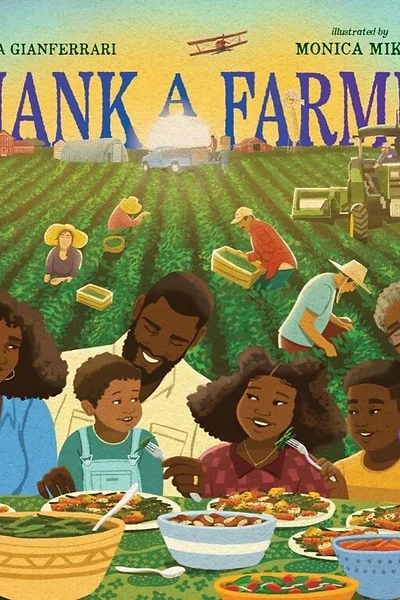
 K-3
K-3P GIANFERRARI
Thank a Farmer
by Maria Gianferrari
Pacing MaterialA celebration of farmers and the food they grow, tracing the journey from seed to table and the many hands that make every meal possible.
Big Idea
Every meal we eat connects us to the people who grow our food.
Discussion Questions
- 1.What are some of the things a farmer does to grow our food?
- 2.How does food get from the farm to our table?
- 3.Have you ever visited a farm? What did you see?
- 4.What is your favorite fruit or vegetable? Could you grow it yourself?
- 5.Why is it important to thank farmers for their work?
Classroom Activity
Farm to Table Thank You Cards
Students create a 'Thank a Farmer' gratitude card featuring a fruit or vegetable of their choice, then trace the journey from farm to table.
Lesson Plan
Learning Goals
- Understand the farm-to-table food journey
- Develop gratitude for the people who produce food
- Learn about different types of farming
- Make text-to-world connections about food systems
Activity Steps
- 1.Discuss the journey of food from farm to table.
- 2.Each student chooses a fruit or vegetable.
- 3.On the front of the card, students draw their chosen food being harvested on a farm.
- 4.Inside, students write: 'Thank you, farmer, for growing ___.'
- 5.On the back, students draw their food on their plate at home.
- 6.Students share their cards with a partner.
Standards Connections
- ELA: RI.K-3.7 (Illustrations in Informational Text)
- ELA: W.K-3.2 (Informative Writing)
- Science: LS2.A (Interdependent Relationships)
- Social Studies: Economics — Production and Distribution
Pace-Write-Read Study with Pace-Write It!
Focus question: How does an author slow down and speed up a story to help readers feel grateful for everyday things? In Thank a Farmer by Maria Gianferrari, the text celebrates farmers and follows food from seed to table, showing how many people help bring a meal to us. The pacing moves step by step through growing, harvesting, transporting, and eating, while short, expressive lines invite readers to pause and appreciate each part of the journey.
| Element | How to notice or teach it in the novel |
|---|---|
| Pace | Read: Notice how Thank a Farmer moves at a steady, step-by-step pace from planting seeds to food reaching the table, helping readers understand the full journey and feel gratitude for each helper. Classroom Activity: Write 4 short sentences that show the pace of one food's journey from farm to plate, using time-order words like first, next, then, and finally. |
| Plot | Read: Notice that the plot is not about one problem to solve, but about the process of how farmers and many workers help food grow and travel to families. Classroom Activity: Make a simple plot map with beginning, middle, and end for an apple, loaf of bread, or carrot in the style of the book. |
| Prosody | Read: Notice how the lines in Thank a Farmer are meant to be read aloud with expression, with warm gratitude and energy that match the celebration of farmers. Classroom Activity: Choose 3 lines to practice reading aloud, then write 2 new lines with the same thankful, musical sound. |
| Word pause | Read: Notice where single words or short phrases make you slow down and think about the work of planting, tending, harvesting, and sharing food. Classroom Activity: Write a thank-you sentence to a farmer and add one intentional word pause by placing an important word on its own line. |
| Concept | Read: Notice that the big idea is gratitude for farmers, food, and the many hands involved from seed to table. Classroom Activity: Write 3 sentences explaining the concept of gratitude in the book and give one example of a person we can thank besides the farmer. |
| Voice & World View | Read: Notice that Maria Gianferrari uses a warm, appreciative voice that views farming as important community work that connects people to the earth and to one another. Classroom Activity: Write in a grateful voice about one worker in your community, using words that show respect and appreciation. |
| Setting & Place | Read: Notice the farm fields, growing spaces, and food pathways that connect rural places with homes, markets, and tables. Classroom Activity: Draw and label a setting from the book, then write 3 sentences showing how that place helps the story move. |
| Point of View | Read: Notice that the book speaks from an outside narrator's point of view, inviting all readers to notice and thank the people who grow food. Classroom Activity: Rewrite one moment from the point of view of a farmer, a seed, or a child eating the meal. |
| Original Characters | Read: Notice that the important people in Thank a Farmer are not fantasy heroes, but real community helpers like farmers and others who make meals possible. Classroom Activity: Invent an original character inspired by the book, such as a berry farmer or truck driver, and write 3 sentences about how that character helps food get to people. |
| Dialogue | Read: Notice that the book is more lyrical and explanatory than talk-filled, so readers focus on the message of gratitude and the chain of helpers. Classroom Activity: Add a short dialogue between a child and a farmer that fits the book's theme of appreciation. |
| Details | Read: Notice the specific details about seeds, plants, crops, and food that make the journey from farm to table feel real and important. Classroom Activity: Write a list of 5 precise details about one fruit or vegetable, then turn the list into 2 complete sentences. |
| Descriptions | Read: Notice how the descriptions help readers picture growing food and all the careful work behind each meal. Classroom Activity: Describe a tomato, ear of corn, or loaf of bread using at least 3 describing words and 1 action word. |
| Strong First Lines | Read: Notice how the opening quickly invites readers into the thankful message and the world of food and farming. Classroom Activity: Write your own strong first line for a class book called Thank a Helper or Thank a Gardener. |
| Immediacy & Engagement | Read: Notice how the direct, inviting language makes readers feel close to the action and connected to the farmers right away. Classroom Activity: Write 2 sentences that make the reader feel present on a farm by using sensory words such as see, hear, smell, or feel. |
| Story Scenes & Summaries & Unique Structures | Read: Notice that Thank a Farmer blends small scene-like moments with summary, moving across many parts of the food journey instead of staying in one event. Classroom Activity: Write one scene sentence about planting and one summary sentence about all the work that happens after. |
| Flashback & Flash Forward & Cliffhangers | Read: Notice that this book mostly moves forward through the food journey, but readers can think backward to the seed and forward to the meal on the table. Classroom Activity: Write one flashback sentence beginning with Before this... and one flash-forward sentence beginning with Soon... about a vegetable in the book. |
| Tension & Suspense & Surprise | Read: Notice that the book does not build big danger, but it creates interest by revealing how many surprising people and steps are involved in one meal. Classroom Activity: Write 3 sentences that build surprise by starting with a food on a plate and then revealing all the helpers behind it. |
| Page Turns and Chapter Breaks | Read: Notice how page turns help reveal the next step in the journey from seed to table, encouraging readers to keep going. Classroom Activity: Plan a 4-page mini-book about one food item and decide what new step will be revealed on each page turn. |
| Performance | Read: Notice that Thank a Farmer works well as a read-aloud because the lines can be spoken with pride, warmth, and pauses for emphasis. Classroom Activity: Practice performing 4 lines with a partner, then mark your own writing with slash marks to show where to pause. |
| Personality | Read: Notice that the book's personality feels thankful, respectful, and celebratory rather than silly or dramatic. Classroom Activity: Write 3 sentences about food helpers using a joyful, appreciative personality that matches the book. |
| Humor | Read: Notice that humor is gentle and not the main focus; the tone stays sincere so gratitude remains central. Classroom Activity: Write one light, friendly sentence that adds a smile, such as a vegetable or seed doing something playful, while still honoring the book's thankful tone. |
| Pause | Read: Notice how the text gives readers places to pause and reflect on each person's contribution to a meal. Classroom Activity: Write a short gratitude poem with 3 lines and leave a pause after each line by ending with punctuation that slows the reader down. |
| Poetry and Poetic Devices | Read: Notice the lyrical language in Thank a Farmer, including repetition, sound, and vivid imagery that make the informational story feel poetic. Classroom Activity: Write 4 poetic lines thanking a farmer and include one example of alliteration, such as busy bees or golden grain. |
| Repetition | Read: Notice how repeated thankful language reinforces the message that many people deserve appreciation for the food we eat. Classroom Activity: Write 5 lines beginning with Thank you for... and name different parts of the food journey. |
| Rhythm | Read: Notice the smooth rhythm of the short lines, which helps the book sound strong and memorable when read aloud. Classroom Activity: Clap the beat of one page, then write 2 sentences with a similar rhythm using short phrases. |
| Punctuation | Read: Notice how punctuation helps control pacing by telling readers when to pause, stop, or read with excitement and emphasis. Classroom Activity: Rewrite one plain sentence about farming in 3 ways using a period, comma, and exclamation mark to change the pacing. |
| Questions | Read: Notice how the book makes readers wonder where food comes from and who helped produce it, even when every line is not written as a question. Classroom Activity: Write 3 questions a child could ask after reading Thank a Farmer, including one about seeds, one about workers, and one about meals. |
| Compare-Contrast | Read: Notice how readers can compare the tiny beginning of a seed with the finished meal on a plate, or contrast farm work with eating at home. Classroom Activity: Write 2 compare-contrast sentences using the frame A seed is ___, but a meal is ___. |
| Objects | Read: Notice the important objects in the book such as seeds, soil, tools, crops, trucks, and food on the table, all of which help show the journey. Classroom Activity: Choose one object from the farm-to-table process and write 3 sentences explaining why it matters. |
| Threes | Read: Notice how ideas can be grouped in threes to sound complete and satisfying, such as planting, growing, and harvesting. Classroom Activity: Write a sentence that thanks 3 helpers or names 3 steps in the food journey. |
| Whitespace & Negative Space | Read: Notice how open space on the page can slow readers down and help them focus on key words, images, and feelings of gratitude. Classroom Activity: Create a 1-page poem with only 6 to 10 words, spacing them out to make readers pause on the most important idea. |
| Art & Graphics | Read: Notice how the illustrations support the text by showing the farm, crops, workers, and meals, helping readers understand each step more deeply. Classroom Activity: Make a labeled sketch showing one stage of the book's journey and add 2 caption sentences in the style of the text. |
| Interactives & Gamification | Read: Notice that the book invites readers to participate by spotting foods, naming helpers, and tracing each meal back to the farm. Classroom Activity: Create a class matching game with cards for seeds, crops, helpers, and meals, then write one sentence explaining a match you made. |
Pace-Write It!
20-Minute Classroom Flow\nRead (5 min): Read Thank a Farmer by Maria Gianferrari aloud. Pause to emphasize the step-by-step movement from seed to table and the repeated feeling of gratitude for farmers and other helpers.\nNotice (5 min): Ask: How does the author slow us down to notice each step? Chart student observations such as short lines, repeated thankful language, page turns, and details about growing, harvesting, and sharing food.\nWrite (7 min): Students write their own short seed-to-table gratitude piece about one food. Writing frame: Thank a ________. First, ________. Next, ________. Then, ________. Finally, ________. Thank you for ________. Encourage students to use at least one describing word and one time-order word.\nShare (3 min): Partners read their pieces aloud with expression. Invite listeners to name one place where the writer used pacing to help the audience follow the food journey.\nExit ticket: On a small slip, students complete this sentence: The author helped me notice ________ by slowing down at ________.