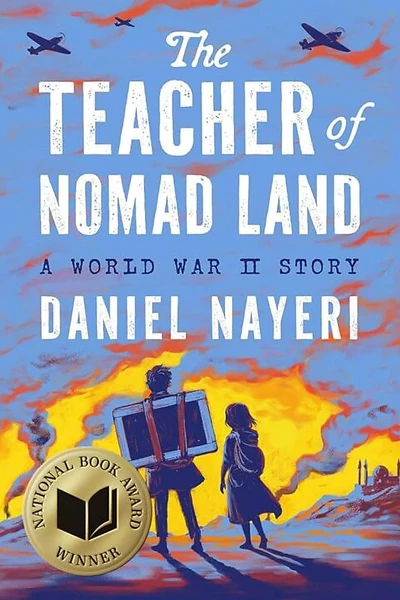
 5-8
5-8M NAYERI
The Teacher of Nomad Land
by Daniel Nayeri
Pacing MaterialDuring World War II, a teacher and their students navigate displacement and danger, finding hope in the power of learning and human connection.
Big Idea
Even in the darkest times, teaching and learning are acts of hope and resistance.
Discussion Questions
- 1.What does the teacher learn from their students?
- 2.How does war change what it means to teach?
- 3.What role does hope play in the story?
- 4.How does the author use the landscape to tell the story?
Classroom Activity
Journey Map
Create a map of the character's journey, labeling key moments of challenge and hope.
Lesson Plan
Learning Goals
- Analyze historical fiction
- Explore themes of war and resilience
- Examine the role of education in crisis
Standards Connections
- ELA: RL.5.1 — Ask and answer questions about key details
- ELA: RL.5.2 — Retell stories, including key details
- ELA: RL.5.3 — Describe characters, setting, and events
- ELA: RL.8.6 — Acknowledge differences in characters' points of view
- ELA: SL.5.1 — Participate in collaborative conversations about the text
- ELA: W.5.3 — Write narratives recounting events with descriptive details
- SEL: Self-Management
- SEL: Responsible Decision-Making
Pace-Write-Read Study with Pace-Write It!
Focus question: How does an author control pacing so a story about danger and displacement also makes space for hope and human connection? In The Teacher of Nomad Land by Daniel Nayeri, the movement between tense wartime moments and quieter scenes of teaching, traveling, and reflection helps readers feel both uncertainty and resilience. Nayeri uses pacing to slow down for meaningful relationships and learning, then speed up when danger, loss, or sudden change confront the teacher and students.
| Element | How to notice or teach it in the novel |
|---|---|
| Pace | Read: Notice how The Teacher of Nomad Land moves between urgent moments of wartime danger and slower moments when the teacher and students learn, observe, and encourage one another. Watch how Daniel Nayeri uses that shift in speed to build resilience and hope. Classroom Activity: Write two short paragraphs about the same journey scene—one fast-paced during danger and one slower-paced during a moment of safety and connection. |
| Plot | Read: Track how the plot follows displacement, survival, and the sustaining power of learning as the teacher and students keep moving through World War II. Notice how each event raises the stakes but also deepens the theme of hope. Classroom Activity: Create a 5-box plot ladder showing a beginning challenge, rising danger, a key learning moment, a turning point, and a hopeful next step. |
| Prosody | Read: Listen for places where the sentences in The Teacher of Nomad Land sound clipped in fearful moments and more flowing in reflective or tender ones. Nayeri’s sentence music helps readers hear tension and calm. Classroom Activity: Rewrite a classroom or campfire scene twice, once with short sharp sentences and once with longer flowing sentences, then explain which version creates more suspense. |
| Word pause | Read: Notice individual words or short phrases that make you stop and feel the weight of fear, waiting, hunger, memory, or courage in the lives of the teacher and students. These small pauses slow the reading just enough to emphasize meaning. Classroom Activity: Draft a 6-8 sentence scene and underline three single words you want readers to pause on for emotional effect. |
| Concept | Read: Think about the central concept that learning can travel even when home cannot. In The Teacher of Nomad Land, school becomes more than a building—it becomes hope, dignity, and resistance against despair. Classroom Activity: Write a paragraph explaining how a lesson, book, or act of teaching could become a form of survival for one student in the story. |
| Voice & World View | Read: Notice how the storytelling voice treats displaced people with dignity and sees learning, memory, and human connection as powerful. Nayeri’s worldview invites readers to value resilience without ignoring fear and loss. Classroom Activity: Write 5-7 sentences in a narrator’s voice that views a hard journey through both honesty and hope. |
| Setting & Place | Read: Pay attention to how wartime landscapes, temporary shelters, roads, and makeshift learning spaces shape the mood of The Teacher of Nomad Land. Place affects pacing because some settings feel exposed and dangerous while others briefly feel protected. Classroom Activity: Describe a temporary classroom in a dangerous place, using at least four sensory details to show both hardship and hope. |
| Point of View | Read: Notice how point of view helps readers stay close to the emotional experience of the teacher and students as they face displacement and uncertainty. Consider how the chosen perspective controls what readers know, fear, and anticipate. Classroom Activity: Rewrite one tense scene from the point of view of a student instead of the teacher, showing how the pace changes when a child notices different details. |
| Original Characters | Read: Study how the teacher and students stand out not just as victims of war but as thinkers, learners, and individuals with courage, fear, and humor. Their uniqueness keeps the story emotionally alive. Classroom Activity: Invent an original student character for the nomad classroom and write a short character sketch that includes one fear, one talent, and one hopeful habit. |
| Dialogue | Read: Notice how dialogue in The Teacher of Nomad Land can reveal care, instruction, worry, and bravery in a few words. Conversations between the teacher and students can slow down action to deepen relationships or speed it up during tense moments. Classroom Activity: Write 8-10 lines of dialogue between the teacher and a student who is afraid to keep going, using the dialogue to show both danger and encouragement. |
| Details | Read: Watch how carefully chosen details—what the students carry, what they see on the road, how they react to uncertainty—make the wartime experience feel immediate. Nayeri selects details that support both realism and emotional pacing. Classroom Activity: Make a list of five meaningful objects a displaced student might carry, then write a paragraph using at least three of them in a scene. |
| Descriptions | Read: Notice when Daniel Nayeri expands description to let readers linger in a place, a face, or a feeling, especially in moments when the teacher creates calm or beauty amid upheaval. Description can slow pacing to make hope feel visible. Classroom Activity: Write a descriptive paragraph of a quiet learning moment during war, using sight, sound, and touch. |
| Strong First Lines | Read: Examine how an opening line in a story like The Teacher of Nomad Land must quickly establish uncertainty, character, and stakes. A strong first line can begin pacing immediately by creating urgency or curiosity. Classroom Activity: Write three possible first lines for a chapter about the teacher leading students into a new unknown place, and choose the one with the strongest pull. |
| Immediacy & Engagement | Read: Notice how the story keeps readers close to unfolding danger and emotion so the teacher’s choices and the students’ responses feel urgent. Immediacy makes readers care about what happens next. Classroom Activity: Write a present-tense version of a tense crossing or escape scene to make the action feel immediate. |
| Story Scenes & Summaries & Unique Structures | Read: Notice when The Teacher of Nomad Land zooms into a full scene with dialogue and action and when it summarizes longer stretches of travel or hardship. This structural shifting helps Nayeri balance momentum with emotional depth. Classroom Activity: Write one scene in full detail about a lesson on the road, then add a 2-3 sentence summary of the next three days of travel. |
| Flashback & Flash Forward & Cliffhangers | Read: Look for places where memory of home, school, or earlier safety might deepen the present moment, and where a chapter could end with uncertainty about what the teacher and students will face next. These moves can stretch tension and build emotional contrast. Classroom Activity: End a paragraph with a cliffhanger, then write a short flashback showing what a student misses most about life before displacement. |
| Tension & Suspense & Surprise | Read: Pay attention to how the dangers of war create constant tension, while small surprises—kindness, a lesson, a safe pause, a brave choice—keep the story from becoming predictable. Hope itself can arrive as a meaningful surprise. Classroom Activity: Write a suspenseful scene in which the group expects danger but encounters an unexpected act of human connection instead. |
| Page Turns and Chapter Breaks | Read: Notice where a chapter about the teacher and students might naturally end: at a decision, a discovery, a threat, or a fragile moment of relief. These breaks control when readers pause and when they rush on. Classroom Activity: Draft the final three lines of a chapter ending with the teacher hearing troubling news just after a lesson ends. |
| Performance | Read: Read parts of The Teacher of Nomad Land aloud and notice how the emotional pacing changes depending on how you stress fear, tenderness, and determination. The story’s meaning becomes clearer when performed with attention to tone. Classroom Activity: Mark a short paragraph for oral reading with slashes for pauses and underline words to emphasize, then practice reading it aloud. |
| Personality | Read: Notice how the teacher’s personality—steady, thoughtful, brave, or quietly warm—affects the pace of scenes with students. A calm personality can slow panic, while an anxious one can speed tension. Classroom Activity: Write a short scene showing the teacher’s personality through actions during a frightening interruption to a lesson. |
| Humor | Read: Watch for moments when humor or lightness might briefly relieve the heaviness of war and remind readers that the students are still children. Even small humor can change pacing by giving readers a breath. Classroom Activity: Write a brief exchange in which a student makes the group smile during a hard day, while still respecting the serious setting. |
| Pause | Read: Notice the moments when the story seems to pause for reflection, grief, wonder, or a lesson. In The Teacher of Nomad Land, these pauses matter because they show that humanity continues even during displacement. Classroom Activity: Write a reflective pause in which a student stops to notice something beautiful before the group must move on. |
| Poetry and Poetic Devices | Read: Look for language that feels lyrical or image-rich, especially when Nayeri connects hardship with hope, memory, and imagination. Metaphor and repetition can make emotional moments linger. Classroom Activity: Write 4-6 lines comparing learning to something portable and powerful, such as a lantern, map, or seed. |
| Repetition | Read: Notice if words, ideas, or routines repeat—walking, teaching, remembering, encouraging—as a way to show both endurance and emotional build. Repetition can create a steady beat in a story about instability. Classroom Activity: Write a paragraph that repeats one key phrase three times to emphasize resilience. |
| Rhythm | Read: Pay attention to the rhythm created by alternating action, dialogue, and reflection in scenes with the teacher and students. This rhythm helps readers move through fear without losing the thread of hope. Classroom Activity: Write a 9-sentence passage with this rhythm pattern: action, action, dialogue, reflection, action, dialogue, description, reflection, action. |
| Punctuation | Read: Notice how punctuation could sharpen pacing in tense moments—dashes for interruption, commas for slowing, ellipses for hesitation, and short end-stopped sentences for urgency. In a wartime story, punctuation can mirror breath and fear. Classroom Activity: Take a plain 5-sentence scene and revise it with punctuation that increases suspense. |
| Questions | Read: Notice the questions raised by the story: Will the students stay safe? Can learning continue? What does hope look like during war? Questions keep readers emotionally invested in the teacher and the children. Classroom Activity: Write five reader questions that might arise during a chapter, then choose one and answer it from a student character’s perspective. |
| Compare-Contrast | Read: Compare scenes of danger with scenes of instruction, and contrast what is lost in war with what is preserved through teaching and community. Nayeri’s pacing often depends on these sharp contrasts. Classroom Activity: Create a T-chart comparing a fearful travel scene and a hopeful teaching scene, then write a paragraph explaining how the contrast builds theme. |
| Objects | Read: Notice how objects in The Teacher of Nomad Land can carry emotional weight: books, papers, bags, food, shoes, or classroom tools may symbolize memory, dignity, or survival. Objects can anchor pacing by focusing attention. Classroom Activity: Choose one object a student carries and write a paragraph explaining its practical use and its emotional meaning. |
| Threes | Read: Watch for places where ideas, images, or actions might come in threes—three dangers, three lessons, three acts of kindness—to create emphasis and momentum. Patterns of three often feel complete and memorable. Classroom Activity: Write a sentence or short paragraph using a set of three to describe what the students learn to carry with them besides belongings. |
| Whitespace & Negative Space | Read: Notice where a story like this benefits from short paragraphs, line breaks, or brief sections that leave emotional room after fear, loss, or revelation. Empty space can slow readers down and honor silence. Classroom Activity: Write a short passage about receiving difficult news, then format it with intentional paragraph breaks to create pause. |
| Art & Graphics | Read: Imagine how maps, sketch-notes, timelines, or symbolic illustrations could support understanding of the teacher’s journey and the students’ movement through wartime spaces. Visuals can shape pacing by clarifying information quickly. Classroom Activity: Design a simple map or one-page visual timeline of the group’s journey and add three captions that highlight moments of resilience. |
| Interactives & Gamification | Read: Think about how readers could interact with the themes of The Teacher of Nomad Land by making choices about what to carry, how to keep learning, or how to support a group under pressure. Interactive thinking reveals the difficult decisions behind the story’s pacing. Classroom Activity: Create a choice board titled 'What would help the class survive and keep learning?' with four options and a short written defense of the best choice. |
Pace-Write It!
20-Minute Classroom Flow Read (5 min): Read aloud a short excerpt or summary section from The Teacher of Nomad Land that includes both a moment of danger and a quieter moment of teaching or encouragement. Ask students to listen for where the pacing speeds up and where it slows down. Notice (5 min): Students annotate for three moves: 1) a place where danger speeds the story up, 2) a place where description or reflection slows it down, and 3) a detail that builds hope. Briefly discuss how Daniel Nayeri balances tension with human connection. Write (7 min): Students write a short original scene inspired by the book’s themes. Writing frame: 'As __________ moved with the class through __________, the air felt __________. When __________ happened, everyone __________. But then the teacher __________, and for a moment __________. Even though __________, the students learned that __________.' Encourage students to include one fast-paced sentence, one reflective sentence, and one meaningful object. Share (3 min): Partners read their scenes aloud and identify one pacing choice that created tension and one that created hope. Exit ticket: In 1-2 sentences, answer: How can a writer slow down a difficult scene to make resilience and hope stand out?