 K-5
K-5P PROIMOS
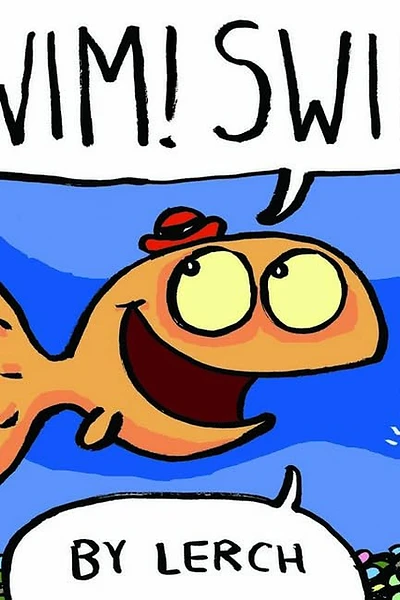
Swim! Swim!
by James Proimos
Pacing MaterialLerch the fish is lonely, and after trying to befriend some unreceptive--and inanimate--objects, he finally succeeds in finding a friend.
Big Idea
True friendship is found when we stop looking for what we expect and start appreciating others for who they are. Lerch the fish learns that connection requires patience and an open heart.
Discussion Questions
- 1.Why do you think Lerch felt lonely at the beginning of the story?
- 2.How did Lerch try to make friends with the inanimate objects, and why didn't it work?
- 3.What does it mean to be a 'good friend' based on how Lerch finally finds his companion?
- 4.How does the author use the pictures to show us how Lerch is feeling?
- 5.If you were Lerch, what would you have done differently to find a friend?
Classroom Activity
The Friendship Aquarium
Students create their own 'friendship fish' and decorate a classroom aquarium, focusing on the qualities that make a good friend and how to express those traits through art and writing.
Lesson Plan
Learning Goals
- Identify the theme of friendship and loneliness in the text.
- Analyze how character actions drive the plot forward.
- Practice descriptive writing by assigning positive traits to their own fish characters.
- Collaborate to build a shared classroom display.
Activity Steps
- 1.Read 'Swim! Swim!' aloud, pausing to discuss Lerch's emotions.
- 2.Brainstorm a list of qualities that make a good friend on the whiteboard.
- 3.Provide students with paper fish cutouts and art supplies.
- 4.Ask students to write one 'friendship quality' on their fish (e.g., 'I am a good listener').
- 5.Have students decorate their fish and place them in a large 'classroom aquarium' mural on the wall.
- 6.Conclude with a gallery walk where students share why their fish would be a great friend for Lerch.
Standards Connections
- ELA: RL.K.3 (Describe characters and settings)
- SEL: Relationship Skills
- Art: Visual Literacy and Expression
- ELA: W.K.2 (Write informative/explanatory texts)
Pace-Write-Read Study with Pace-Write It!
James Proimos uses a minimalist, cartoon-inspired approach to teach the craft of writing through 'Swim! Swim!'. By stripping away unnecessary exposition, he demonstrates how to use visual cues and sparse dialogue to build a narrative arc that is both humorous and emotionally resonant. This book serves as a masterclass in how to use the page turn as a rhythmic device to build anticipation. For young writers, this book illustrates that 'less is more.' Proimos teaches students that a character's internal world can be revealed through their interactions with their environment. By studying this text, students learn how to pace a story by balancing action with silence, allowing the reader to 'breathe' between the humorous attempts Lerch makes to find a friend.
| Element | How to notice or teach it in the novel |
|---|---|
| Pace | The pace is quick and punchy, mirroring the short, energetic movements of a fish. |
| Plot | The plot follows a simple 'search and find' structure that is easy for students to map. |
| Prosody | Read with a sense of longing that shifts to excitement when Lerch finally finds a friend. |
| Word Pause | Use the gaps between Lerch's failed attempts to let the reader feel his disappointment. |
| Concept | The concept is the universal human need for connection, simplified for a young audience. |
| Voice & World View | The voice is whimsical and slightly cynical, reflecting a fish who has seen too many rocks. |
| Setting & Place | The setting is a fishbowl, which creates a sense of confinement that heightens the loneliness. |
| Point of View | The story is told from a third-person perspective that focuses entirely on Lerch's internal experience. |
| Original Characters | Lerch is a unique character because he is a fish with very human-like social anxieties. |
| Dialogue | Dialogue is sparse, emphasizing that Lerch is often talking to things that cannot talk back. |
| Details | Notice the small details in the background objects that Lerch mistakes for friends. |
| Descriptions | Descriptions are visual rather than textual, relying on Proimos's bold cartoon style. |
| Strong First Lines | The opening immediately establishes Lerch's state of being, pulling the reader into his world. |
| Immediacy & Engagement | The direct address of the fish's actions keeps the reader engaged in his quest. |
| Story Scenes & Summaries & Unique Structures | The structure is episodic, with each 'friend' representing a new scene. |
| Flashback & Flash Forward & Cliffhangers | The book avoids these, keeping the narrative strictly in the present moment. |
| Tension & Suspense & Surprise | Tension builds as we wonder if Lerch will ever find a real friend. |
| Page Turns and Chapter Breaks | The page turns are used to reveal the 'surprise' of what Lerch is talking to. |
| Performance | Encourage students to act out Lerch's frustrated 'swim' movements. |
| Personality | Lerch's personality is defined by his persistence despite repeated failure. |
| Humor | The humor comes from the irony of a fish trying to befriend a rock or a plastic diver. |
| Pause | Use the pause before turning the page to let students guess what Lerch is looking at. |
| Poetry and Poetic Devices | The repetition of 'Swim! Swim!' acts as a rhythmic refrain. |
| Repetition | Repetition is used to show the cycle of Lerch's failed attempts. |
| Rhythm | The rhythm is staccato, matching the quick, darting movements of a fish. |
| Punctuation | Exclamation points emphasize Lerch's enthusiasm and eventual joy. |
| Questions | Lerch's internal questions drive the narrative forward. |
| Compare-Contrast | Compare the inanimate objects to the real friend Lerch eventually finds. |
| Objects | Objects are characters in this story, serving as foils to Lerch. |
| Threes | Lerch tries several times before succeeding, following the classic 'rule of three' structure. |
| Whitespace & Negative Space | The open space in the fishbowl emphasizes Lerch's isolation. |
| Art & Graphics | The bold, cartoon-style art is essential to understanding the humor of the story. |
| Interactives & Gamification | The book functions like a game of 'guess who' for the reader. |
Pace-Write It!
Students will write a 3-sentence story about a character who is looking for something. They must use one repeated phrase (like 'Swim! Swim!') and end with a surprise discovery, mimicking Proimos's structure.