
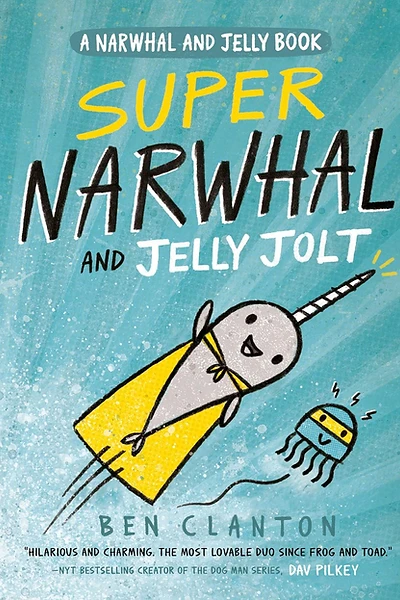
 1-3
1-3GN NARWHAL
Super Narwhal and Jelly Jolt
by Ben Clanton
Pacing MaterialIn this delightful adventure, Narwhal discovers his inner superhero and recruits his best friend Jelly to join him as his sidekick, Jelly Jolt. Together, the pair learns that being a hero isn't just about special powers, but about the kindness and support they offer to others.
Big Idea
True heroism is defined by how we use our strengths to support our friends and help others in our community.
Discussion Questions
- 1.What makes someone a superhero in real life?
- 2.How does Jelly help Narwhal when he is trying to be a hero?
- 3.Why is it important to have a friend to support your goals?
- 4.What kind of super power would you choose to help other people?
- 5.How does being kind make you a hero?
Classroom Activity
The Kindness Cape Craft
Students will design their own superhero capes that represent the kind acts they commit to performing for others.
Lesson Plan
Learning Goals
- Identify characteristics of helpful and kind behavior
- Practice collaborative planning with a partner
- Explain the concept of heroism through creative expression
Activity Steps
- 1.Discuss the qualities of a hero with the class
- 2.Brainstorm three kind deeds students can perform at home or school
- 3.Draw these deeds onto a paper cape template
- 4.Decorate the capes with colors and symbols representing their helpful nature
- 5.Present their capes to a partner and explain why their chosen actions are heroic
Standards Connections
- CCSS.ELA-LITERACY.RL.1.3: Describe characters and major events in a story
- CASEL SEL Competency: Social Awareness
- National Core Arts Standard: Creating
Pace-Write-Read Study with Pace-Write It!
Focus question: How does an author use pacing to make a graphic novel feel funny, exciting, and full of heart? In Super Narwhal and Jelly Jolt by Ben Clanton, Narwhal imagines himself as a superhero and invites Jelly to join his adventures as Jelly Jolt. The book uses graphic-novel pacing through short dialogue, expressive panels, page turns, and quick shifts between action and quiet friendship moments to show that true heroism comes from kindness and teamwork.
| Element | How to notice or teach it in the novel |
|---|---|
| Pace | Read: Notice how Ben Clanton moves quickly through superhero play scenes with Narwhal and Jelly, then slows down for kind moments that show friendship and caring. Classroom Activity: Write 4 short panel descriptions that begin with fast action and end with a calm moment where one friend helps another. |
| Plot | Read: Notice how the story builds from Narwhal’s superhero idea to shared adventures with Jelly Jolt and shows that helping others matters more than flashy powers. Classroom Activity: Write a beginning, middle, and end for a mini superhero story in which two friends solve a problem with kindness. |
| Prosody | Read: Listen to how the words sound lively and playful when Narwhal speaks with excitement and Jelly responds in a steady, friendly way. Classroom Activity: Write 3 speech bubbles for Narwhal and 3 for Jelly that sound different when read aloud. |
| Word pause | Read: Notice where a speech bubble, ellipsis, or small reaction creates a tiny pause before the next joke or action beat. Classroom Activity: Write a short comic exchange between Narwhal and Jelly using one ellipsis and one one-word pause for effect. |
| Concept | Read: Notice the big idea that being a hero is not only about powers, costumes, or dramatic rescues, but about kindness, encouragement, and friendship. Classroom Activity: Write 2-3 sentences explaining what kind of hero Narwhal and Jelly Jolt are, then invent your own hero idea based on helping. |
| Voice & World View | Read: Notice the cheerful, optimistic voice of the book and how the story sees the world as playful, friendly, and full of imaginative possibilities. Classroom Activity: Write a short paragraph in a joyful voice about an ordinary day turning into a hero day. |
| Setting & Place | Read: Notice how the ocean world feels bright, open, and welcoming, giving Narwhal and Jelly space to imagine superhero adventures. Classroom Activity: Describe an underwater place where Narwhal and Jelly Jolt could help someone, using 3 setting details. |
| Point of View | Read: Notice that readers follow the adventures from outside the characters, watching Narwhal’s big ideas and Jelly’s responses through panels and dialogue. Classroom Activity: Rewrite one imagined rescue scene from Jelly’s point of view using first person. |
| Original Characters | Read: Notice how Super Narwhal and Jelly Jolt feel original because one friend is bold and imaginative while the other is supportive and thoughtful. Classroom Activity: Create 2 new side characters for their hero team and write one sentence about each character’s special way of helping. |
| Dialogue | Read: Notice how the dialogue carries much of the story, showing humor, action, and the caring friendship between Narwhal and Jelly. Classroom Activity: Write a 6-line dialogue where Narwhal proposes a heroic mission and Jelly helps improve the plan. |
| Details | Read: Notice the small details in expressions, actions, and word choices that make the superhero game feel real and funny. Classroom Activity: Write 5 specific details you could add to a comic panel showing Narwhal and Jelly Jolt helping a sea creature. |
| Descriptions | Read: Notice that descriptions are brief because the art does a lot of the work, so each word needs to be clear and strong. Classroom Activity: Write 3 short caption boxes that describe action in a comic style without using long sentences. |
| Strong First Lines | Read: Notice how graphic novels hook readers quickly with playful energy, character voice, and a sense that adventure is about to begin. Classroom Activity: Write 2 possible opening lines for a new Super Narwhal and Jelly Jolt adventure. |
| Immediacy & Engagement | Read: Notice how short panels, direct speech, and quick reactions make readers feel close to the action right away. Classroom Activity: Write a comic opening that starts in the middle of a rescue with Narwhal already calling for Jelly Jolt. |
| Story Scenes & Summaries & Unique Structures | Read: Notice how the book balances full action scenes with shorter transitions, using the graphic-novel structure to move smoothly through the adventure. Classroom Activity: Plan a 6-panel comic with 4 action panels and 2 summary captions to show time moving forward. |
| Flashback & Flash Forward & Cliffhangers | Read: Notice whether a scene ends with a question, surprise, or problem that makes you want to turn the page, even without a big flashback. Classroom Activity: Write the last line of a page where Narwhal and Jelly Jolt discover a new problem and readers must turn the page. |
| Tension & Suspense & Surprise | Read: Notice that the tension stays light and child-friendly, with suspense coming from wondering how the friends will help and what funny twist might happen next. Classroom Activity: Write 3 sentences that build mild suspense before Narwhal and Jelly solve a problem in a surprising kind way. |
| Page Turns and Chapter Breaks | Read: Notice how a page turn in a graphic novel can reveal a joke, a dramatic superhero pose, or a new challenge for Narwhal and Jelly Jolt. Classroom Activity: Design a page-turn moment by writing what appears on the left page and the surprise on the right page. |
| Performance | Read: Notice how the book invites dramatic reading with bold hero voices, quiet thinking moments, and excited exclamations. Classroom Activity: Choose a short exchange and mark where you would read loudly, softly, quickly, or slowly. |
| Personality | Read: Notice how Narwhal’s playful confidence and Jelly’s loyal, steady support shape the timing of the story and make each scene feel warm. Classroom Activity: Write a character note for Narwhal and one for Jelly, then write a scene where their personalities help solve a problem. |
| Humor | Read: Notice how the humor grows from superhero pretending, expressive reactions, silly confidence, and the sweet friendship between the characters. Classroom Activity: Write a funny 4-line scene where Narwhal takes a hero idea too far and Jelly responds kindly. |
| Pause | Read: Notice how a silent panel, a reaction face, or a brief stop after excitement gives readers time to enjoy the joke or the heart of the moment. Classroom Activity: Plan one silent panel in a comic and explain what the characters’ faces would show. |
| Poetry and Poetic Devices | Read: Notice playful sound patterns, repeated phrases, and exciting superhero-style language that make the book feel musical at times. Classroom Activity: Write a 4-line hero chant for Super Narwhal and Jelly Jolt using alliteration. |
| Repetition | Read: Notice how repeated words, phrases, or hero ideas help the jokes land and make the friendship feel familiar and strong. Classroom Activity: Write a repeated catchphrase that Narwhal says and show Jelly reacting to it in 3 short lines. |
| Rhythm | Read: Notice the rhythm created by short speech bubbles, quick panel changes, and alternating action with calm support. Classroom Activity: Write a sequence of 5 very short lines that create a quick comic rhythm during a rescue. |
| Punctuation | Read: Notice how exclamation points, question marks, ellipses, and bold comic-style punctuation help show superhero energy and emotion. Classroom Activity: Write 4 speech bubbles using different punctuation marks to show excitement, confusion, thinking, and relief. |
| Questions | Read: Notice how characters’ questions keep the story moving and invite readers to wonder what makes a real hero. Classroom Activity: Write 5 questions Jelly might ask Narwhal during a new mission, including one big theme question about heroism. |
| Compare-Contrast | Read: Notice how Narwhal and Jelly are different in style but similar in kindness, which strengthens the friendship theme. Classroom Activity: Make a compare-contrast list for Narwhal and Jelly, then write 2 sentences about how their differences help them be a team. |
| Objects | Read: Notice how superhero ideas can grow from simple objects, costume details, or visual props in a graphic novel world. Classroom Activity: Invent 3 hero objects Narwhal and Jelly Jolt might use and write one sentence explaining each one. |
| Threes | Read: Notice how stories often feel satisfying when actions or jokes happen in sets of three, especially in humorous adventures. Classroom Activity: Write a 3-step rescue plan for Narwhal and Jelly Jolt with each step getting funnier or more surprising. |
| Whitespace & Negative Space | Read: Notice how open space around characters and speech bubbles helps readers pause, focus on expressions, and feel the beat between actions. Classroom Activity: Sketch or describe a panel with lots of open space and explain why that pause matters in the story. |
| Art & Graphics | Read: Notice how the illustrations, panel size, facial expressions, and comic layout help pace the superhero action and the tender friendship moments. Classroom Activity: Storyboard 3 panels for a new scene, labeling where the art should show action, humor, and kindness. |
| Interactives & Gamification | Read: Notice how the playful superhero setup invites readers to imagine joining Narwhal and Jelly Jolt on a mission of helping others. Classroom Activity: Create a 'Hero Helper Mission Card' with a problem, a kindness power, and a final action for students to write and trade. |
Pace-Write It!
20-Minute Classroom Flow\nRead (5 min): Read aloud a short section of Super Narwhal and Jelly Jolt by Ben Clanton that shows Narwhal acting like a superhero and Jelly joining in. Pause to show how the panels move quickly during action and then slow down during friendship moments.\nNotice (5 min): Ask: How do the speech bubbles, page turns, and pictures change the speed of the story? Chart student ideas under these headings: Fast action, Funny pause, Kind moment.\nWrite (7 min): Students write their own 4-panel mini comic about two friends being heroes through kindness. Writing frame: Panel 1: ___ had a big hero idea: "___!" Panel 2: ___ said, "___?" Panel 3: Together they helped ___ by ___. Panel 4: In the end, they learned that a hero is someone who ___. Encourage students to use at least one exclamation point, one question, and one pause.\nShare (3 min): Partners read their comics aloud with expression and point to one place where they used fast pacing and one place where they slowed down for meaning.\nExit ticket: Write one sentence answering: How does pacing help show both heroism and friendship in this story?