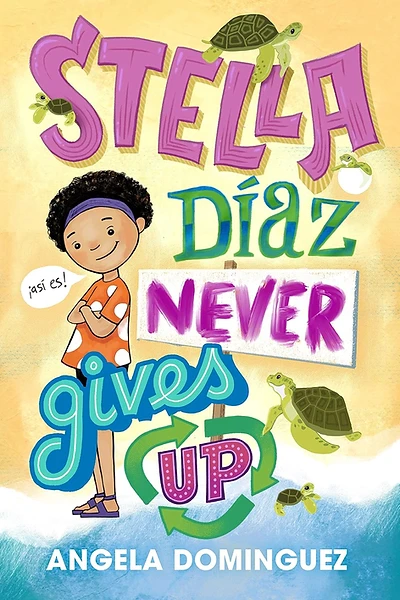
 1-4
1-4C STELLA-DIAZ
Stella Diaz Never Gives Up
by Angela Dominguez
Pacing MaterialStella Diaz learns about ocean conservation and discovers that even one small voice can make a big difference when she campaigns to save the sea and the animals she loves.
Big Idea
Stella Diaz Never Gives Up demonstrates that even a shy person can become a powerful leader and environmental advocate by taking small, consistent actions to protect the world around them.
Discussion Questions
- 1.How does Stella’s perspective on being a 'leader' change from the beginning of the book to the end?
- 2.Why is it important for Stella to learn about ocean pollution during her trip to Mexico, and how does this discovery change her summer?
- 3.Stella often feels shy or quiet. How does she use her voice to make a difference despite these feelings?
- 4.What are some of the 'small steps' Stella takes to help the ocean, and why are they just as important as 'big' actions?
- 5.How do Stella’s friends and family support her in her mission to save the sea?
Classroom Activity
The Ocean Hero Action Plan
Students will identify a local environmental issue and create a 'Small Steps' action plan, mirroring how Stella breaks down the massive problem of ocean pollution into manageable, impactful tasks.
Lesson Plan
Learning Goals
- Identify the connection between personal interests and environmental advocacy.
- Analyze how a character overcomes internal obstacles like shyness to achieve a goal.
- Develop a multi-step plan to address a community or environmental problem.
- Understand the impact of individual contributions to collective environmental health.
Activity Steps
- 1.Brainstorm a list of environmental issues in the local community or school.
- 2.Select one issue and discuss why it matters to the students.
- 3.Create a 'Small Steps' chart that breaks the large goal into three manageable actions.
- 4.Design a poster or digital graphic that encourages others to join the cause.
- 5.Present the action plans to the class to practice using their 'voice' for advocacy.
Standards Connections
- ELA: RL.1.6 (Identify who is telling the story)
- SCI: K-2.5.4.2.F (Interactions between land and ocean)
- SEL: Self-awareness and social responsibility
- TECH: 8.1.2.F (Critical thinking and problem solving)
Pace-Write-Read Study with Pace-Write It!
Stella Diaz Never Gives Up is a masterclass in pacing for young readers, utilizing a blend of narrative prose and visual storytelling to mirror the protagonist's internal growth. The book teaches the craft of writing by balancing quiet, reflective moments of character development with the urgent, active pacing of an environmental campaign. By studying this text, students learn how to use 'white space' and illustrations to control the speed of a story. Dominguez shows that a writer can slow down a scene to emphasize a character's emotional realization, then speed up the narrative when the character takes action. This book is an excellent model for teaching students how to structure a story that feels both personal and purposeful.
| Element | How to notice or teach it in the novel |
|---|---|
| Pace | Notice how the story slows down during Stella's introspective moments and speeds up during her active campaign efforts. |
| Plot | The plot follows a clear arc from summer boredom to purposeful activism, showing how one discovery can drive an entire narrative. |
| Prosody | Encourage students to read Stella's internal thoughts with a softer, more hesitant tone, contrasting with her more confident voice when speaking up. |
| Word Pause | Point out how the author uses short sentences to emphasize Stella's nervousness or sudden realizations. |
| Concept | The core concept is that small, individual actions can lead to significant environmental change. |
| Voice & World View | Stella’s voice is authentic to a shy child; teach students how to write from a specific, relatable perspective. |
| Setting & Place | The contrast between the beach in Mexico and Stella's home environment highlights the global nature of environmental issues. |
| Point of View | The first-person perspective allows readers to experience Stella's shyness and growth intimately. |
| Original Characters | Stella is a relatable, multi-dimensional character; discuss how her personality traits drive the story's events. |
| Dialogue | Analyze how Stella's dialogue changes as she becomes more confident in her advocacy. |
| Details | The specific details about ocean life and pollution make the environmental theme feel urgent and real. |
| Descriptions | Use the vivid descriptions of the ocean to teach students how to set a scene for the reader. |
| Strong First Lines | The opening sets the tone of summer disappointment, immediately hooking the reader into Stella's emotional state. |
| Immediacy & Engagement | The direct address to the reader makes the story feel like a personal diary or conversation. |
| Story Scenes & Summaries & Unique Structures | The book uses a mix of traditional prose and graphic elements to keep the reader engaged. |
| Flashback & Flash Forward & Cliffhangers | Discuss how the trip to Mexico serves as a catalyst for the rest of the summer's events. |
| Tension & Suspense & Surprise | The tension comes from Stella's internal struggle to speak up, not just the external environmental problem. |
| Page Turns and Chapter Breaks | Observe how chapter breaks are used to transition between Stella's home life and her environmental research. |
| Performance | The book is perfect for read-alouds; encourage students to perform Stella's internal monologue. |
| Personality | Stella's personality is defined by her shyness and her love for animals; show how these traits define her actions. |
| Humor | The lighthearted moments with friends balance the serious environmental themes. |
| Pause | Use the moments where Stella stops to think as opportunities for students to reflect on their own feelings. |
| Poetry and Poetic Devices | Look for rhythmic descriptions of the ocean that mimic the movement of waves. |
| Repetition | The repetition of the theme 'never giving up' reinforces the book's central message. |
| Rhythm | The rhythm of the book matches the rhythm of a summer vacation—starting slow and building momentum. |
| Punctuation | Point out how the author uses punctuation to show Stella's hesitation or excitement. |
| Questions | Stella asks herself many questions; use these to teach students how to use inquiry in their own writing. |
| Compare-Contrast | Compare Stella's initial feelings about summer with her feelings at the end of the book. |
| Objects | Objects like the ocean trash serve as symbols for the larger environmental problem. |
| Threes | Look for lists of three that the author uses to describe Stella's feelings or the ocean's beauty. |
| Whitespace & Negative Space | The illustrations provide visual 'breathing room' that helps pace the reading experience. |
| Art & Graphics | The illustrations are integral to the story; discuss how they convey information that the text does not. |
| Interactives & Gamification | The book's structure invites readers to join Stella's mission, acting as a call to action. |
Pace-Write It!
Spend 20 minutes having students write a 'Letter to the Ocean' from Stella's perspective. They must include one specific detail about the ocean they learned from the book and one 'small step' they promise to take to protect it, focusing on using a voice that starts shy but ends with conviction.