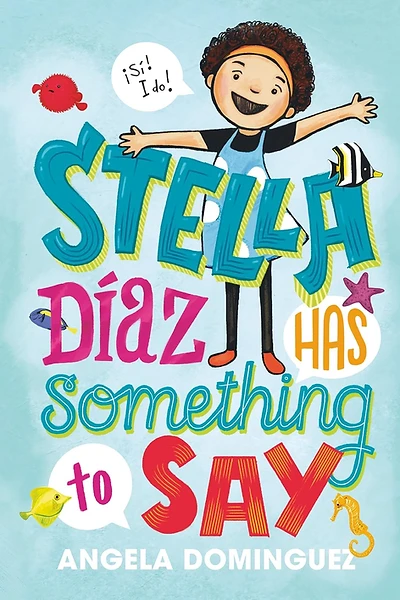
 1-4
1-4C STELLA-DIAZ
Stella Diaz Has Something to Say
by Angela Dominguez
Pacing MaterialShy Stella Diaz finds her voice—literally and figuratively—as she navigates a new school year, a big presentation, and learning to speak up for herself even when it's scary.
Big Idea
Stella Díaz Has Something to Say teaches that our unique voices, including the languages we speak, are strengths rather than obstacles, and that courage is found in sharing our true selves with others.
Discussion Questions
- 1.Why does Stella feel like she turns 'roja' when she speaks in class, and have you ever felt that way?
- 2.How does Stella’s bilingualism shape her identity, and why might it be a challenge for her at school?
- 3.Stella is nervous about presenting her fish project. What strategies could she use to feel more confident?
- 4.How does the friendship between Stella and Stanley grow throughout the story despite Stella's initial shyness?
- 5.What does it mean to 'have something to say,' and why is it important for Stella to find her voice?
Classroom Activity
My Bilingual Identity Map
Students create a visual map representing their own unique voices, including words they love in different languages, their passions (like Stella’s love for fish), and things that make them feel brave.
Lesson Plan
Learning Goals
- Identify and celebrate personal strengths and cultural identity.
- Practice empathy by connecting with Stella’s experiences of shyness and language barriers.
- Develop oral communication skills by sharing personal 'maps' with peers.
- Understand the value of linguistic diversity in a classroom setting.
Activity Steps
- 1.Provide students with paper and art supplies to create a 'My Voice' map.
- 2.Ask students to draw or write three things they are passionate about, similar to Stella’s love for marine life.
- 3.Encourage students to include words or phrases from their family heritage or languages they find interesting.
- 4.Have students write one 'brave goal'—something they want to share with the class but feel nervous about.
- 5.Allow students to share their maps in small groups to practice speaking in a supportive environment.
Standards Connections
- ELA: RL.3.3 (Describe characters in a story and explain how their actions contribute to the sequence of events)
- SEL: Self-awareness (Recognizing personal qualities and strengths)
- CCSS.ELA-LITERACY.SL.3.1 (Engage effectively in a range of collaborative discussions)
Pace-Write-Read Study with Pace-Write It!
Stella Díaz Has Something to Say is a masterclass in using a character’s internal monologue to drive the pacing of a narrative. By weaving Spanish phrases into the English text, Dominguez creates a rhythmic, authentic voice that mirrors the protagonist's own linguistic journey. The book teaches students that writing is not just about plot, but about capturing the 'in-between' moments of hesitation and growth. Students can study how Dominguez uses short, punchy sentences to reflect Stella’s anxiety and longer, descriptive passages to show her passion for marine biology. This book demonstrates how to use white space and illustrations to control the reader's speed, allowing the audience to pause and reflect on Stella’s emotional state alongside her.
| Element | How to notice or teach it in the novel |
|---|---|
| Pace | Notice how the pace slows down during Stella’s speech therapy sessions to emphasize her internal struggle. |
| Plot | The plot is driven by Stella’s goal to present her fish project, creating a clear timeline for the reader. |
| Prosody | The integration of Spanish words adds a unique cadence that requires the reader to slow down and appreciate the bilingual flow. |
| Word Pause | Dominguez uses line breaks to mimic the hesitation Stella feels when she is nervous about speaking. |
| Concept | The core concept is the struggle of finding one's voice in a new environment. |
| Voice & World View | The story is told through the lens of a shy, observant, and passionate third-grader. |
| Setting & Place | The school setting acts as a pressure cooker for Stella’s anxiety, contrasting with her safe home life. |
| Point of View | First-person narration allows the reader to feel Stella’s embarrassment and joy directly. |
| Original Characters | Stanley is introduced as a foil to Stella, helping her realize that others have their own insecurities. |
| Dialogue | Dialogue is used sparingly to highlight the moments where Stella finally finds the courage to speak. |
| Details | Specific details about fish species show Stella’s expertise and passion. |
| Descriptions | Descriptions of Stella turning 'roja' provide a visceral sense of her physical reaction to stress. |
| Strong First Lines | The opening establishes Stella’s internal conflict immediately, hooking the reader into her world. |
| Immediacy & Engagement | The present-tense narration makes the reader feel like they are experiencing the school day with Stella. |
| Story Scenes & Summaries & Unique Structures | The book uses a mix of prose and illustrations to break up the narrative flow. |
| Flashback & Flash Forward & Cliffhangers | The looming presentation date acts as a constant cliffhanger for the reader. |
| Tension & Suspense & Surprise | Tension builds as the day of the class presentation approaches. |
| Page Turns and Chapter Breaks | Chapter breaks are used to transition between Stella’s home life and school challenges. |
| Performance | The book encourages readers to think about how we perform our identities in public versus private. |
| Personality | Stella’s personality is defined by her shyness and her deep love for marine animals. |
| Humor | Lighthearted moments with her family provide a balance to the school-based stress. |
| Pause | The illustrations provide visual pauses that allow the reader to process Stella’s emotions. |
| Poetry and Poetic Devices | The repetition of Spanish phrases acts as a poetic refrain throughout the book. |
| Repetition | The recurring theme of 'turning roja' reinforces Stella’s primary emotional struggle. |
| Rhythm | The rhythm of the text shifts between English and Spanish, reflecting Stella’s bilingual brain. |
| Punctuation | The use of exclamation points in Spanish phrases adds energy and emphasis. |
| Questions | Stella often asks herself internal questions, showing her self-reflective nature. |
| Compare-Contrast | Stella compares her life in Mexico to her life in Chicago, highlighting her dual identity. |
| Objects | Fish-related objects are used as symbols of Stella’s comfort and expertise. |
| Threes | The story follows a three-part structure: the struggle, the preparation, and the final presentation. |
| Whitespace & Negative Space | The generous use of white space on the page mirrors Stella’s quiet, reserved nature. |
| Art & Graphics | The black-and-white illustrations are essential to understanding Stella’s internal world. |
| Interactives & Gamification | The book invites readers to learn simple Spanish words alongside Stella. |
Pace-Write It!
Students will spend 20 minutes writing a 'brave moment' scene. They must include one sentence in a language other than English and use a 'pause' (a line break or a descriptive illustration note) to show the character’s hesitation before they speak.