 1-4
1-4C STELLA-DIAZ
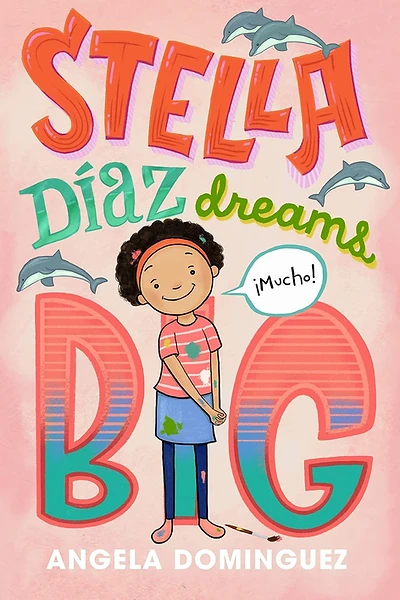
Stella Diaz Dreams Big
by Angela Dominguez
Pacing MaterialStella sets her sights on a big dream and learns that with friendship, creativity, and determination, she can reach for the stars and make her biggest wishes come true.
Big Idea
Stella Díaz Dreams Big teaches that while pursuing big goals is rewarding, true success requires balancing our passions with self-care and knowing when to ask for help.
Discussion Questions
- 1.Why does Stella feel the need to join so many clubs and activities at once?
- 2.How does Stella's personality change when she becomes 'way too busy' compared to when she is relaxed?
- 3.What role do Stella's friends and family play in helping her manage her stress?
- 4.How does Stella use her creativity to solve the problems she faces in her daily life?
- 5.What does it mean to 'dream big' in a way that is healthy and sustainable?
Classroom Activity
The Stella-Style Balance Map
Students create a visual 'Balance Map' that categorizes their own interests, responsibilities, and self-care activities to practice the time-management skills Stella learns in the book.
Lesson Plan
Learning Goals
- Identify the relationship between setting goals and managing personal time.
- Analyze how characters navigate stress and overcommitment.
- Apply strategies for balancing academic, social, and personal interests.
- Reflect on personal priorities through creative visual representation.
Activity Steps
- 1.Discuss Stella's busy schedule as president of the Sea Musketeers and her new clubs.
- 2.Have students list their own current activities, chores, and hobbies on a piece of paper.
- 3.Guide students to categorize these items into 'Must-Dos,' 'Passions,' and 'Rest/Self-Care.'
- 4.Ask students to draw a 'Balance Map' where they place these items in a circle, ensuring that 'Rest/Self-Care' is given equal space to 'Must-Dos.'
- 5.Have students share one strategy they will use to keep their own 'tides' from getting too rough.
Standards Connections
- ELA: RL.3.3 (Describe characters in a story and explain how their actions contribute to the sequence of events)
- SEL: Self-Management (Managing stress and setting goals)
- Art: Visual Literacy (Using symbols and layout to convey personal meaning)
Pace-Write-Read Study with Pace-Write It!
Stella Díaz Dreams Big is a masterclass in pacing for young readers, demonstrating how a character's internal state can dictate the speed of a narrative. Angela Dominguez uses the accumulation of activities to mirror Stella's rising anxiety, effectively speeding up the prose as her schedule becomes more chaotic. By observing how the author shifts from short, punchy sentences during busy moments to more reflective, descriptive passages during quiet times, students can learn how to manipulate the 'tempo' of their own writing. Beyond tempo, the book teaches the craft of structural pacing through the use of illustrations and chapter breaks. Dominguez uses these visual elements to provide 'breathing room' for the reader, mirroring the very lesson Stella learns about needing rest. This study allows students to see how white space and graphic elements are not just decorative, but essential tools for controlling how a reader experiences the emotional arc of a story.
| Element | How to notice or teach it in the novel |
|---|---|
| Pace | Notice how the sentences become shorter and more frequent when Stella is overwhelmed by her busy schedule. |
| Plot | The plot is driven by Stella's desire to do everything, creating a natural conflict between her ambition and her capacity. |
| Prosody | Encourage students to read aloud with a frantic tone during the 'busy' chapters and a calm, steady tone during the 'art club' scenes. |
| Word Pause | Look for moments where Stella stops to think; these pauses are often marked by internal monologue or a shift in the illustration. |
| Concept | The central concept is the 'tide'—a metaphor for the ebb and flow of life's demands. |
| Voice & World View | Stella's voice is authentic to a fourth-grader, blending her cultural identity with her specific interests in marine biology. |
| Setting & Place | The school and the home are distinct settings that require different versions of Stella's personality. |
| Point of View | The first-person perspective allows the reader to feel the direct pressure of Stella's overbooked calendar. |
| Original Characters | Stella's friends provide a mirror for her own growth, showing different ways to handle school pressures. |
| Dialogue | Dialogue is used to show Stella's hesitation and her eventual growth in confidence when speaking up. |
| Details | Pay attention to the specific details of her schedule and the marine life facts she shares. |
| Descriptions | Descriptions of her art projects reflect her internal emotional state. |
| Strong First Lines | Analyze how the opening chapter immediately establishes Stella's current status and her goals. |
| Immediacy & Engagement | The use of present-tense narration keeps the reader locked into Stella's immediate struggles. |
| Story Scenes & Summaries & Unique Structures | The book uses a mix of traditional prose and graphic-novel style illustrations to break up the text. |
| Flashback & Flash Forward & Cliffhangers | Chapter endings often leave Stella at a crossroads, encouraging the reader to turn the page. |
| Tension & Suspense & Surprise | Tension builds as Stella realizes she cannot keep up with all her commitments. |
| Page Turns and Chapter Breaks | Use the chapter breaks as natural points to discuss what Stella might do next. |
| Performance | The book invites performance through its expressive dialogue and emotional shifts. |
| Personality | Stella's personality is defined by her empathy and her love for marine life. |
| Humor | Humor is found in the relatable, slightly chaotic situations Stella finds herself in. |
| Pause | Identify the 'white space' on the page as a deliberate pause for the reader. |
| Poetry and Poetic Devices | The metaphor of the 'tide' is a recurring poetic device that anchors the story. |
| Repetition | Stella's repeated attempts to organize her schedule highlight her struggle with time management. |
| Rhythm | The rhythm of the book mimics a heartbeat—fast during stress, slow during rest. |
| Punctuation | Look for exclamation points that show Stella's excitement and ellipses that show her hesitation. |
| Questions | Stella often asks herself questions, which helps the reader understand her internal conflict. |
| Compare-Contrast | Compare Stella's behavior at the beginning of the book to her behavior at the end. |
| Objects | Her schedule and her art supplies are objects that represent her competing priorities. |
| Threes | Stella often juggles three main things: school, clubs, and family/friends. |
| Whitespace & Negative Space | The illustrations provide negative space that allows the reader to process the emotional weight of the text. |
| Art & Graphics | The black-and-white illustrations are essential to the storytelling, showing Stella's expressions. |
| Interactives & Gamification | The book's structure invites readers to 'check off' their own progress alongside Stella. |
Pace-Write It!
Students will write a 5-sentence 'Busy Day' paragraph using short, choppy sentences to create a fast pace, followed by a 3-sentence 'Calm Moment' paragraph using longer, flowing sentences to show how they can control the reader's experience.