 K-5
K-5C DISASTER DIARIES
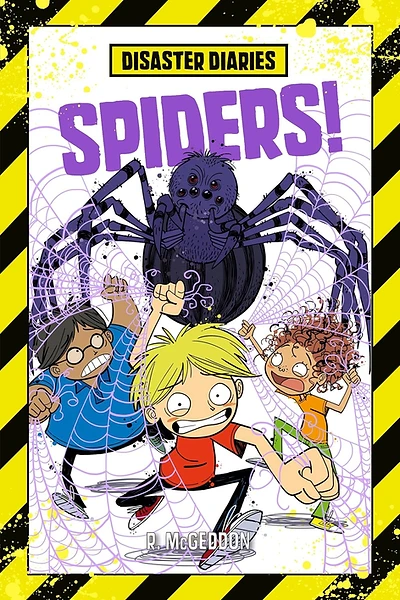
Disaster Diaries: Spiders!
by R. McGeddon
Pacing MaterialNew student Felicia Forester quickly becomes the star of science class! But she secretly runs dangerous science experiments that soon have the entire town completely overrun with giant, human-eating spiders!
Big Idea
Actions have consequences, and even the most brilliant scientific curiosity must be balanced with responsibility and safety. This story explores the thin line between innovation and chaos.
Discussion Questions
- 1.Why do you think Felicia Forester kept her science experiments a secret from her teacher and classmates?
- 2.How does the author use the setting of a science classroom to build suspense as the spiders begin to take over?
- 3.If you were in Felicia's class, what would you have said to her when you first noticed the spiders growing?
- 4.What does this story teach us about the importance of following safety rules during science experiments?
- 5.How does the tone of the book change from the beginning of the story to the moment the town is overrun?
Classroom Activity
The Scientific Responsibility Lab
Students will design a 'Safety Protocol' poster for Felicia's science lab to prevent future spider-related disasters, focusing on identifying risks and proposing responsible solutions.
Lesson Plan
Learning Goals
- Identify the cause-and-effect relationship between Felicia's experiments and the town's spider problem.
- Practice persuasive writing by creating safety rules.
- Analyze character motivations and the consequences of secret-keeping.
- Develop creative problem-solving skills in a scientific context.
Activity Steps
- 1.Review the plot of 'Spiders!' and identify the specific moment Felicia's experiment went wrong.
- 2.Brainstorm a list of 'What went wrong?' factors in Felicia's lab.
- 3.In small groups, draft three essential safety rules that Felicia should have followed.
- 4.Create a visual 'Safety Protocol' poster that includes these rules and a warning sign.
- 5.Present the posters to the class, explaining why these rules would have prevented the spider takeover.
Standards Connections
- ELA: RL.K.3 (Describe characters, settings, and major events)
- ELA: W.K.1 (Use a combination of drawing and writing to compose opinion pieces)
- SEL: Responsible Decision-Making
- Science: Engineering Design Process
Pace-Write-Read Study with Pace-Write It!
In 'Spiders!' by R. McGeddon, the author masterfully uses pacing to mirror the escalating chaos of a science experiment gone wrong. By starting with the quiet, focused environment of a classroom and rapidly shifting to a town-wide infestation, the book demonstrates how authors control the reader's heart rate through narrative speed. This book serves as an excellent mentor text for teaching students how to build tension. Through the strategic use of page turns and descriptive shifts, McGeddon shows that writing is not just about the words on the page, but about the rhythm of the story's delivery. Students will learn how to manipulate time to keep their readers on the edge of their seats.
| Element | How to notice or teach it in the novel |
|---|---|
| Pace | Notice how the sentences get shorter and more urgent as the spiders multiply. |
| Plot | The plot follows a classic 'escalation' structure where one small secret leads to a massive problem. |
| Prosody | Encourage students to read the 'spider attack' scenes with increasing speed and volume. |
| Word Pause | Use pauses before turning the page to build suspense about what the spiders will do next. |
| Concept | The core concept is 'unintended consequences' of scientific curiosity. |
| Voice & World View | The voice is humorous yet cautionary, reflecting a world where science is exciting but dangerous. |
| Setting & Place | The setting shifts from the controlled science lab to the chaotic, overrun town. |
| Point of View | Discuss how the story would change if told from the perspective of a spider. |
| Original Characters | Felicia is a 'mad scientist' archetype; analyze how her personality drives the plot. |
| Dialogue | Look for how the dialogue becomes more frantic as the town realizes the danger. |
| Details | Focus on the specific, gross details of the spiders to make the threat feel real. |
| Descriptions | The author uses vivid adjectives to describe the spiders' size and behavior. |
| Strong First Lines | The opening introduces Felicia as a star student, setting up the irony of her secret. |
| Immediacy & Engagement | The immediate threat of the spiders keeps the reader engaged from the first page. |
| Story Scenes & Summaries & Unique Structures | The book uses a mix of classroom scenes and town-wide summaries to show the scale of the problem. |
| Flashback & Flash Forward & Cliffhangers | Each page turn acts as a mini-cliffhanger, forcing the reader to see the next disaster. |
| Tension & Suspense & Surprise | Tension is built by showing the spiders growing just a little bit more on every page. |
| Page Turns and Chapter Breaks | Use the page turns to reveal the spiders in new, unexpected locations. |
| Performance | Encourage students to act out the 'spider takeover' with dramatic flair. |
| Personality | Felicia's ambition is her defining personality trait. |
| Humor | The humor comes from the absurdity of giant spiders in a normal town. |
| Pause | Use a long pause after the reveal of the giant spiders to let the shock sink in. |
| Poetry and Poetic Devices | Look for alliteration in the descriptions of the spiders' movements. |
| Repetition | The repetition of the spiders appearing reinforces the theme of being 'overrun.' |
| Rhythm | The rhythm of the text mimics the scurrying of many spider legs. |
| Punctuation | Exclamation points are used to heighten the panic of the townspeople. |
| Questions | The book asks the reader to wonder: 'What will Felicia do next?' |
| Compare-Contrast | Compare Felicia's classroom behavior with her secret lab behavior. |
| Objects | The science equipment acts as the catalyst for the entire plot. |
| Threes | Look for the 'rule of three' in the way the spiders invade different parts of the town. |
| Whitespace & Negative Space | The author uses empty space on the page to make the spiders look even larger. |
| Art & Graphics | The illustrations provide the visual evidence of the spiders' growth. |
| Interactives & Gamification | Create a 'spot the spider' game using the illustrations in the book. |
Pace-Write It!
Students have 20 minutes to write a 'Breaking News' report about the spider invasion. They must use short, punchy sentences to mimic the fast-paced, chaotic energy of the book's climax.