 2-5
2-5GN CODY
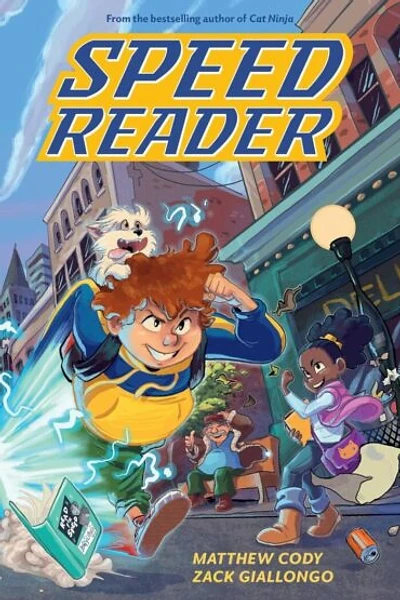
Speed Reader
by Matthew Cody
Pacing MaterialA boy discovers he can read at super speed — but his new power comes with big responsibilities when the city needs a hero who can think fast.
Big Idea
Reading is a superpower — and the more you read, the more you can do and become.
Discussion Questions
- 1.What would you do if you could read as fast as Speed Reader?
- 2.How does reading help the main character solve problems?
- 3.What responsibilities come with having a special ability?
- 4.What's your favorite book to read over and over?
Classroom Activity
Speed Reading Challenge
Time yourself reading a short passage, then reread it to see if you can improve. Track your words-per-minute and celebrate your progress.
Lesson Plan
Learning Goals
- Explain how the boy’s super-speed reading helps him respond to the city’s needs, using details from the story’s words and illustrations.
- Practice rereading a short passage to improve accuracy, expression, and understanding—not just speed.
- Calculate or record words read correctly per minute and compare personal reading attempts.
- Connect the book’s message about responsibility to using reading skills to learn, solve problems, and help others.
Activity Steps
- 1.Introduce the Speed Reading Challenge after reading an excerpt from Speed Reader. Discuss: How does the boy’s reading power help him act as a hero? Why must he understand what he reads rather than simply read quickly?
- 2.Model fluent reading with a short, teacher-selected prose passage about helping others or solving a problem. Explain that graphic novel panels require attention to illustrations and reading order, so today’s timed practice will use a passage with a clear word sequence.
- 3.Give each student an accessible passage of approximately 100–200 words. In pairs, have one student read aloud for one minute while a partner follows along and gently records skipped or misread words. Calculate words correct per minute: words attempted minus errors. Keep results private; provide teacher support or an untimed option as needed.
- 4.Have students answer two brief comprehension questions and explain one important idea from the passage. Partners then practice tricky words and reread together, focusing on accuracy, phrasing, and expression.
- 5.Repeat the one-minute reading with the same passage, switch partner roles, and record both attempts on a personal progress chart. Compare comprehension and fluency as well as words correct per minute; do not rank classmates.
- 6.Celebrate each student’s progress or effort with a paper 'Reading Superpower' badge. Have students complete: 'Like the hero in Speed Reader, I can use reading to ___.' Share examples of how reading can help someone make a responsible choice.
Standards Connections
- ELA: CCSS.RL.2.3 / RL.3.3 — Describe characters and explain how their responses or actions shape story events.
- ELA: CCSS.RL.2.7 / RL.3.7 / RL.4.7 / RL.5.7 — Use or analyze illustrations and visual elements to deepen understanding of a text.
- ELA: CCSS.RF.2.4 / RF.3.4 / RF.4.4 / RF.5.4 — Read with sufficient accuracy and fluency to support comprehension, including successive readings.
- Math: CCSS.2.MD.D.10 / 3.MD.B.4 — Represent measurement data using a grade-appropriate graph or line plot.
- SEL: Self-awareness and responsible decision-making — Recognize personal growth and consider how skills can be used to help others.
Pace-Write-Read Study with Pace-Write It!
Focus question: How does an author speed up and slow down a story to show courage, responsibility, and exciting action? In Speed Reader by Matthew Cody, a boy discovers he can read and think at super speed, and the fast-moving graphic novel format helps readers feel the rush of his new power. Cody uses quick panels, page turns, dialogue, and action beats to control pacing so we can feel both the excitement of being a hero and the pressure of making brave choices.
| Element | How to notice or teach it in the novel |
|---|---|
| Pace | Read: Notice how Speed Reader moves quickly when the boy uses his reading power and slows down when he must decide how to help others responsibly. Watch how Matthew Cody matches fast action with the theme of courage under pressure. Classroom Activity: Write a 6-sentence scene about a student who discovers a learning superpower; make the first 3 sentences fast and the last 3 slower to show an important choice. |
| Plot | Read: Track how the plot begins with an exciting discovery, grows into bigger problems, and then pushes the main character to use resilience when the city needs help. Notice how each event raises the stakes of his responsibility. Classroom Activity: Make a plot ladder with 5 steps: discovery, test of power, problem, brave decision, and result; then write one sentence for each step. |
| Prosody | Read: Listen to how dialogue and action in Speed Reader would sound aloud—quick, breathless, and energetic during hero moments, but steadier during thinking moments. The changing sound helps build pacing and emotion. Classroom Activity: Choose one exciting moment and one thoughtful moment and mark them for oral reading with arrows for faster and slower parts; then practice reading both aloud. |
| Word pause | Read: Notice where a single word, reaction, or short speech bubble creates a pause before the next burst of action. In a graphic novel, even one word can make readers stop and feel the weight of a decision. Classroom Activity: Write 4 comic-style panels about a hero solving a problem and include one panel with only 1-3 words to create a dramatic pause. |
| Concept | Read: The central concept in Speed Reader is that reading can become a superpower, but power brings responsibility. Notice how the pacing supports this idea by making fast reading feel exciting and serious at the same time. Classroom Activity: Write a paragraph explaining a school skill that could become a superpower and how that power could help others. |
| Voice & World View | Read: Notice how the story’s voice feels energetic, kid-friendly, and adventurous while still showing that bravery means helping people, not just showing off. The world view suggests that intelligence and courage matter together. Classroom Activity: Write 5 sentences in a lively, confident voice from the point of view of a kid who wants to do the right thing with a new talent. |
| Setting & Place | Read: Pay attention to how the city setting makes the stakes feel bigger because the boy’s super-speed reading matters beyond school or home. The places in the story help shift the pace from ordinary life to high-action hero scenes. Classroom Activity: Draw or describe two settings for your own superhero reader story—an ordinary place and an emergency place—and write 2 sentences about how each setting changes the pace. |
| Point of View | Read: Notice how the story keeps us close to the boy’s experience so we feel his excitement, worry, and growing courage. This point of view helps readers understand how fast thinking can also mean fast pressure. Classroom Activity: Rewrite one hero moment from the point of view of a friend, teacher, or city helper who sees the main character in action. |
| Original Characters | Read: Look at how the main character stands out because his power comes from reading, not from flying or lifting cars. Notice how this original idea supports the theme that learning and bravery can work together. Classroom Activity: Invent an original hero whose power comes from another literacy skill, such as spelling, listening, or storytelling, and write a character card with powers, weakness, and responsibility. |
| Dialogue | Read: Notice how dialogue in Speed Reader helps the pace feel quick because characters react in short bursts during tense scenes. Their words also reveal fear, excitement, and determination. Classroom Activity: Write 8 lines of dialogue between a young hero and a worried friend just before a rescue, using short lines to keep the scene moving. |
| Details | Read: Watch for small details in expressions, actions, and quick observations that show how the boy processes information rapidly. In a graphic novel, details often appear in both words and pictures, speeding up understanding. Classroom Activity: Write a 5-sentence action scene and include 3 small details that show your character notices things faster than everyone else. |
| Descriptions | Read: Notice that descriptions are often brief but vivid, letting the action keep moving while still helping us picture the city, the danger, and the hero’s speed. Matthew Cody does not stop the story for long descriptions; he uses just enough. Classroom Activity: Describe a super-fast moment in only 4 sentences, using strong verbs and one sensory detail in each sentence. |
| Strong First Lines | Read: Think about how the opening needs to grab readers quickly in an adventure graphic novel like Speed Reader. A strong beginning matches the fast pace and promises a surprising power and a big challenge. Classroom Activity: Write 3 possible first lines for a graphic novel about a child who discovers a secret power at school, and choose the one that creates the most excitement. |
| Immediacy & Engagement | Read: Notice how the story makes readers feel close to the action right away through quick problem-solving, urgent moments, and visual storytelling. That immediacy keeps us engaged and cheering for the boy to be brave. Classroom Activity: Write a scene that begins in the middle of a problem with no long introduction, so the reader feels pulled in at once. |
| Story Scenes & Summaries & Unique Structures | Read: Notice how some parts of Speed Reader feel like full scenes with moment-by-moment action, while other parts move more quickly to cover time and get to the next challenge. The graphic novel structure helps balance both. Classroom Activity: Write one detailed scene of 6 sentences and one 2-sentence summary about the same character’s day, then explain which part feels faster. |
| Flashback & Flash Forward & Cliffhangers | Read: Notice whether the story uses memory, hints about what could happen next, or scene endings that make you want to turn the page. In a superhero adventure, cliffhangers are especially important for pacing and suspense. Classroom Activity: End a 5-panel comic script with a cliffhanger about a hero hearing shocking news and needing to act fast. |
| Tension & Suspense & Surprise | Read: Watch how tension grows when the boy realizes his gift can help in serious situations, not just fun ones. Surprise comes from the unusual power of reading fast and from the pressure of rising danger in the city. Classroom Activity: Write a paragraph in which a character’s helpful talent suddenly becomes important during an emergency; include one surprise sentence. |
| Page Turns and Chapter Breaks | Read: In Speed Reader, page turns matter because readers often discover new action, danger, or information when they turn the page. Notice how breaks can leave us waiting for what the boy will do next. Classroom Activity: Plan a 4-page mini graphic story and write what big reveal or problem should happen at the end of page 1 and page 3. |
| Performance | Read: Notice how the hero may perform confidence outwardly even when he feels unsure inside. In graphic novels, body language, pose, and speech help show that performance quickly. Classroom Activity: Write a monologue for a hero who says brave words to others while secretly feeling nervous, and include one stage direction in brackets. |
| Personality | Read: Pay attention to how the main character’s personality shapes the pacing—his curiosity, excitement, and growing responsibility help push the story forward. His resilience matters because courage is shown through choices, not only powers. Classroom Activity: Make a T-chart of your character’s outside personality and inside worries, then write 4 sentences showing both. |
| Humor | Read: Notice how humor can lighten the mood in a fast adventure and make the main character feel more real and relatable. Funny reactions or visual moments can create a quick pause before tension rises again. Classroom Activity: Add one humorous line and one funny visual idea to a rescue scene so the story stays exciting but kid-friendly. |
| Pause | Read: Watch for moments when the action pauses so the boy can think, worry, or choose the brave path. These pauses are important because they show that courage often happens in a quiet decision before the big action. Classroom Activity: Write a 5-sentence scene that stops right before a rescue, focusing on what the hero thinks during the pause. |
| Poetry and Poetic Devices | Read: Even though Speed Reader is an adventure graphic novel, notice places where sound words, repeated phrases, or strong imagery make the language feel poetic. These choices can speed up or sharpen important moments. Classroom Activity: Write 4 lines about super-speed reading using alliteration or onomatopoeia, such as zip, whir, or flash. |
| Repetition | Read: Look for repeated words, ideas, or actions that emphasize the hero’s speed, responsibility, or need to keep trying. Repetition can make a fast story feel more powerful and memorable. Classroom Activity: Write a short paragraph about a brave moment using the same starter phrase in 3 sentences to build energy. |
| Rhythm | Read: Notice the rhythm created by short dialogue, action panels, and quick reactions in Speed Reader. The rhythm may feel like bursts of speed followed by shorter rests when the hero must think. Classroom Activity: Write 6 sentences with this rhythm pattern: short, short, long, short, long, short to imitate a fast-moving adventure scene. |
| Punctuation | Read: Pay attention to exclamation marks, ellipses, question marks, and dashes that shape how fast or dramatic a line feels. In a graphic novel, punctuation works with art to control pacing and emotion. Classroom Activity: Write 5 speech bubbles for a hero scene and use at least 3 different punctuation marks to show urgency, pause, and surprise. |
| Questions | Read: Notice the questions raised by the story: How should the boy use his power? Can he handle the pressure? What does a real hero do? These questions keep readers turning pages. Classroom Activity: Write 4 wonder questions a reader might ask during the middle of a superhero story, then answer one in a complete sentence. |
| Compare-Contrast | Read: Compare the boy’s ordinary life with his superhero life, and contrast reading for school with reading to save the city. These differences help readers see how quickly his world changes and how resilience grows. Classroom Activity: Make a compare-contrast chart with two columns: Before the power and After the power; then write a summary sentence about the biggest change. |
| Objects | Read: Notice how objects connected to reading or city life can become important in the story, helping the hero solve problems or understand danger quickly. Objects in graphic novels often carry meaning without long explanation. Classroom Activity: Choose one object, such as a book, note, sign, map, or backpack, and write how it helps a character be brave in a crisis. |
| Threes | Read: Look for patterns of three in actions, attempts, or details, because three often creates a satisfying rhythm in adventure stories. A hero may try, fail, and try again before succeeding, which connects to resilience. Classroom Activity: Write 3 linked sentences showing a character’s first attempt, second attempt, and third brave success. |
| Whitespace & Negative Space | Read: In a graphic novel like Speed Reader, empty space around panels or words can slow readers down, highlight a reaction, or make a dramatic beat stand out. Notice how less on the page can sometimes create more suspense. Classroom Activity: Design a 3-panel page plan and decide where one panel should have extra empty space to emphasize a big feeling or important pause. |
| Art & Graphics | Read: Notice how the art, panel size, motion lines, facial expressions, and page layout help readers feel the speed of the boy’s power and the danger facing the city. The visuals are a major part of pacing in this adventure. Classroom Activity: Sketch or describe 4 panels that show a character moving from discovery to action, using one note about how the art should show speed. |
| Interactives & Gamification | Read: Think about how Speed Reader could inspire interactive reading choices, such as predicting what the boy should do with his power or timing how quickly readers can spot clues in panels. These playful structures connect to the theme that thinking fast also means thinking wisely. Classroom Activity: Create a choose-your-path chart with 2 decisions a hero reader could make and write the different outcomes for each choice. |
Pace-Write It!
20-Minute Classroom Flow\nRead (5 min): Read aloud a short, high-action section of Speed Reader by Matthew Cody. Ask students to listen for places where the story speeds up and slows down, and to notice how the boy’s reading power connects to courage and responsibility.\nNotice (5 min): Students turn and talk: Where did the pacing feel fastest? Where did it pause? Chart student observations under these headings: quick action, thinking pause, dialogue burst, page-turn suspense, brave choice.\nWrite (7 min): Students write their own short graphic-novel style scene about a child who discovers a school-related superpower and must use it to help someone. Writing frame: “At first, I discovered I could ____. Everything happened fast when ____. Then I had to stop and think because ____. I decided to be brave and ____. In the end, I learned ____.” Encourage students to include at least one short dialogue line, one pause, and one sentence that speeds the action up.\nShare (3 min): Invite partners to read their scenes aloud with expression, reading the fast parts quickly and the pause parts slowly. Ask listeners to name one place where the pacing matched the character’s courage.\nExit ticket: Write one sentence answering this question: How did you change the pace of your writing to show resilience or courage?
Pace-Write-Read Connection
Teach this book using the Pace-Write-Read method — Tool 1: Pacing.
Open the Mastery Manual