 2-6
2-6GN MENDEZ
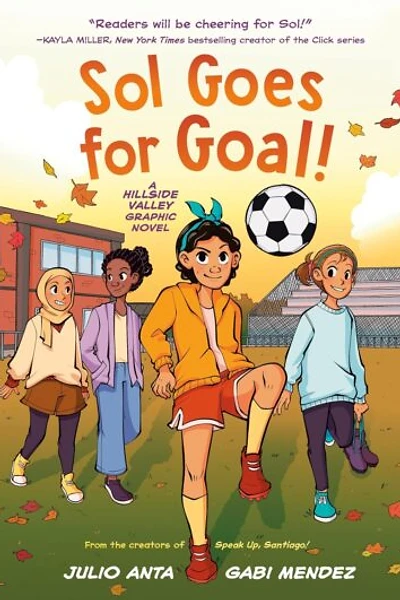
Sol Goes for Goal!
by Julio Anta and Gabi Mendez
Pacing MaterialSol loves soccer more than anything — but balancing school, family, and her sport tests her courage and determination on and off the field.
Big Idea
Great goals take practice, heart, and the support of the people who believe in you.
Discussion Questions
- 1.What challenges does Sol face on and off the field?
- 2.How does Sol balance soccer with school and family?
- 3.Who supports Sol when things get tough?
- 4.What's a goal you're working toward? Who helps you?
Classroom Activity
Goal Poster
Create a poster showing a personal goal. Draw yourself achieving it and write one sentence about what it will take to get there.
Lesson Plan
Learning Goals
- Describe how Sol’s love of soccer and responsibilities at school and home shape her challenges and goals.
- Use details from the story’s words and illustrations to explain how Sol shows courage or determination.
- Identify a personal goal and name a practice step and a supportive person who can help.
- Create a goal poster combining a drawing and a sentence that explains what achieving the goal will take.
Activity Steps
- 1.Read selected scenes from "Sol Goes for Goal!" together. Discuss: What does Sol want to achieve? How do school, family, and soccer create competing demands?
- 2.Examine a graphic-novel panel where Sol faces a challenge. Have students explain how her expression, actions, and dialogue help readers understand her feelings and determination.
- 3.Invite students to choose a personal goal related to school, sports, art, friendship, or another interest. Ask them to name one action they can practice and one person they can ask for support.
- 4.Create a "Goal Poster" with a large drawing of themselves achieving their goal. Encourage students to add graphic-novel features, such as a speech bubble or a caption, inspired by the book.
- 5.Have students write one sentence beneath the drawing explaining what success will take. Offer the frame: "To reach my goal of ___, I will practice ___ and ask ___ for support."
- 6.Share posters with a partner or in a gallery walk. Ask students to connect their plans to Sol’s determination and offer one encouraging comment to a classmate.
Standards Connections
- ELA: CCSS RL.2.3 / RL.3.3 — Describe how characters respond to challenges and how their actions contribute to story events.
- ELA: CCSS RL.4.3 / RL.5.3 / RL.6.3 — Analyze characters and their responses to challenges using specific story details, with grade-appropriate depth.
- ELA: CCSS SL.2.1–SL.6.1 — Participate in collaborative discussions, build on others’ ideas, and express ideas clearly.
- SEL: Self-management — Set a personal goal and identify actions that require practice and persistence.
- SEL: Relationship skills — Recognize supportive people, ask for help, and encourage classmates.
Pace-Write-Read Study with Pace-Write It!
Focus question: How does pacing help readers feel Sol’s pressure, courage, and determination both on and off the soccer field? In Sol Goes for Goal! by Julio Anta and Gabi Mendez, the story moves between school, family, and soccer in ways that help readers feel when life speeds up and when Sol has to pause and think. As a graphic novel, it uses panels, dialogue, page turns, and visual action to control pacing and show Sol’s resilience.
| Element | How to notice or teach it in the novel |
|---|---|
| Pace | Read: Notice how Sol’s story speeds up during soccer action and slows down during moments when she is dealing with school or family responsibilities. The shifts in speed help show how hard it is for Sol to balance everything and still stay brave. Classroom Activity: Write two short scenes about one character juggling two important responsibilities—make one scene fast-paced and one scene slow and reflective. |
| Plot | Read: Track how Sol’s love of soccer connects to the bigger problems she faces with school, family, and her own determination. The plot builds through challenges that test her courage both in games and in everyday life. Classroom Activity: Make a 5-part plot ladder for Sol-like character: dream, problem, bigger problem, turning point, and result. |
| Prosody | Read: Listen to how dialogue and narration sound when read aloud, especially in high-energy soccer scenes and quieter emotional moments. The changing sound of the language helps the graphic novel feel lively, urgent, or thoughtful. Classroom Activity: Choose one tense moment and rewrite the dialogue so it can be read once with excitement and once with worry. |
| Word pause | Read: Notice where brief words, short speech bubbles, or small beats make you stop before the next action. In Sol’s story, these pauses can show hesitation, pressure, or a moment of courage before she moves forward. Classroom Activity: Write a short conversation in which a character pauses before answering an important question. |
| Concept | Read: Think about the big idea that loving something, like soccer, does not make life simple—it can make balancing responsibilities harder. Sol Goes for Goal! shows resilience by connecting a personal passion to real-life challenges. Classroom Activity: Write a paragraph about a character whose favorite activity creates both joy and problems. |
| Voice & World View | Read: Notice how the story centers Sol’s perspective as a young person who deeply cares about soccer while also navigating expectations at school and at home. Her worldview helps readers understand why every success and setback feels important. Classroom Activity: Write in first person about a goal that matters so much to the narrator that even small obstacles feel huge. |
| Setting & Place | Read: Pay attention to how the soccer field, school spaces, and home life create different moods and different kinds of pressure for Sol. Each place affects the pacing because some settings invite action while others invite reflection or conflict. Classroom Activity: Write three short setting descriptions for the same character: at practice, in class, and at home. |
| Point of View | Read: Notice how the story keeps readers close to Sol’s experiences so we feel her determination, stress, and courage. This point of view makes everyday challenges feel personal and immediate. Classroom Activity: Rewrite one possible scene from the point of view of a coach, family member, or classmate watching Sol struggle and succeed. |
| Original Characters | Read: Study how Sol stands out as a main character whose passion for soccer shapes her choices, reactions, and growth. The supporting characters around her help reveal different pressures and sources of encouragement. Classroom Activity: Create an original character who has one strong passion and two outside pressures that complicate it. |
| Dialogue | Read: Notice how dialogue can move the story quickly in a graphic novel, especially when Sol is talking with teammates, family members, or people at school. Short exchanges can show support, conflict, or urgency without long explanation. Classroom Activity: Write a 6-line dialogue between a student athlete and a family member about balancing practice and homework. |
| Details | Read: Look for small details in Sol’s actions, expressions, and routines that show how much soccer matters to her and how heavy her responsibilities feel. These details deepen the theme of resilience without needing long narration. Classroom Activity: List five small details that show a character is stressed but determined, then use at least three in a scene. |
| Descriptions | Read: Notice how descriptions in a graphic novel often work together with illustrations, so the words do not have to explain everything. In Sol’s story, brief description can sharpen the feeling of motion, fatigue, or hope. Classroom Activity: Write a short description of a game moment using vivid action words and emotion words. |
| Strong First Lines | Read: Think about how an opening in a graphic novel can quickly establish energy, conflict, or a main interest like Sol’s connection to soccer. A strong beginning helps set the pace right away. Classroom Activity: Write three possible opening lines for a story about a kid racing to keep up with school, family, and a sport. |
| Immediacy & Engagement | Read: Notice how the graphic novel format pulls readers into Sol’s challenges quickly through visual action, expressive faces, and concise text. This immediacy helps readers feel like they are right beside her as problems build. Classroom Activity: Write the beginning of a scene that starts in the middle of action, with no long explanation first. |
| Story Scenes & Summaries & Unique Structures | Read: Watch how some parts of Sol’s story are shown as close-up scenes while other parts are condensed to move time forward. This balance keeps the story focused while showing the many demands in her life. Classroom Activity: Write one full scene of an important moment, then write a 3-sentence summary of the rest of the week. |
| Flashback & Flash Forward & Cliffhangers | Read: Notice whether the story uses memory, looking ahead, or stopping at tense moments to make readers wonder what Sol will do next. In an adventure-style sports story, cliffhanger-like pauses can heighten the pressure around choices and games. Classroom Activity: End a short scene with a cliffhanger right before your character must make a difficult decision. |
| Tension & Suspense & Surprise | Read: Pay attention to how Sol’s conflicts create tension not only in soccer but also in school and family life. Readers keep turning pages because they want to know whether her determination will be enough. Classroom Activity: Write a scene where a character’s biggest challenge is not the competition itself but everything surrounding it. |
| Page Turns and Chapter Breaks | Read: Notice how page turns in a graphic novel can deliver a new problem, a visual surprise, or the result of a tense moment for Sol. Breaks in the story help control suspense and give readers time to process. Classroom Activity: Plan a two-page scene and decide what reveal should happen only after the page turn. |
| Performance | Read: Think about soccer in the book as a kind of performance where Sol’s body language, effort, and confidence are visible to others. Her performance on the field connects to how she is performing under pressure in life. Classroom Activity: Write a scene in which a character performs in public while carrying a private worry. |
| Personality | Read: Notice how Sol’s personality comes through in her persistence, reactions, and the choices she makes when things get difficult. Her courage feels believable because it grows out of who she is, not just what happens to her. Classroom Activity: Write a character sketch showing personality through actions instead of a list of traits. |
| Humor | Read: Look for moments when humor, lightness, or visual play give readers a break from tension. In a story about pressure and resilience, humor can help the pacing breathe. Classroom Activity: Add one humorous line or visual detail to a stressful scene without ruining the serious mood. |
| Pause | Read: Notice when the story pauses after a stressful moment so readers can sit with Sol’s feelings. These pauses make the fast parts feel faster because the emotional beats have space. Classroom Activity: Write a 4-sentence pause after a big event, focusing on what the character notices, feels, and decides. |
| Poetry and Poetic Devices | Read: Notice whether repeated images, strong comparisons, or sound patterns make certain soccer or emotional moments feel almost poetic. Even in a graphic novel, poetic techniques can intensify courage, fear, and hope. Classroom Activity: Write three lines comparing a character’s feelings to something from sports or movement. |
| Repetition | Read: Watch for repeated ideas, images, or situations—such as practice, pressure, or trying again—that reinforce Sol’s resilience. Repetition helps show that courage often means continuing, not just winning once. Classroom Activity: Write a paragraph that repeats one key phrase three times to show determination building. |
| Rhythm | Read: Notice the rhythm created by quick panels, short dialogue, and alternating busy and quiet moments in Sol’s story. That rhythm mirrors the stop-and-go feeling of her life. Classroom Activity: Write five sentences with changing lengths to create a rhythm of rush, stop, and restart. |
| Punctuation | Read: Pay attention to exclamation points, ellipses, question marks, and dashes in dialogue and narration. In Sol Goes for Goal!, punctuation can speed up excitement, stretch out uncertainty, or sharpen conflict. Classroom Activity: Rewrite the same line of dialogue three times using different punctuation to change its feeling. |
| Questions | Read: Notice the questions readers ask while following Sol: Can she keep up? Will she handle school, family, and soccer? These open questions help move the pacing forward. Classroom Activity: Write three reader-hook questions that could guide a story about a student facing a difficult goal. |
| Compare-Contrast | Read: Compare Sol on the field with Sol in other parts of her life, and contrast moments of confidence with moments of stress. These contrasts sharpen the theme of courage across different settings. Classroom Activity: Make a T-chart comparing your character in a favorite place versus a stressful place, then write a scene using both sides. |
| Objects | Read: Notice how important objects connected to soccer, school, or home may carry meaning for Sol. Objects can act as quick reminders of duty, dreams, or pressure. Classroom Activity: Choose one object that represents a character’s goal and write a paragraph showing its importance in two different scenes. |
| Threes | Read: Notice how Sol’s story naturally connects three major forces—school, family, and soccer—and how that trio shapes the pacing of her days. Groups of three can make ideas feel complete and memorable. Classroom Activity: Write a sentence set or short paragraph organized around three pressures your character must manage. |
| Whitespace & Negative Space | Read: In a graphic novel, notice how empty space around panels, characters, or speech can slow readers down and highlight emotion. Moments of visual quiet can make Sol’s worries or courage stand out. Classroom Activity: Storyboard a 4-panel page and plan where extra blank space would help emphasize emotion or suspense. |
| Art & Graphics | Read: Pay attention to how the illustrations show speed, facial expression, movement, and mood in Sol’s world. The art works with the text to pace the action and deepen the themes of resilience and courage. Classroom Activity: Sketch or describe three panels that show a character moving from frustration to determination. |
| Interactives & Gamification | Read: Think about how readers could track Sol’s goals, challenges, and turning points almost like levels in a game or stages in a season. The sports structure makes progress visible and motivating. Classroom Activity: Create a simple goal tracker for a character with Level 1 problem, Level 2 setback, Level 3 courage moment, and Final Goal outcome. |
Pace-Write It!
20-Minute Classroom Flow Read (5 min): Read a short section from Sol Goes for Goal! that shows Sol moving between soccer pressure and another responsibility like school or family. Ask students to notice where the story feels fast and where it slows down. Notice (5 min): Discuss: What makes the pace change? Point students to panels, dialogue, facial expressions, page turns, and short pauses. Chart two columns: Fast Pace and Slow Pace, using examples connected to Sol’s resilience and courage. Write (7 min): Students write a short graphic-novel-style scene about a character balancing a personal passion with another responsibility. Writing frame: “My character loves ____. Today, they must also ____. First, ____. Then, everything speeds up when ____. After that, there is a pause as the character realizes ____. In the end, they choose to ____.” Encourage students to include at least one line of dialogue and one pause. Share (3 min): Students read one part where they made the pacing speed up and one part where they slowed it down. Classmates name the craft moves they heard. Exit ticket: In one or two sentences, explain how pacing helped show Sol’s courage in Sol Goes for Goal! and name one pacing move you used in your own writing.