
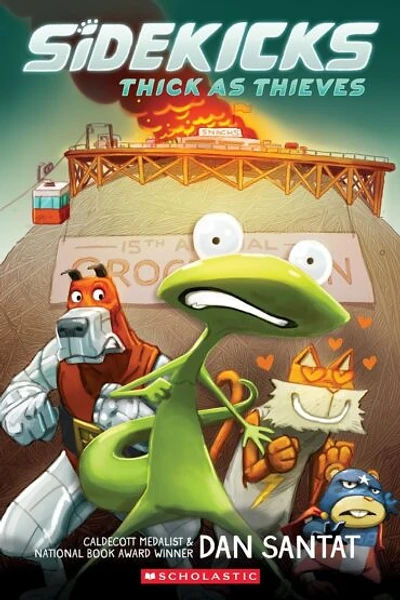
 3-7
3-7GN SANTAT
Sidekicks: Thick as Thieves
by Dan Santat
Pacing MaterialThe sidekicks are back! When a mission goes wrong, the team must rely on each other — and their differences — to save the day.
Big Idea
A team's strength comes from its differences — and true friends have each other's backs, no matter what.
Discussion Questions
- 1.What makes each sidekick unique?
- 2.How do the sidekicks work together despite their differences?
- 3.What happens when a mission doesn't go as planned?
- 4.What does it mean to be 'thick as thieves' with your friends?
Classroom Activity
Team Sidekick
Create your own team of sidekicks. Draw each one, give them a special skill, and write about how they'd work together to solve a problem.
Lesson Plan
Learning Goals
- Explain how the sidekicks respond when their mission goes wrong, using details from dialogue and illustrations.
- Identify how different skills and perspectives strengthen a team and connect this idea to the book’s friendship theme.
- Create three original sidekick characters with distinct skills, personalities, and ways of supporting teammates.
- Develop a short graphic narrative in which the sidekicks solve a problem through cooperation rather than one character acting alone.
Activity Steps
- 1.Discuss the team’s response to the failed mission in Sidekicks: Thick as Thieves. Ask: What makes working together difficult? How do the characters’ differences help them? Record examples supported by dialogue or illustrations.
- 2.Introduce Team Sidekick: students will invent a team that succeeds because its members are different. Brainstorm useful skills beyond superpowers, such as listening, planning, noticing details, or encouraging others.
- 3.Have students draw three original sidekicks. Beside each drawing, add a name, special skill, personality trait, and one challenge that makes the character need help from teammates.
- 4.Choose a fictional mission that goes wrong, such as a rescue route becoming blocked. Plan how each sidekick contributes a different skill and how at least one teammate supports another through a mistake or setback.
- 5.Create a four-to-six-panel comic showing the problem, the setback, teamwork, and the solution. Include captions, dialogue balloons, and visual details. Grades 3–4 may use sentence starters; grades 5–7 should develop more detailed dialogue and cause-and-effect connections.
- 6.Share comics with a partner. Partners identify each sidekick’s contribution and one example of friendship. Finish with a written reflection: 'My team is stronger because its members are different in these ways…'
Standards Connections
- ELA: CCSS RL.3.3 / RL.4.3 / RL.5.3 / RL.6.3 / RL.7.3 — Analyze characters, their responses to challenges, and interactions that shape events.
- ELA: CCSS W.3.3–W.7.3 — Write narratives with a clear sequence, descriptive details, and dialogue appropriate to grade level.
- ELA: CCSS SL.3.1–SL.7.1 — Participate in collaborative discussions, build on others’ ideas, and explain interpretations.
- SEL: Relationship skills — Practice cooperation, supportive communication, and shared problem-solving.
- Visual Arts: Creating — Use character design, panel sequence, and visual details to communicate a story.
Pace-Write-Read Study with Pace-Write It!
Focus question: How does Dan Santat speed up and slow down the action in Sidekicks: Thick as Thieves to show teamwork, friendship, and problem-solving? In Sidekicks: Thick as Thieves by Dan Santat, the sidekick team faces a mission that goes wrong and must depend on one another’s different strengths to recover. As a graphic novel, the book uses pacing through panel size, page turns, action beats, dialogue, and quiet reaction moments to move readers quickly through danger and then slow down for humor, emotion, and teamwork.
| Element | How to notice or teach it in the novel |
|---|---|
| Pace | Read: Notice how the story moves quickly during the failed mission and slows when the sidekicks regroup, react, and figure out how to help one another. Watch how Dan Santat uses fast action panels beside calmer team moments to show that friendship takes time even when the mission does not. Classroom Activity: Write a 6-8 sentence scene about a team problem, using 3 short action sentences to speed the pace and 3 longer reflection sentences to slow it down. |
| Plot | Read: Trace how the plot begins with a mission, hits trouble, and then builds toward a solution that depends on the whole team instead of one hero. Notice that each setback pushes the sidekicks to trust each other more. Classroom Activity: Make a quick plot ladder with 5 steps—mission, mistake, problem grows, teamwork plan, rescue—and then write one paragraph for the middle step where everything goes wrong. |
| Prosody | Read: Listen to how the dialogue and action sound when read aloud—urgent during danger, playful during teasing, and warm during friendship moments. The changing sound of the lines helps readers feel the pace of the sidekicks’ adventure. Classroom Activity: Choose one high-action moment and rewrite the dialogue for a read-aloud, adding expression notes like whisper, shout, groan, or gasp. |
| Word pause | Read: Notice places where a single word, reaction, or beat creates a pause before the next burst of action, especially when the team realizes the mission has gone wrong. These tiny stops make the next moment feel bigger. Classroom Activity: Write a comic-style exchange in which a character says only one important word on its own line before the action continues. |
| Concept | Read: Think about the central idea that sidekicks, who may seem less powerful alone, become stronger together. The pacing supports this concept by showing how each teammate’s difference matters at exactly the right moment. Classroom Activity: Write 4-5 sentences explaining a team concept for your own story, then add one moment where a character’s unusual skill changes the outcome. |
| Voice & World View | Read: Notice the energetic, playful voice of the book and its belief that friendship, kindness, and teamwork matter as much as action. Even when the mission goes wrong, the story’s world view suggests mistakes can lead to better cooperation. Classroom Activity: Write a short narrator’s note in a funny, upbeat voice that introduces a group of heroes who keep learning from each other. |
| Setting & Place | Read: Watch how the mission setting shapes the pace—dangerous spaces speed readers up, while regrouping spaces give characters time to talk and plan. In a graphic novel, place can change the energy of the whole page. Classroom Activity: Invent a mission setting and write 5 sentences showing how the place makes your characters move faster, hide, or pause. |
| Point of View | Read: Notice whose reactions and choices are highlighted in different moments and how that affects what readers know about the mission. The focus on the sidekicks keeps the story centered on cooperation rather than only on a main hero. Classroom Activity: Rewrite one mission moment from the point of view of a nervous sidekick who thinks the team may fail. |
| Original Characters | Read: Pay attention to how each sidekick brings a different personality, strength, or weakness to the team, making the group feel balanced and memorable. Their differences are not extras—they are what solve the problem. Classroom Activity: Create an original sidekick with one surprising strength and one flaw, then write a short scene where both traits affect the action. |
| Dialogue | Read: Notice how the characters talk to one another during pressure, disagreement, and encouragement. In Sidekicks: Thick as Thieves, dialogue helps reveal friendship because the team must communicate clearly when things fall apart. Classroom Activity: Write 8 lines of dialogue between two teammates after a plan fails; include one misunderstanding and one supportive line. |
| Details | Read: Study the small visual and text details that show who the sidekicks are—expressions, poses, props, and quick comments. These details help readers understand relationships without slowing the story too much. Classroom Activity: Write a character snapshot using 5 specific details that show a sidekick’s personality without directly naming the trait. |
| Descriptions | Read: Notice that descriptions in a graphic novel are often shared by words and pictures; action, expressions, and background details describe the mood of the mission. Dan Santat keeps descriptions vivid but efficient so the story can keep moving. Classroom Activity: Describe a rescue scene in 5-6 sentences using strong verbs and visual details that would fit inside comic panels. |
| Strong First Lines | Read: Think about how an opening in an action-filled friendship story must quickly hook readers into the problem, the team, or the tone. A strong first line in a book like this promises both adventure and humor. Classroom Activity: Write 3 possible first lines for a sidekick story—one funny, one suspenseful, and one that starts in the middle of action. |
| Immediacy & Engagement | Read: Notice how readers are pulled right into the mission through urgent action, expressive art, and quick character reactions. The story feels immediate because problems happen now and the team must respond now. Classroom Activity: Write a present-tense opening paragraph that begins with a team discovering that its plan has just gone wrong. |
| Story Scenes & Summaries & Unique Structures | Read: Notice when the book lingers in full scenes—like a mishap, argument, or rescue attempt—and when it moves quickly through time with shorter transitions. This balance keeps the mission exciting while still making room for friendship growth. Classroom Activity: Write one full scene of a team mistake, then add a 2-sentence summary that jumps ahead to the next challenge. |
| Flashback & Flash Forward & Cliffhangers | Read: Look for places where the story hints at what happened before, what might happen next, or ends a moment with a question that makes readers turn the page. Cliffhanger pacing fits a mission story where each choice matters. Classroom Activity: End a short comic scene with a cliffhanger line or image that leaves the team in sudden danger. |
| Tension & Suspense & Surprise | Read: Watch how tension grows when the mission gets harder and the sidekicks do not yet know whether their differences will help or hurt them. Surprises become more meaningful because teamwork, not just power, changes the outcome. Classroom Activity: Write a suspense paragraph where a team expects one problem but discovers a different, bigger one. |
| Page Turns and Chapter Breaks | Read: In a graphic novel, page turns can deliver reveals, jokes, and danger at just the right second. Notice how a turn can hide a surprise until the reader physically moves forward, making the sidekicks’ mission feel more dramatic. Classroom Activity: Plan a 4-panel page and decide what surprise should be saved for the page turn; write a note explaining why. |
| Performance | Read: Notice how characters perform emotion through posture, facial expressions, and big reactions, almost like actors onstage. These performances help readers feel fear, frustration, relief, and kindness without long explanations. Classroom Activity: Write stage directions for a comic scene in which two sidekicks go from panic to teamwork in 5 beats. |
| Personality | Read: Pay attention to how each sidekick’s personality affects the pace—an impulsive character may rush ahead, while a cautious one may slow the group to think. Their personalities create both conflict and solutions. Classroom Activity: Write a paragraph comparing two teammates with opposite personalities and explain how those differences could save a mission. |
| Humor | Read: Notice how humor breaks up the tension so the story does not stay intense for too long. Dan Santat uses funny reactions, visual jokes, and playful interactions to show that friendship can survive mistakes. Classroom Activity: Add one humorous line and one funny visual detail to a serious rescue scene you write. |
| Pause | Read: Notice the emotional pauses when characters stop arguing, look at each other, or realize they need help. These pauses matter because they let friendship and kindness rise to the surface between action beats. Classroom Activity: Write a short pause scene where a team goes silent after a mistake, then one character chooses to speak kindly. |
| Poetry and Poetic Devices | Read: Even in an action graphic novel, poetic devices can appear through sound words, repeated phrases, vivid imagery, and careful line placement. These choices can make the sidekicks’ mission sound sharper, louder, or more emotional. Classroom Activity: Write 4 lines describing a mission moment using onomatopoeia, alliteration, or imagery. |
| Repetition | Read: Notice whether words, reactions, or visual patterns repeat across the book to build humor, emphasize teamwork, or remind readers of a problem. Repetition can speed recognition and strengthen a theme of sticking together. Classroom Activity: Write a scene that repeats a phrase like “We’ve got this” three times, changing its meaning each time. |
| Rhythm | Read: Watch the rhythm created by alternating action, dialogue, reaction, and silence. The rhythm of Sidekicks: Thick as Thieves helps readers feel the bumps and bursts of a mission gone wrong. Classroom Activity: Write 6 lines that follow this rhythm: action, dialogue, action, reaction, silence, solution idea. |
| Punctuation | Read: Notice how punctuation such as exclamation points, ellipses, dashes, and question marks changes the speed and emotion of dialogue. In a mission story, punctuation can make a warning feel urgent or a pause feel uncertain. Classroom Activity: Rewrite the same 3 lines of dialogue three ways by changing only the punctuation to create panic, confusion, and relief. |
| Questions | Read: Pay attention to the questions readers ask while reading: What went wrong? Who will fix it? Can the team trust each other? The story keeps momentum by making those questions stronger before answering them. Classroom Activity: Write 5 reader questions your own team adventure should raise in the first page. |
| Compare-Contrast | Read: Compare the sidekicks’ different strengths, reactions, and problem-solving styles. The book shows that contrasting personalities do not weaken the group; they make the team more capable. Classroom Activity: Write a compare-contrast paragraph about two teammates and explain how their differences help in one emergency. |
| Objects | Read: Notice important mission objects, gear, or tools and how they help move the plot. In a graphic novel, an object can become a fast visual clue, a joke, or the key to solving a problem. Classroom Activity: Choose one object a sidekick carries and write a scene where it first seems useless but later becomes essential. |
| Threes | Read: Look for patterns of three in actions, attempts, jokes, or team strategies. Groups of three can make pacing feel satisfying because readers sense a build, a build, and a payoff. Classroom Activity: Write a short sequence where a team tries to solve a problem three times, with the third attempt working because of cooperation. |
| Whitespace & Negative Space | Read: Notice the spaces between panels and the open areas on a page that create pause, focus, or dramatic emphasis. In Sidekicks: Thick as Thieves, these spaces can slow a key reaction or spotlight a surprise. Classroom Activity: Sketch or describe a comic page with one nearly empty panel used to show shock, worry, or realization. |
| Art & Graphics | Read: Study how Dan Santat’s art carries pacing through panel size, movement lines, expressions, and page layout. The graphics help readers feel the speed of danger and the warmth of teamwork without needing many extra words. Classroom Activity: Storyboard 4 panels for a mission scene, using one large panel for the most important action beat. |
| Interactives & Gamification | Read: Think about how readers can almost “play” the mission by predicting choices, noticing clues in the art, and deciding which sidekick strength will matter next. The book invites active reading because the team’s next move feels like a challenge to solve. Classroom Activity: Design a mini mission card for classmates: list the problem, 3 sidekick strengths, and ask which one should be used first and why. |
Pace-Write It!
20-Minute Classroom Flow\nRead (5 min): Read a short mission sequence from Sidekicks: Thick as Thieves by Dan Santat in which the team faces a setback and must rely on one another. Ask students to watch for moments when the story speeds up with action and slows down with reaction, humor, or teamwork.\nNotice (5 min): Students turn and talk: Where did the pacing feel fastest? Where did it slow down? How did the panels, dialogue, and character expressions show friendship and kindness during the problem? Chart 3 craft moves students notice, such as short dialogue, a page-turn surprise, or a silent reaction panel.\nWrite (7 min): Students write their own short team-rescue scene inspired by the sidekicks. Writing frame: “At first, our mission seemed simple: ____. Then everything went wrong when ____. ‘____!’ shouted ____. For one second, no one moved. Then ____ noticed ____. Because each teammate could ____, ____, and ____, we finally ____.” Challenge students to include 1 fast action sentence, 1 pause sentence, and 1 line of dialogue that shows kindness.\nShare (3 min): Partners read their scenes aloud with expression. Listeners name one place where the pacing sped up and one place where it slowed down effectively.\nExit ticket: In 1-2 sentences, answer: How can a writer use pacing to show both action and friendship in a team story?