 1-4
1-4R KEATING
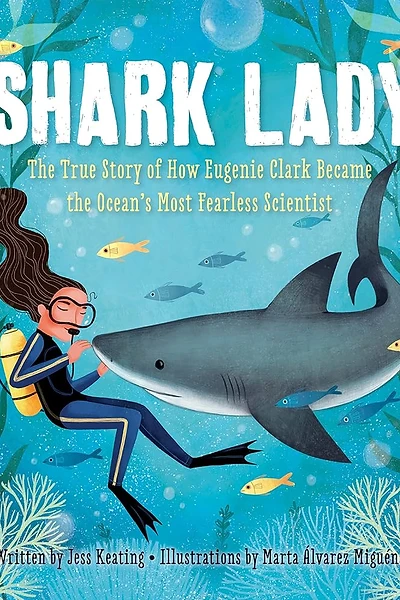
Shark Lady: The True Story of How Eugenie Clark Became the Ocean's Most Fearless Scientist
by Jess Keating
Pacing MaterialThe true story of Eugenie Clark, who fell in love with sharks as a child and devoted her life to proving they are intelligent, misunderstood creatures.
Big Idea
Passion and persistence can overturn myths, and one person's curiosity can change how the world sees an animal.
Discussion Questions
- 1.Why did Eugenie love sharks?
- 2.What myths did she prove wrong?
- 3.What challenges did she face as a woman in science?
- 4.How did Eugenie change how people see sharks?
- 5.What animal would you want to study?
Classroom Activity
Myth-Buster Poster
Choose a misunderstood animal and create a poster that busts one myth with three facts.
Lesson Plan
Learning Goals
- Describe how Eugenie Clark’s childhood curiosity about sharks grew into scientific study.
- Use examples from the book to explain how Eugenie’s persistence challenged misconceptions about sharks and women scientists.
- Distinguish an animal myth from a fact supported by reliable information.
- Create a poster that challenges one misconception about a misunderstood animal using three accurate facts.
Activity Steps
- 1.Read Shark Lady aloud, pausing to discuss what Eugenie wondered about sharks, the obstacles she faced, and how she used observation and research to learn about them.
- 2.Make a class chart labeled “Myth” and “What the Evidence Shows.” Discuss the misconception that sharks are mindless creatures, and identify examples from the book showing their ability to learn.
- 3.Have students choose a misunderstood animal, such as a shark, bat, snake, or spider. Using teacher-selected nonfiction resources, help each student identify one misconception and collect three facts that challenge it. Younger students may dictate facts or work with a partner.
- 4.Model a poster with the headings “The Myth” and “The Facts.” Students create their own posters with one clearly labeled myth, three numbered facts, an animal illustration, and the title of their information source.
- 5.Hold a gallery walk. Students explain how their facts challenge the myth and complete the reflection: “Like Eugenie Clark, I can use curiosity to _____.”
Standards Connections
- ELA: CCSS RI.1.3 — Describe connections among Eugenie Clark’s curiosity, experiences, and scientific discoveries.
- ELA: CCSS RI.3.1 — Refer explicitly to details in the biography when explaining Eugenie’s persistence and discoveries.
- ELA: CCSS W.2.7 — Participate in shared research using nonfiction sources to create an animal myth-buster poster.
- ELA: CCSS W.4.2 — Present a topic clearly and develop it with accurate facts and an informative illustration.
- SEL: Self-awareness and self-management — Identify personal interests and discuss how persistence helps people pursue goals.
Pace-Write-Read Study with Pace-Write It!
Focus question: How does an author slow down and speed up a true story to show a scientist’s curiosity, courage, and discoveries? In Shark Lady: The True Story of How Eugenie Clark Became the Ocean’s Most Fearless Scientist by Jess Keating, the author tells the real story of a girl who loved sharks and grew up to become a scientist who changed people’s minds about them. The pacing moves between important life moments, vivid ocean scenes, and short, powerful facts so readers can feel Eugenie’s wonder, challenges, and breakthroughs.
| Element | How to notice or teach it in the novel |
|---|---|
| Pace | Read: Notice how Jess Keating moves quickly through some parts of Eugenie Clark’s childhood and slows down for exciting shark encounters and scientific discoveries. The pacing helps readers feel both the long journey of her life and the important moments when she proves sharks are intelligent, not monsters. Classroom Activity: Write 4 sentences about a real person you admire, using 2 quick life events and 1 slowed-down important moment at the end. |
| Plot | Read: Notice the plot arc: Eugenie loves sea creatures as a child, studies fish and sharks, faces people’s wrong ideas, and grows into a scientist who changes what the world thinks. Each event builds her path toward becoming the "Shark Lady." Classroom Activity: Make a beginning-middle-end chart for Eugenie’s story, then write 3 sentences telling the plot in order. |
| Prosody | Read: Listen to how the sentences sound when read aloud, especially in lines about sharks, oceans, and discovery. The rise and fall of the language helps readers hear excitement, awe, and determination in Eugenie’s story. Classroom Activity: Choose 3 lines from the book to read aloud with expression, then write 1 sentence of your own that sounds dramatic and full of wonder. |
| Word pause | Read: Notice where you naturally stop on strong words or short phrases about sharks, danger, or discovery. These pauses help important ideas stand out, like Eugenie’s careful observations and the truth that sharks are misunderstood. Classroom Activity: Write 2 short sentences about an animal, underlining the word where a reader should pause for emphasis. |
| Concept | Read: The big concept is that science can change fear into understanding. Eugenie Clark studies sharks closely and shows that creatures people fear may actually be intelligent and important. Classroom Activity: Write 2-3 sentences explaining a big idea from the book: how learning more about something can change people’s minds. |
| Voice & World View | Read: Notice the voice is admiring, energetic, and curious, showing respect for Eugenie and for ocean life. The worldview celebrates science, bravery, and women in STEM while challenging unfair ideas about sharks. Classroom Activity: Write a short paragraph in an excited, respectful voice about a scientist, explorer, or animal expert you think is important. |
| Setting & Place | Read: Notice the places in Eugenie’s life, from childhood spaces where her curiosity begins to the ocean and research settings where she studies sharks. These places help pace the story by moving her from dreamer to scientist. Classroom Activity: Write 3 sentences describing a place where someone could learn about animals, using at least 2 sensory details. |
| Point of View | Read: The book is told in third person, so readers follow Eugenie Clark from the outside while still learning about her dreams and actions. This point of view helps the author tell the true story clearly and smoothly across many years. Classroom Activity: Write 2 sentences about Eugenie using third person words like she and her, then rewrite 1 sentence in first person as if Eugenie is speaking. |
| Original Characters | Read: Even though this is nonfiction, Eugenie Clark stands out as a memorable central figure because of her bold curiosity, love of sharks, and determination to keep learning. Sharks also become important presences in the story because the book helps readers see them in a new way. Classroom Activity: Write a character sketch of Eugenie using 3 describing words and 1 example from her life. |
| Dialogue | Read: Notice that this biography likely uses very little or no direct dialogue, so the pacing depends more on action, facts, and description than on conversation. That choice keeps the focus on Eugenie’s real-life accomplishments and scientific journey. Classroom Activity: Imagine a short conversation between young Eugenie and someone who is afraid of sharks, and write 4 lines of dialogue. |
| Details | Read: Notice the specific details about sharks, science, and Eugenie’s studies that make the true story believable and interesting. These details help readers trust the information and stay engaged. Classroom Activity: Write 3 factual details you remember about Eugenie Clark or sharks, then use them in a short informational paragraph. |
| Descriptions | Read: Pay attention to the vivid descriptions of sharks and ocean life that help readers picture what Eugenie loved. Description slows the pacing so readers can feel wonder instead of fear. Classroom Activity: Write 3 descriptive sentences about a sea animal, using color, movement, and shape words. |
| Strong First Lines | Read: Notice how the opening introduces Eugenie’s fascination in a way that grabs attention quickly. A strong opening sets the pace by making readers want to know how a girl who loved sharks became a famous scientist. Classroom Activity: Write an opening line for a biography of a brave scientist or animal expert that makes readers curious right away. |
| Immediacy & Engagement | Read: The book keeps readers engaged by making Eugenie’s passion feel immediate, as if we are discovering sharks with her. Facts are woven into the story so the reading never feels too far away or dry. Classroom Activity: Write 2 sentences that make a reader feel close to a moment of discovery, starting with “Right then…” or “At that moment…”. |
| Story Scenes & Summaries & Unique Structures | Read: Notice how the book mixes short life summaries with more scene-like moments about Eugenie’s interests and work. This structure helps cover many years while still slowing down for the most meaningful parts. Classroom Activity: Write 1 summary sentence about someone’s life and 2 scene sentences that zoom in on one important moment. |
| Flashback & Flash Forward & Cliffhangers | Read: Notice that the biography mostly moves forward in time, but readers may think back to Eugenie’s childhood love of sea life when they see her later success. The page turns can still create a “what will she discover next?” feeling even without dramatic cliffhangers. Classroom Activity: Write 3 sentences about a person’s life that include “When she was little…” and “Years later…”. |
| Tension & Suspense & Surprise | Read: Notice the tension between what people believe about sharks and what Eugenie Clark discovers through science. Surprise comes when readers learn that sharks can be intelligent and misunderstood rather than simply dangerous. Classroom Activity: Write 3 sentences that begin with a common belief about an animal and end with a surprising fact. |
| Page Turns and Chapter Breaks | Read: In a picture-book biography like Shark Lady, page turns help hold suspense and curiosity, especially before a new fact, image, or stage in Eugenie’s life. Turning the page can reveal a new place, new challenge, or new understanding about sharks. Classroom Activity: Plan a 4-page mini-book about an animal scientist, writing 1 sentence for each page that makes the reader want to turn to the next one. |
| Performance | Read: This book invites expressive reading because parts can sound full of amazement, pride, and discovery. Reading it aloud with energy helps students feel Eugenie’s passion for science and the ocean. Classroom Activity: Practice reading a favorite part aloud like a storyteller, then write 1 sentence you would perform with extra excitement. |
| Personality | Read: Eugenie’s personality shines through as curious, brave, patient, and determined. Her strong personality helps move the story forward because she keeps asking questions and seeking answers. Classroom Activity: Write 4 sentences about how Eugenie’s personality helped her become a scientist, using at least 2 character traits. |
| Humor | Read: The book is mostly inspiring and informative, but there may be light, playful moments in the way a shark-loving child is shown as different from what people expect. This gentle contrast can make readers smile while still supporting the serious message. Classroom Activity: Write a lighthearted sentence or two about someone loving an animal that other people find scary or strange. |
| Pause | Read: Notice where the story asks readers to stop and think, especially after important facts or big changes in Eugenie’s life. These pauses help the message about courage, science, and misunderstood animals sink in. Classroom Activity: Write 3 sentences about a discovery, and place a dash or line break where you want the reader to pause and think. |
| Poetry and Poetic Devices | Read: Jess Keating uses lyrical language and strong word choices that can feel poetic, especially in descriptions of the sea and sharks. Sound, imagery, and careful repetition help the nonfiction read like a story. Classroom Activity: Write 3 poetic lines about the ocean or a shark using imagery and one repeated word or phrase. |
| Repetition | Read: Notice how key ideas repeat, such as Eugenie’s love of sharks and the truth that sharks are misunderstood. Repetition helps the book’s message stay clear and strong for young readers. Classroom Activity: Write a 3-sentence paragraph about an animal using the same important phrase in each sentence for emphasis. |
| Rhythm | Read: Listen for the rhythm created by short and long sentences placed together. This rhythm helps the pacing shift between quick facts and slower moments of awe in Eugenie Clark’s journey. Classroom Activity: Write 1 short sentence, 1 longer sentence, and 1 short sentence about a scientist to create a strong rhythm. |
| Punctuation | Read: Notice how punctuation such as commas, periods, and exclamation points shapes pacing and feeling in the text. Strong punctuation can make shark facts feel exciting, thoughtful, or powerful. Classroom Activity: Write 3 versions of the same sentence about sharks—one with a period, one with an exclamation point, and one with a question mark—and discuss how the feeling changes. |
| Questions | Read: Readers may keep asking questions like why Eugenie loved sharks, what she discovered, and how she changed minds. The topic itself invites curiosity, which helps move the reading forward. Classroom Activity: Write 3 questions you would ask Eugenie Clark if she visited your classroom, then choose 1 and write a possible answer based on the book. |
| Compare-Contrast | Read: Notice the contrast between how many people saw sharks as scary monsters and how Eugenie saw them as fascinating animals worth studying. This compare-contrast structure strengthens the book’s message and pacing by setting up a problem and response. Classroom Activity: Make a T-chart comparing “What people thought about sharks” and “What Eugenie learned about sharks,” then write 2 compare-contrast sentences. |
| Objects | Read: Important objects in Eugenie’s story may include books, aquariums, scientific tools, fish, and sharks themselves. These objects help tell the story of her growing interest and career in marine science. Classroom Activity: Choose 1 object connected to learning, such as a notebook, tank, or magnifying glass, and write 3 sentences about how it could help a young scientist. |
| Threes | Read: Notice how ideas can be grouped in threes, such as traits Eugenie shows or steps in her journey: she wonders, studies, and discovers. Groups of three can make information feel complete and memorable. Classroom Activity: Write a sentence about Eugenie using 3 actions in a row, such as “She watched, studied, and proved…”. |
| Whitespace & Negative Space | Read: In a picture book, open space on the page helps readers slow down, focus on key lines, and take in the illustrations of sharks and the sea. Whitespace can create calm, wonder, or emphasis during important moments in Eugenie’s story. Classroom Activity: Create a one-page biography sentence about a scientist and leave blank space around the most important words to show emphasis. |
| Art & Graphics | Read: The illustrations help pace the story by showing ocean movement, shark shapes, and Eugenie’s excitement in ways the words do not have to explain fully. Art deepens understanding of marine science and makes the biography more inviting. Classroom Activity: Draw one scene from Eugenie’s life and add 2 caption sentences that match the mood of the illustration. |
| Interactives & Gamification | Read: Even though the book itself is not a game, students can interact with its ideas by sorting facts, making timelines, and matching fears with scientific truths. The real story of Eugenie Clark works well for active learning because it includes strong facts, changes over time, and surprising discoveries. Classroom Activity: Make 4 fact cards about Eugenie or sharks and challenge a partner to put them in order from her childhood to her scientific achievements. |
Pace-Write It!
20-Minute Classroom Flow Read (5 min): Read aloud a section of Shark Lady: The True Story of How Eugenie Clark Became the Ocean’s Most Fearless Scientist by Jess Keating that shows Eugenie as a curious child and another section that shows her as a scientist. Ask students to listen for places where the story moves quickly and places where it slows down. Notice (5 min): Discuss: Where did the author speed through time? Where did the author slow down to help us picture sharks, the ocean, or Eugenie’s discoveries? Chart student ideas under “Fast Pace” and “Slow Pace.” Write (7 min): Students write a short true-story-inspired paragraph about a person who learns about an animal or nature. Writing frame: “At first, ___ loved ___. Soon, ___ learned more and more about ___. One important day, ___ ___. In that moment, ___ discovered ___. Because of this, people began to understand ___ in a new way.” Encourage students to use 1 quick summary sentence and 1 slowed-down moment. Share (3 min): Partners read their paragraphs aloud and point out the sentence that moves quickly and the sentence that slows down. Exit ticket: Write one sentence answering this question: How did Jess Keating’s pacing help you understand Eugenie Clark’s courage and love of sharks?
Pace-Write-Read Connection
Teach this book using the Pace-Write-Read method — Tool 11: Details.
Open the Mastery Manual